{"title":"Modulation of Sensory Input to the Spinal Cord by Peripheral Afferent Fibres via GABAergic Astrocytes","authors":"Urszula Sławińska, Ingela Hammar, Elzbieta Jankowska","doi":"10.1111/ejn.70057","DOIUrl":null,"url":null,"abstract":"<p>A long-lasting GABA-dependent increase in the excitability of afferent fibres, and thus modulation of the sensory input to the spinal cord, may be evoked by epidural polarization. However, the direct effects of fibre polarization are short-lasting and the sustained increase in their excitability appears to be secondary to the release of GABA from nearby astrocytes. We have now investigated whether the modulation of spinal sensory input by stimulation of a peripheral nerve, previously attributed to synaptically evoked intraspinal field potentials, is evoked in a similar way. However, as neither its dependence on GABA nor its relays have been investigated, we addressed the question of whether the increase in the excitability of epidurally stimulated afferent fibres following a peripheral nerve stimulation does or does not depend on GABA and whether it might be mediated by astrocytes. The effects of conditioning stimulation of the tibial nerve were evaluated from changes in the excitability of both Group I and II muscle afferents, estimated from action potentials recorded in peripheral nerves and in field potentials recorded in the dorsal horn respectively in acute experiments on deeply anaesthetized rats. The excitability of the afferents was increased by stimulation of Group II and/or cutaneous but not Group I muscle afferents. The effects were significantly weakened by blocking GABA channels by gabazine and by astrocyte toxin L-alpha-aminoadipic acid (L-AAA), indicating that the excitability of both Group I and II afferent fibres may be modulated by GABAergic astrocytes, the new role played by astrocytes.</p>","PeriodicalId":11993,"journal":{"name":"European Journal of Neuroscience","volume":"61 6","pages":""},"PeriodicalIF":2.4000,"publicationDate":"2025-03-23","publicationTypes":"Journal Article","fieldsOfStudy":null,"isOpenAccess":false,"openAccessPdf":"https://onlinelibrary.wiley.com/doi/epdf/10.1111/ejn.70057","citationCount":"0","resultStr":null,"platform":"Semanticscholar","paperid":null,"PeriodicalName":"European Journal of Neuroscience","FirstCategoryId":"3","ListUrlMain":"https://onlinelibrary.wiley.com/doi/10.1111/ejn.70057","RegionNum":4,"RegionCategory":"医学","ArticlePicture":[],"TitleCN":null,"AbstractTextCN":null,"PMCID":null,"EPubDate":"","PubModel":"","JCR":"Q3","JCRName":"NEUROSCIENCES","Score":null,"Total":0}
引用次数: 0
Abstract
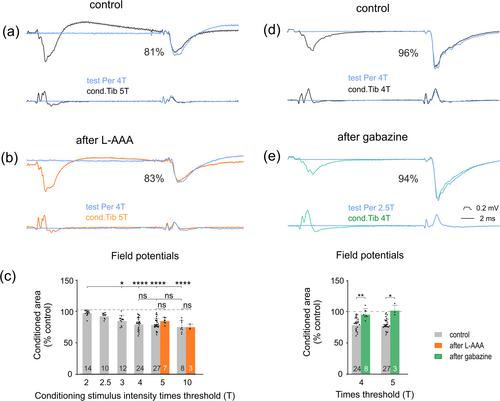
A long-lasting GABA-dependent increase in the excitability of afferent fibres, and thus modulation of the sensory input to the spinal cord, may be evoked by epidural polarization. However, the direct effects of fibre polarization are short-lasting and the sustained increase in their excitability appears to be secondary to the release of GABA from nearby astrocytes. We have now investigated whether the modulation of spinal sensory input by stimulation of a peripheral nerve, previously attributed to synaptically evoked intraspinal field potentials, is evoked in a similar way. However, as neither its dependence on GABA nor its relays have been investigated, we addressed the question of whether the increase in the excitability of epidurally stimulated afferent fibres following a peripheral nerve stimulation does or does not depend on GABA and whether it might be mediated by astrocytes. The effects of conditioning stimulation of the tibial nerve were evaluated from changes in the excitability of both Group I and II muscle afferents, estimated from action potentials recorded in peripheral nerves and in field potentials recorded in the dorsal horn respectively in acute experiments on deeply anaesthetized rats. The excitability of the afferents was increased by stimulation of Group II and/or cutaneous but not Group I muscle afferents. The effects were significantly weakened by blocking GABA channels by gabazine and by astrocyte toxin L-alpha-aminoadipic acid (L-AAA), indicating that the excitability of both Group I and II afferent fibres may be modulated by GABAergic astrocytes, the new role played by astrocytes.
期刊介绍:
EJN is the journal of FENS and supports the international neuroscientific community by publishing original high quality research articles and reviews in all fields of neuroscience. In addition, to engage with issues that are of interest to the science community, we also publish Editorials, Meetings Reports and Neuro-Opinions on topics that are of current interest in the fields of neuroscience research and training in science. We have recently established a series of ‘Profiles of Women in Neuroscience’. Our goal is to provide a vehicle for publications that further the understanding of the structure and function of the nervous system in both health and disease and to provide a vehicle to engage the neuroscience community. As the official journal of FENS, profits from the journal are re-invested in the neuroscientific community through the activities of FENS.



 京公网安备 11010802042870号
京ICP备2023020795号-1
京公网安备 11010802042870号
京ICP备2023020795号-1

 分享
分享
 求助内容:
求助内容: 应助结果提醒方式:
 扫码关注我们
