{"title":"Potential Distribution of Fusarium Head Blight Under Climate Change Scenarios in Iran","authors":"Farid Houshyar, Behnam Pouzeshimiyab, Sevil Nematollahi, Khalil Valizadeh Kamran, Manizheh Jamshidi","doi":"10.1111/jph.70034","DOIUrl":null,"url":null,"abstract":"<div>\n \n <p>Climate change is predicted to impact crop production and food security, with increased risks of pest infestations and crop failures. Using proximal climate variables and maximum entropy (MaxEnt) model, this research predicts the current and future potential distribution of Fusarium Head Blight (FHB), a significant disease affecting wheat and barley. The analysis considered two Climate Change Shared Socioeconomic Pathways (SSPs) over two distinct time periods across various agro-ecological zones (AEZs) in Iran. The results indicated that the climate conditions for FHB includes maximum temperature, precipitation and minimum temperature in March, contributing 47.85% ± 1.63%, 28.75% ± 3.20% and 23.40% ± 1.56% to its distribution, respectively. Currently, this disease was predicted predominantly to present in AEZs including North West, Caspian Coastal, Central Zagros and Southern Zagros, which collectively account for 49% of Iran's national crop production. However, projections suggested a future shift in these areas to Central, Khorasan, Arid Central and Southern Coastal AEZs, which currently contribute 36% to national crop production. This research emphasises the need for effective management strategies to mitigate the impacts of climate change on agricultural crops in Iran due to the shifting distribution of FHB.</p>\n </div>","PeriodicalId":16843,"journal":{"name":"Journal of Phytopathology","volume":"173 2","pages":""},"PeriodicalIF":1.1000,"publicationDate":"2025-03-25","publicationTypes":"Journal Article","fieldsOfStudy":null,"isOpenAccess":false,"openAccessPdf":"","citationCount":"0","resultStr":null,"platform":"Semanticscholar","paperid":null,"PeriodicalName":"Journal of Phytopathology","FirstCategoryId":"97","ListUrlMain":"https://onlinelibrary.wiley.com/doi/10.1111/jph.70034","RegionNum":4,"RegionCategory":"农林科学","ArticlePicture":[],"TitleCN":null,"AbstractTextCN":null,"PMCID":null,"EPubDate":"","PubModel":"","JCR":"Q3","JCRName":"PLANT SCIENCES","Score":null,"Total":0}
引用次数: 0
Abstract
Climate change is predicted to impact crop production and food security, with increased risks of pest infestations and crop failures. Using proximal climate variables and maximum entropy (MaxEnt) model, this research predicts the current and future potential distribution of Fusarium Head Blight (FHB), a significant disease affecting wheat and barley. The analysis considered two Climate Change Shared Socioeconomic Pathways (SSPs) over two distinct time periods across various agro-ecological zones (AEZs) in Iran. The results indicated that the climate conditions for FHB includes maximum temperature, precipitation and minimum temperature in March, contributing 47.85% ± 1.63%, 28.75% ± 3.20% and 23.40% ± 1.56% to its distribution, respectively. Currently, this disease was predicted predominantly to present in AEZs including North West, Caspian Coastal, Central Zagros and Southern Zagros, which collectively account for 49% of Iran's national crop production. However, projections suggested a future shift in these areas to Central, Khorasan, Arid Central and Southern Coastal AEZs, which currently contribute 36% to national crop production. This research emphasises the need for effective management strategies to mitigate the impacts of climate change on agricultural crops in Iran due to the shifting distribution of FHB.
预计气候变化将影响作物生产和粮食安全,增加虫害和作物歉收的风险。利用近端气候变量和最大熵(MaxEnt)模型,对小麦和大麦赤霉病(Fusarium Head Blight, FHB)当前和未来的潜在分布进行了预测。该分析考虑了伊朗不同农业生态区(aez)两个不同时期的两种气候变化共享社会经济路径(ssp)。结果表明:3月最高气温、降水和最低气温对赤霉病分布的贡献率分别为47.85%±1.63%、28.75%±3.20%和23.40%±1.56%;目前,预计这种疾病主要发生在包括西北部、里海沿岸、中部扎格罗斯和南部扎格罗斯在内的经济特区,这些地区合计占伊朗全国作物产量的49%。然而,预测表明,这些地区未来将转向中部、呼罗珊、干旱中部和南部沿海经济特区,这些地区目前对全国作物产量贡献了36%。这项研究强调需要有效的管理战略,以减轻气候变化对伊朗农作物的影响,这是由于粮食食毒菌分布的变化。
期刊介绍:
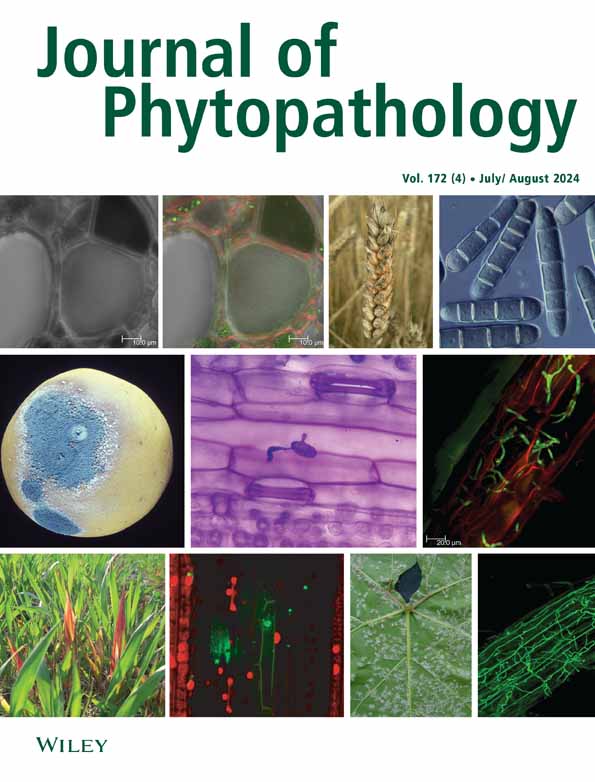
Journal of Phytopathology publishes original and review articles on all scientific aspects of applied phytopathology in agricultural and horticultural crops. Preference is given to contributions improving our understanding of the biotic and abiotic determinants of plant diseases, including epidemics and damage potential, as a basis for innovative disease management, modelling and forecasting. This includes practical aspects and the development of methods for disease diagnosis as well as infection bioassays.
Studies at the population, organism, physiological, biochemical and molecular genetic level are welcome. The journal scope comprises the pathology and epidemiology of plant diseases caused by microbial pathogens, viruses and nematodes.
Accepted papers should advance our conceptual knowledge of plant diseases, rather than presenting descriptive or screening data unrelated to phytopathological mechanisms or functions. Results from unrepeated experimental conditions or data with no or inappropriate statistical processing will not be considered. Authors are encouraged to look at past issues to ensure adherence to the standards of the journal.



 京公网安备 11010802042870号
京ICP备2023020795号-1
京公网安备 11010802042870号
京ICP备2023020795号-1

 分享
分享
 求助内容:
求助内容: 应助结果提醒方式:
 扫码关注我们
