To clarify the feasibility and the anatomical characteristics related to round window exposure via the external auditory canal (EAC) without bony removal.
Surgical videos and radiological data from 50 adult patients who underwent endoscopic tympanoplasty type I were collected. According to surgical videos, round window niche (RWN) exposure was classified as “Certainly,” “Possibly,” and “None,” and round window membrane (RWM) exposure was classified as “Clear visualization,” “Incomplete visualization,” “Just perceptible” and “Invisible.” Basing on CT reconstruction, distances among RWM, RWN, tympanic annulus (TA), width, and orientation of scala tympani (ST) were measured under the Coordinate System of Cochlea, and anatomic features of EAC under the Coordinate System of EAC.
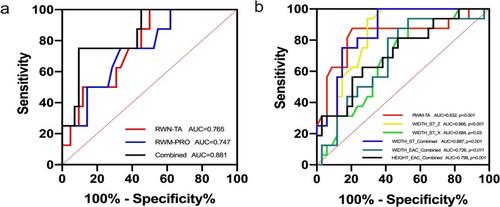
60% of RWNs were “Certainly,” 24% “Possibly,” and 16% “None” exposed. RWM exposure was 32% “Clear visualization,” 22% “Incomplete visualization,” 14% “Just perceptible,” and 32% “Invisible.” Longer distances between RWM and TA (RWM-TA), and the Width of ST in x and z sections were related to RWM exposure (RWM-TA: Spearman-r = 0.663, p < 0.001, ST in x: Spearman-r = −0.337, p = 0.017, z: Spearman-r = −0.586, p < 0.001). RWM-TA longer than 7.06 mm indicated a possibility of RWM exposure (AUC = 0.784, p = 0.011). Widths of ST in x and z sections shorter than 1.85 mm and 1.84 mm, respectively, indicated better RWM exposure (AUC = 0.887, p < 0.001). The size of EAC in axial and coronal sections could significantly predict RWM exposure (axial: AUC = 0.726, p = 0.011, coronal: AUC = 0.798, p = 0.001).
In adults, 54% of RWM could be partially visualized via EAC without bony removal. There are reliable pre-operative predictors for RWM exposure, which are helpful for future inner ear therapy.
3




 京公网安备 11010802042870号
京ICP备2023020795号-1
京公网安备 11010802042870号
京ICP备2023020795号-1

 分享
分享
 求助内容:
求助内容: 应助结果提醒方式:
 扫码关注我们
