Shoufang Liu, Xiangyu Xu, Jie Zhou, Yuxuan Jiang, Xue Liu, Yan Kuai, Benli Yu and Siqi Li
{"title":"Destruction for growth: a novel laser direct writing perovskite strategy with intelligent anti-counterfeiting applications†","authors":"Shoufang Liu, Xiangyu Xu, Jie Zhou, Yuxuan Jiang, Xue Liu, Yan Kuai, Benli Yu and Siqi Li","doi":"10.1039/D4NH00612G","DOIUrl":null,"url":null,"abstract":"<p >Perovskites are widely acknowledged as promising optoelectronic materials due to their superior carrier mobility, high optical absorption coefficient, and versatile structural design. Among the various synthesis methods, laser direct writing (LDW) of perovskites has demonstrated unique and promising applications in precise patterning and the fabrication of perovskite-based devices. In this study, we propose a novel mechanism for LDW perovskites: laser destruction-induced perovskite growth. Unlike previous LDW technologies that rely on thermal effects and photon absorption-induced nucleation, our approach uses a pulsed laser to rapidly disrupt the stress-rich perovskite precursor phosphate glass surface within a truly short duration. The release of stress and the reverse movement shear band effect of phosphate glass bring Cs, Pb, and Br atoms into closer proximity, facilitating the nucleation and growth of perovskite crystals. Meanwhile, the broken P–O–P bonds provide the necessary energy for this nucleation and growth process. Utilizing this mechanism, we have successfully etched intricate perovskite patterns on the glass surface with high precision. Furthermore, this unique light destruction-induced perovskite growth strategy can be integrated with artificial intelligence and deep learning algorithms to fabricate various anti-counterfeiting patterns. Our proposed laser destruction-induced precipitation strategy enriches the current understanding of LDW perovskites and demonstrates significant potential and promise in optoelectronics.</p>","PeriodicalId":93,"journal":{"name":"Nanoscale Horizons","volume":" 5","pages":" 896-904"},"PeriodicalIF":6.6000,"publicationDate":"2025-03-12","publicationTypes":"Journal Article","fieldsOfStudy":null,"isOpenAccess":false,"openAccessPdf":"","citationCount":"0","resultStr":null,"platform":"Semanticscholar","paperid":null,"PeriodicalName":"Nanoscale Horizons","FirstCategoryId":"88","ListUrlMain":"https://pubs.rsc.org/en/content/articlelanding/2025/nh/d4nh00612g","RegionNum":2,"RegionCategory":"材料科学","ArticlePicture":[],"TitleCN":null,"AbstractTextCN":null,"PMCID":null,"EPubDate":"","PubModel":"","JCR":"Q1","JCRName":"CHEMISTRY, PHYSICAL","Score":null,"Total":0}
引用次数: 0
Abstract
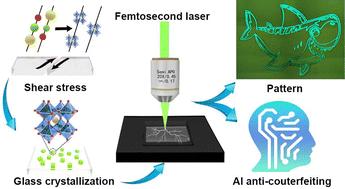
Perovskites are widely acknowledged as promising optoelectronic materials due to their superior carrier mobility, high optical absorption coefficient, and versatile structural design. Among the various synthesis methods, laser direct writing (LDW) of perovskites has demonstrated unique and promising applications in precise patterning and the fabrication of perovskite-based devices. In this study, we propose a novel mechanism for LDW perovskites: laser destruction-induced perovskite growth. Unlike previous LDW technologies that rely on thermal effects and photon absorption-induced nucleation, our approach uses a pulsed laser to rapidly disrupt the stress-rich perovskite precursor phosphate glass surface within a truly short duration. The release of stress and the reverse movement shear band effect of phosphate glass bring Cs, Pb, and Br atoms into closer proximity, facilitating the nucleation and growth of perovskite crystals. Meanwhile, the broken P–O–P bonds provide the necessary energy for this nucleation and growth process. Utilizing this mechanism, we have successfully etched intricate perovskite patterns on the glass surface with high precision. Furthermore, this unique light destruction-induced perovskite growth strategy can be integrated with artificial intelligence and deep learning algorithms to fabricate various anti-counterfeiting patterns. Our proposed laser destruction-induced precipitation strategy enriches the current understanding of LDW perovskites and demonstrates significant potential and promise in optoelectronics.
期刊介绍:
Nanoscale Horizons stands out as a premier journal for publishing exceptionally high-quality and innovative nanoscience and nanotechnology. The emphasis lies on original research that introduces a new concept or a novel perspective (a conceptual advance), prioritizing this over reporting technological improvements. Nevertheless, outstanding articles showcasing truly groundbreaking developments, including record-breaking performance, may also find a place in the journal. Published work must be of substantial general interest to our broad and diverse readership across the nanoscience and nanotechnology community.



 京公网安备 11010802042870号
京ICP备2023020795号-1
京公网安备 11010802042870号
京ICP备2023020795号-1

 分享
分享
 求助内容:
求助内容: 应助结果提醒方式:
 扫码关注我们
