Khanh Thi Ngoc Ong, Ha Thi Thu Nguyen, Anh Thai Nguyen, Vu Huynh Luu, Dat Huy Tran, Thuy Thi Ca, Tan Le Hoang Doan, Hung Huy Nguyen and Tung Thanh Nguyen
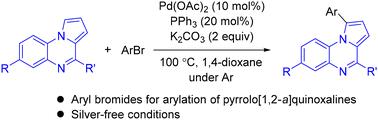
{"title":"Silver-free, palladium-catalyzed arylation of pyrrolo[1,2-a]quinoxaline C–H bonds with aryl bromides†","authors":"Khanh Thi Ngoc Ong, Ha Thi Thu Nguyen, Anh Thai Nguyen, Vu Huynh Luu, Dat Huy Tran, Thuy Thi Ca, Tan Le Hoang Doan, Hung Huy Nguyen and Tung Thanh Nguyen","doi":"10.1039/D5OB00023H","DOIUrl":null,"url":null,"abstract":"<p >Arylation of C1–H bonds in pyrrolo[1,2-<em>a</em>]quinoxaline derivatives has hitherto been challenging. The sole method known until now suffers from a narrow scope of aryl iodides, while requiring an overstoichiometric amount of a silver additive and a high-molecular-weight phosphine ligand. Herein, we developed a method for coupling C1–H bonds in pyrrolo[1,2-<em>a</em>]quinoxalines with aryl bromides in the presence of simple reagents, namely Pd(OAc)<small><sub>2</sub></small> as catalyst, PPh<small><sub>3</sub></small> as ligand, K<small><sub>2</sub></small>CO<small><sub>3</sub></small> as base, and 1,4-dioxane as solvent. This successful arylation did not require any silver additive and was tolerant of a wide range of functional groups such as aldehyde, nitro, cyano, ester, and heterocycles.</p>","PeriodicalId":96,"journal":{"name":"Organic & Biomolecular Chemistry","volume":" 15","pages":" 3562-3566"},"PeriodicalIF":2.7000,"publicationDate":"2025-03-17","publicationTypes":"Journal Article","fieldsOfStudy":null,"isOpenAccess":false,"openAccessPdf":"","citationCount":"0","resultStr":null,"platform":"Semanticscholar","paperid":null,"PeriodicalName":"Organic & Biomolecular Chemistry","FirstCategoryId":"92","ListUrlMain":"https://pubs.rsc.org/en/content/articlelanding/2025/ob/d5ob00023h","RegionNum":3,"RegionCategory":"化学","ArticlePicture":[],"TitleCN":null,"AbstractTextCN":null,"PMCID":null,"EPubDate":"","PubModel":"","JCR":"Q1","JCRName":"CHEMISTRY, ORGANIC","Score":null,"Total":0}
引用次数: 0
Abstract
Arylation of C1–H bonds in pyrrolo[1,2-a]quinoxaline derivatives has hitherto been challenging. The sole method known until now suffers from a narrow scope of aryl iodides, while requiring an overstoichiometric amount of a silver additive and a high-molecular-weight phosphine ligand. Herein, we developed a method for coupling C1–H bonds in pyrrolo[1,2-a]quinoxalines with aryl bromides in the presence of simple reagents, namely Pd(OAc)2 as catalyst, PPh3 as ligand, K2CO3 as base, and 1,4-dioxane as solvent. This successful arylation did not require any silver additive and was tolerant of a wide range of functional groups such as aldehyde, nitro, cyano, ester, and heterocycles.
期刊介绍:
Organic & Biomolecular Chemistry is an international journal using integrated research in chemistry-organic chemistry. Founded in 2003 by the Royal Society of Chemistry, the journal is published in Semimonthly issues and has been indexed by SCIE, a leading international database. The journal focuses on the key research and cutting-edge progress in the field of chemistry-organic chemistry, publishes and reports the research results in this field in a timely manner, and is committed to becoming a window and platform for rapid academic exchanges among peers in this field. The journal's impact factor in 2023 is 2.9, and its CiteScore is 5.5.



 京公网安备 11010802042870号
京ICP备2023020795号-1
京公网安备 11010802042870号
京ICP备2023020795号-1

 分享
分享
 求助内容:
求助内容: 应助结果提醒方式:
 扫码关注我们
