Özge Edebali, Anna Goellner, Marek Stiborek, Zdeněk Šimek, Melis Muz, Branislav Vrana and Lisa Melymuk
{"title":"Characterizing the distribution of aromatic amines between polyester, cotton, and wool textiles and air†","authors":"Özge Edebali, Anna Goellner, Marek Stiborek, Zdeněk Šimek, Melis Muz, Branislav Vrana and Lisa Melymuk","doi":"10.1039/D5EM00015G","DOIUrl":null,"url":null,"abstract":"<p >Textiles play an important role in the accumulation of harmful chemicals and can serve as a secondary source of chemical pollutants in indoor environments, releasing these chemicals back into indoor air, as well as a vector from which indoor pollution can be released by laundering to wastewater systems. Among harmful indoor pollutants, aromatic amines (AAs) are particularly concerning due to their mutagenic and carcinogenic properties, but have received limited attention in non-occupational indoor environments. We have characterized the distribution of 19 AAs between cotton, wool, and polyester textiles and air. Chamber exposure experiments were conducted under controlled laboratory conditions to quantify textile–air distributions of AAs and identify key parameters impacting the distribution. The mass-normalized textile/air distribution coefficients (<em>K</em><small><sub>TA</sub></small>) of AAs for polyester, cotton, and wool range from 5.28 to 9.52 log units (L kg<small><sup>−1</sup></small>). The findings suggest that cotton generally exhibits higher distribution coefficients than polyester and wool for most analytes. Overall, the results show a strong positive relationship between octanol–air distribution coefficients (<em>K</em><small><sub>OA</sub></small>) and <em>K</em><small><sub>TA</sub></small> values. The consistent uptake capacity of all tested textiles for AAs highlights the potential for textiles to play a key role in AA indoor distributions.</p>","PeriodicalId":74,"journal":{"name":"Environmental Science: Processes & Impacts","volume":" 4","pages":" 1054-1062"},"PeriodicalIF":3.9000,"publicationDate":"2025-03-24","publicationTypes":"Journal Article","fieldsOfStudy":null,"isOpenAccess":false,"openAccessPdf":"https://pubs.rsc.org/en/content/articlepdf/2025/em/d5em00015g?page=search","citationCount":"0","resultStr":null,"platform":"Semanticscholar","paperid":null,"PeriodicalName":"Environmental Science: Processes & Impacts","FirstCategoryId":"93","ListUrlMain":"https://pubs.rsc.org/en/content/articlelanding/2025/em/d5em00015g","RegionNum":3,"RegionCategory":"环境科学与生态学","ArticlePicture":[],"TitleCN":null,"AbstractTextCN":null,"PMCID":null,"EPubDate":"","PubModel":"","JCR":"Q1","JCRName":"CHEMISTRY, ANALYTICAL","Score":null,"Total":0}
引用次数: 0
Abstract
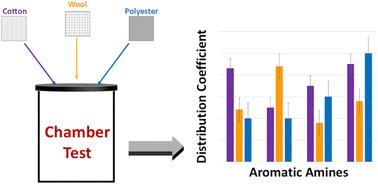
Textiles play an important role in the accumulation of harmful chemicals and can serve as a secondary source of chemical pollutants in indoor environments, releasing these chemicals back into indoor air, as well as a vector from which indoor pollution can be released by laundering to wastewater systems. Among harmful indoor pollutants, aromatic amines (AAs) are particularly concerning due to their mutagenic and carcinogenic properties, but have received limited attention in non-occupational indoor environments. We have characterized the distribution of 19 AAs between cotton, wool, and polyester textiles and air. Chamber exposure experiments were conducted under controlled laboratory conditions to quantify textile–air distributions of AAs and identify key parameters impacting the distribution. The mass-normalized textile/air distribution coefficients (KTA) of AAs for polyester, cotton, and wool range from 5.28 to 9.52 log units (L kg−1). The findings suggest that cotton generally exhibits higher distribution coefficients than polyester and wool for most analytes. Overall, the results show a strong positive relationship between octanol–air distribution coefficients (KOA) and KTA values. The consistent uptake capacity of all tested textiles for AAs highlights the potential for textiles to play a key role in AA indoor distributions.
期刊介绍:
Environmental Science: Processes & Impacts publishes high quality papers in all areas of the environmental chemical sciences, including chemistry of the air, water, soil and sediment. We welcome studies on the environmental fate and effects of anthropogenic and naturally occurring contaminants, both chemical and microbiological, as well as related natural element cycling processes.



 京公网安备 11010802042870号
京ICP备2023020795号-1
京公网安备 11010802042870号
京ICP备2023020795号-1

 分享
分享
 求助内容:
求助内容: 应助结果提醒方式:
 扫码关注我们
