{"title":"A Fully Conjugated Benzo[1,2-b:4,5-b′]Dithiophene-Based Covalent Organic Framework Enables Efficient Blue Light-Driven Photocatalytic Sulfoxidation","authors":"Keke Zhang, Fulin Zhang, Yuexin Wang, Kanghui Xiong, Siyu Zhang, Xianjun Lang","doi":"10.1002/cssc.202500552","DOIUrl":null,"url":null,"abstract":"<p>Covalent organic frameworks (COFs) are becoming increasingly attractive in photocatalytic transformations because of the designable structures grounded on the building blocks and linkages. Herein, benzo[1,2-<i>b</i>:4,5-<i>b</i>′]dithiophene, essential for various organic optoelectronic materials, is adopted as the building block for COFs. Hence, a fully conjugated COF BDTT-sp<sup>2</sup>c-COF and an imine-linked COF BDTT-COF are constructed by the condensations of 5′,5″″-(benzo[1,2-<i>b</i>:4,5-<i>b</i>′]dithiophene-2,6-diyl)bis([1,1′:3′,1″-terphenyl]-4,4″-dicarbaldehyde) with <i>p</i>-phenyldiacetonitrile and <i>p</i>-phenylenediamine, respectively. Thorough characterizations and theoretical calculations disclose that BDTT-sp<sup>2</sup>c-COF is superior to BDTT-COF in terms of specific surface area, photocarrier separation, and electron transfer. As such, BDTT-sp<sup>2</sup>c-COF enables more efficient photocatalytic sulfoxidation with oxygen than BDTT-COF. The fully conjugated structure guarantees the recyclability of BDTT-sp<sup>2</sup>c-COF. The blue light-driven photocatalytic sulfoxidation is generally applicable and proceeds selectively via energy and electron transfers with oxygen over BDTT-sp<sup>2</sup>c-COF. The fully conjugated COFs are promising to enable efficient photocatalytic reactions.</p>","PeriodicalId":149,"journal":{"name":"ChemSusChem","volume":"18 12","pages":""},"PeriodicalIF":6.6000,"publicationDate":"2025-03-24","publicationTypes":"Journal Article","fieldsOfStudy":null,"isOpenAccess":false,"openAccessPdf":"","citationCount":"0","resultStr":null,"platform":"Semanticscholar","paperid":null,"PeriodicalName":"ChemSusChem","FirstCategoryId":"92","ListUrlMain":"https://chemistry-europe.onlinelibrary.wiley.com/doi/10.1002/cssc.202500552","RegionNum":2,"RegionCategory":"化学","ArticlePicture":[],"TitleCN":null,"AbstractTextCN":null,"PMCID":null,"EPubDate":"","PubModel":"","JCR":"Q1","JCRName":"CHEMISTRY, MULTIDISCIPLINARY","Score":null,"Total":0}
引用次数: 0
Abstract
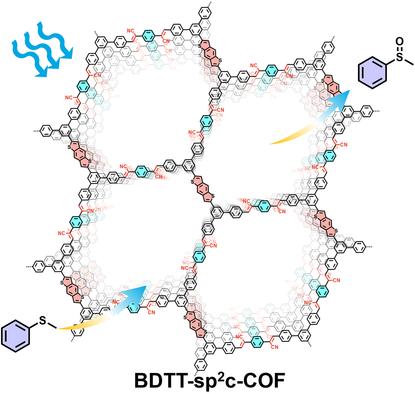
Covalent organic frameworks (COFs) are becoming increasingly attractive in photocatalytic transformations because of the designable structures grounded on the building blocks and linkages. Herein, benzo[1,2-b:4,5-b′]dithiophene, essential for various organic optoelectronic materials, is adopted as the building block for COFs. Hence, a fully conjugated COF BDTT-sp2c-COF and an imine-linked COF BDTT-COF are constructed by the condensations of 5′,5″″-(benzo[1,2-b:4,5-b′]dithiophene-2,6-diyl)bis([1,1′:3′,1″-terphenyl]-4,4″-dicarbaldehyde) with p-phenyldiacetonitrile and p-phenylenediamine, respectively. Thorough characterizations and theoretical calculations disclose that BDTT-sp2c-COF is superior to BDTT-COF in terms of specific surface area, photocarrier separation, and electron transfer. As such, BDTT-sp2c-COF enables more efficient photocatalytic sulfoxidation with oxygen than BDTT-COF. The fully conjugated structure guarantees the recyclability of BDTT-sp2c-COF. The blue light-driven photocatalytic sulfoxidation is generally applicable and proceeds selectively via energy and electron transfers with oxygen over BDTT-sp2c-COF. The fully conjugated COFs are promising to enable efficient photocatalytic reactions.
期刊介绍:
ChemSusChem
Impact Factor (2016): 7.226
Scope:
Interdisciplinary journal
Focuses on research at the interface of chemistry and sustainability
Features the best research on sustainability and energy
Areas Covered:
Chemistry
Materials Science
Chemical Engineering
Biotechnology





 京公网安备 11010802042870号
京ICP备2023020795号-1
京公网安备 11010802042870号
京ICP备2023020795号-1

 分享
分享
 求助内容:
求助内容: 应助结果提醒方式:
 扫码关注我们
