Finding Suitable Discharge Potential and Effect of Succinic Anhydride as Electrolyte Additive on MoS2/Carbon Composites for Efficient and Stable Sodium Ion Battery Anode
{"title":"Finding Suitable Discharge Potential and Effect of Succinic Anhydride as Electrolyte Additive on MoS2/Carbon Composites for Efficient and Stable Sodium Ion Battery Anode","authors":"Rajib Samanta, Sudip Barman","doi":"10.1002/cssc.202402462","DOIUrl":null,"url":null,"abstract":"<p>A series of MoS<sub>2</sub>/C composites are synthesized for sodium-ion battery anode by changing sulfur sources using a facile hydrothermal and ball milling strategy. The carbon modification increases the conductivity and minimizes volume expansion of the material. The intercalation potential is found out for MoS<sub>2</sub>/C composites by several electrochemical and ex situ X-ray diffraction measurements. The MoS<sub>2</sub>-NS/C, MoS<sub>2</sub>-Tu/C, and MoS<sub>2</sub>-S/C electrodes deliver ≈312, 304, and 293 mAh g<sup>−1</sup> reversible capacities at 50 mA g<sup>−1</sup> current densities between 0.3 and 2.5 V. The different reversible capacities of MoS<sub>2</sub>/C composites could be due to the different surface areas or morphologies of the composites. The effect of succinic anhydride (SA) as electrolyte additive in cyclic stabilities, which shows an increment of (≈60–≈76%) capacity retention with SA addition, is demonstrated. The ex situ X-ray photoelectron spectroscopy and transmission electron microscopy analysis reveal that more Na<sub>2</sub>CO<sub>3</sub>-rich solid–electrolyte interphase (SEI) is formed in the presence of SA. The SA-derived SEI also prevents the NaPF<sub>6</sub> degradation, thereby increases the cyclic performance. Furthermore, the full cells assembled with MoS<sub>2</sub>/C (anode) and Na<sub>3</sub>V<sub>2</sub>(PO<sub>4</sub>)<sub>3</sub> (cathode) show ≈280 mAh g<sup>−1</sup> specific capacity at 0.05 A g<sup>−1</sup> based on active mass of anode. The improved Na<sup>+</sup> storage performance is attributed to the fast Na<sup>+</sup> intercalation, improved conductivity, and stable SEI formation during charge/discharge.</p>","PeriodicalId":149,"journal":{"name":"ChemSusChem","volume":"18 12","pages":""},"PeriodicalIF":6.6000,"publicationDate":"2025-03-23","publicationTypes":"Journal Article","fieldsOfStudy":null,"isOpenAccess":false,"openAccessPdf":"","citationCount":"0","resultStr":null,"platform":"Semanticscholar","paperid":null,"PeriodicalName":"ChemSusChem","FirstCategoryId":"92","ListUrlMain":"https://chemistry-europe.onlinelibrary.wiley.com/doi/10.1002/cssc.202402462","RegionNum":2,"RegionCategory":"化学","ArticlePicture":[],"TitleCN":null,"AbstractTextCN":null,"PMCID":null,"EPubDate":"","PubModel":"","JCR":"Q1","JCRName":"CHEMISTRY, MULTIDISCIPLINARY","Score":null,"Total":0}
引用次数: 0
Abstract
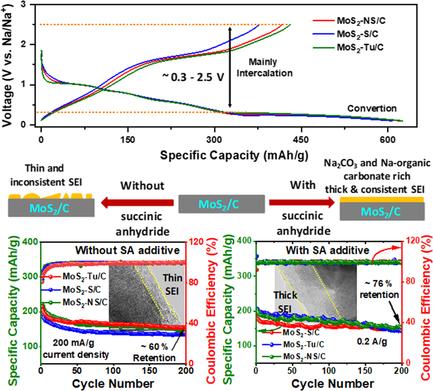
A series of MoS2/C composites are synthesized for sodium-ion battery anode by changing sulfur sources using a facile hydrothermal and ball milling strategy. The carbon modification increases the conductivity and minimizes volume expansion of the material. The intercalation potential is found out for MoS2/C composites by several electrochemical and ex situ X-ray diffraction measurements. The MoS2-NS/C, MoS2-Tu/C, and MoS2-S/C electrodes deliver ≈312, 304, and 293 mAh g−1 reversible capacities at 50 mA g−1 current densities between 0.3 and 2.5 V. The different reversible capacities of MoS2/C composites could be due to the different surface areas or morphologies of the composites. The effect of succinic anhydride (SA) as electrolyte additive in cyclic stabilities, which shows an increment of (≈60–≈76%) capacity retention with SA addition, is demonstrated. The ex situ X-ray photoelectron spectroscopy and transmission electron microscopy analysis reveal that more Na2CO3-rich solid–electrolyte interphase (SEI) is formed in the presence of SA. The SA-derived SEI also prevents the NaPF6 degradation, thereby increases the cyclic performance. Furthermore, the full cells assembled with MoS2/C (anode) and Na3V2(PO4)3 (cathode) show ≈280 mAh g−1 specific capacity at 0.05 A g−1 based on active mass of anode. The improved Na+ storage performance is attributed to the fast Na+ intercalation, improved conductivity, and stable SEI formation during charge/discharge.
期刊介绍:
ChemSusChem
Impact Factor (2016): 7.226
Scope:
Interdisciplinary journal
Focuses on research at the interface of chemistry and sustainability
Features the best research on sustainability and energy
Areas Covered:
Chemistry
Materials Science
Chemical Engineering
Biotechnology





 京公网安备 11010802042870号
京ICP备2023020795号-1
京公网安备 11010802042870号
京ICP备2023020795号-1

 分享
分享
 求助内容:
求助内容: 应助结果提醒方式:
 扫码关注我们
