The mortality rate of people with cancer judged to have a limited life expectancy by physicians performing work disability assessments in the Netherlands: a retrospective cohort study.
Jetske A Kraan, Michiel A Greidanus, Sietske J Tamminga, Jan L Hoving
{"title":"The mortality rate of people with cancer judged to have a limited life expectancy by physicians performing work disability assessments in the Netherlands: a retrospective cohort study.","authors":"Jetske A Kraan, Michiel A Greidanus, Sietske J Tamminga, Jan L Hoving","doi":"10.1186/s12885-025-13900-y","DOIUrl":null,"url":null,"abstract":"<p><strong>Purpose: </strong>There is a lack of consensus among physicians working in the field of disability assessment about the definition of a limited life expectancy. The aim of this study was to describe the mortality rate of employees with cancer who were judged to have a limited life expectancy and to study whether factors are associated with mortality.</p><p><strong>Methods: </strong>A retrospective cohort study, including 534 Dutch employees with a diagnosis of cancer who were granted full work disability pension after being judged by physicians working in the field of disability assessment as having a limited life expectancy. Descriptive statistics were used to describe the one- and two-year mortality rates. Factors potentially associated with mortality were studied using univariate logistic regression analysis.</p><p><strong>Results: </strong>The mortality rates one and two years after the disability assessment were 46% (n = 247) and 63% (n = 339), respectively. We did not observe a statistically significant association between age at death or between sex and death after one year, but after two years the probability of death was greater among men. Both one and two-years after the disability assessment, the probability of dying was greater among employees diagnosed with a digestive type of cancer, compared to employees diagnosed with a urogenital type of cancer.</p><p><strong>Conclusions: </strong>Approximately six in ten people died within two years of their work disability assessment. In addition to the type of cancer, no factors in this study were associated with mortality. Physicians should be supported in making evidence-based assessments of life expectancy in patients with cancer.</p>","PeriodicalId":9131,"journal":{"name":"BMC Cancer","volume":"25 1","pages":"531"},"PeriodicalIF":3.4000,"publicationDate":"2025-03-23","publicationTypes":"Journal Article","fieldsOfStudy":null,"isOpenAccess":false,"openAccessPdf":"https://www.ncbi.nlm.nih.gov/pmc/articles/PMC11930007/pdf/","citationCount":"0","resultStr":null,"platform":"Semanticscholar","paperid":null,"PeriodicalName":"BMC Cancer","FirstCategoryId":"3","ListUrlMain":"https://doi.org/10.1186/s12885-025-13900-y","RegionNum":2,"RegionCategory":"医学","ArticlePicture":[],"TitleCN":null,"AbstractTextCN":null,"PMCID":null,"EPubDate":"","PubModel":"","JCR":"Q2","JCRName":"ONCOLOGY","Score":null,"Total":0}
引用次数: 0
Abstract
Purpose: There is a lack of consensus among physicians working in the field of disability assessment about the definition of a limited life expectancy. The aim of this study was to describe the mortality rate of employees with cancer who were judged to have a limited life expectancy and to study whether factors are associated with mortality.
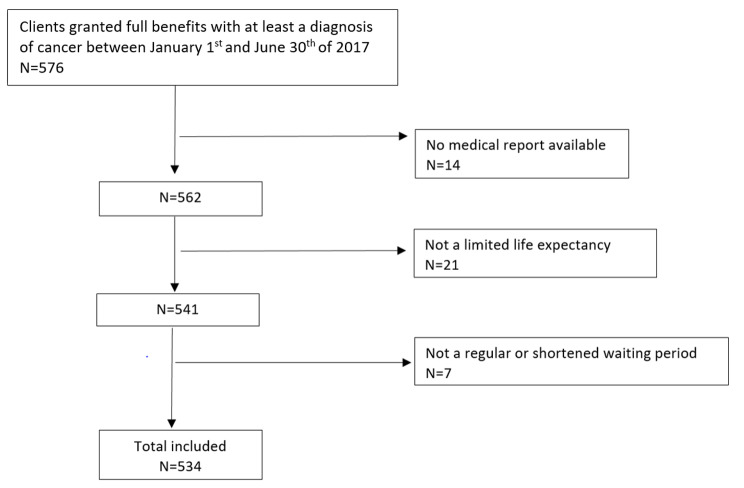
Methods: A retrospective cohort study, including 534 Dutch employees with a diagnosis of cancer who were granted full work disability pension after being judged by physicians working in the field of disability assessment as having a limited life expectancy. Descriptive statistics were used to describe the one- and two-year mortality rates. Factors potentially associated with mortality were studied using univariate logistic regression analysis.
Results: The mortality rates one and two years after the disability assessment were 46% (n = 247) and 63% (n = 339), respectively. We did not observe a statistically significant association between age at death or between sex and death after one year, but after two years the probability of death was greater among men. Both one and two-years after the disability assessment, the probability of dying was greater among employees diagnosed with a digestive type of cancer, compared to employees diagnosed with a urogenital type of cancer.
Conclusions: Approximately six in ten people died within two years of their work disability assessment. In addition to the type of cancer, no factors in this study were associated with mortality. Physicians should be supported in making evidence-based assessments of life expectancy in patients with cancer.
期刊介绍:
BMC Cancer is an open access, peer-reviewed journal that considers articles on all aspects of cancer research, including the pathophysiology, prevention, diagnosis and treatment of cancers. The journal welcomes submissions concerning molecular and cellular biology, genetics, epidemiology, and clinical trials.




 京公网安备 11010802042870号
京ICP备2023020795号-1
京公网安备 11010802042870号
京ICP备2023020795号-1

 分享
分享
 求助内容:
求助内容: 应助结果提醒方式:
 扫码关注我们
