Health workers' perspectives on self-monitoring of blood pressure by pregnant women: a qualitative study among community health workers, midwives, doctors and health system managers in Lombok, Indonesia.
Tigest Tamrat, Yuni Dwi Setiyawati, Raissa Manika Purwaningtias, Nya Jeumpa Madani, María Barreix, Antoine Geissbuhler, Anuraj H Shankar, Özge Tunçalp
{"title":"Health workers' perspectives on self-monitoring of blood pressure by pregnant women: a qualitative study among community health workers, midwives, doctors and health system managers in Lombok, Indonesia.","authors":"Tigest Tamrat, Yuni Dwi Setiyawati, Raissa Manika Purwaningtias, Nya Jeumpa Madani, María Barreix, Antoine Geissbuhler, Anuraj H Shankar, Özge Tunçalp","doi":"10.1136/bmjgh-2024-017532","DOIUrl":null,"url":null,"abstract":"<p><strong>Introduction: </strong>Hypertensive disorders of pregnancy (HDPs) are a leading cause of maternal mortality and morbidity globally but could be mitigated through accurate and timely blood pressure (BP) monitoring. Self-monitoring of blood pressure (SMBP) in pregnancy is an emerging approach for the management of HDPs but mainly studied from the perspectives of pregnant women, in high-income contexts, or tertiary care. This qualitative study explored health workers' perspectives on SMBP by pregnant women, including through using a smartphone application, within primary healthcare settings of Lombok, Indonesia.</p><p><strong>Methods: </strong>We conducted focus group discussions (FGDs) and in-depth interviews (IDIs) with community health workers, community-based midwives, facility-based midwives from primary healthcare centres, obstetrician/gynaecologists and health system managers (including heads of facilities, midwife supervisor and District Health Office administrators). Themes were grouped according to the normalisation process theory, which includes (1) coherence/understanding of the intervention, (2) cognitive participation/perceived value and (3) collective action/how the intervention will affect processes and organisational practices.</p><p><strong>Results: </strong>We recruited 68 participants across 8 FGDs and 26 IDIs. SMBP was perceived to improve timeliness of care and detection of high BP, but health workers expressed concerns about women's ability to accurately self-monitor, reliability and affordability of BP devices, and accountability and management of SMBP results. Embedding SMBP into routine antenatal care counselling, collaboration with family members, clarification on liability implications and protocols on SMBP follow-up actions, and use of digital communication channels were cited as potential ways to facilitate uptake of SMBP.</p><p><strong>Conclusion: </strong>For SMBP to be valued by health workers and effectively integrated into the health system as a strategy for addressing HDPs, it needs to be accompanied by clear clinical and data management protocols, referral mechanisms, reassurance on the accuracy and trust in the self-monitored measurements and demonstration of timeliness in the provision of follow-up care for pregnant women.</p>","PeriodicalId":9137,"journal":{"name":"BMJ Global Health","volume":"10 3","pages":""},"PeriodicalIF":6.1000,"publicationDate":"2025-03-22","publicationTypes":"Journal Article","fieldsOfStudy":null,"isOpenAccess":false,"openAccessPdf":"https://www.ncbi.nlm.nih.gov/pmc/articles/PMC11931923/pdf/","citationCount":"0","resultStr":null,"platform":"Semanticscholar","paperid":null,"PeriodicalName":"BMJ Global Health","FirstCategoryId":"3","ListUrlMain":"https://doi.org/10.1136/bmjgh-2024-017532","RegionNum":2,"RegionCategory":"医学","ArticlePicture":[],"TitleCN":null,"AbstractTextCN":null,"PMCID":null,"EPubDate":"","PubModel":"","JCR":"Q1","JCRName":"PUBLIC, ENVIRONMENTAL & OCCUPATIONAL HEALTH","Score":null,"Total":0}
引用次数: 0
Abstract
Introduction: Hypertensive disorders of pregnancy (HDPs) are a leading cause of maternal mortality and morbidity globally but could be mitigated through accurate and timely blood pressure (BP) monitoring. Self-monitoring of blood pressure (SMBP) in pregnancy is an emerging approach for the management of HDPs but mainly studied from the perspectives of pregnant women, in high-income contexts, or tertiary care. This qualitative study explored health workers' perspectives on SMBP by pregnant women, including through using a smartphone application, within primary healthcare settings of Lombok, Indonesia.
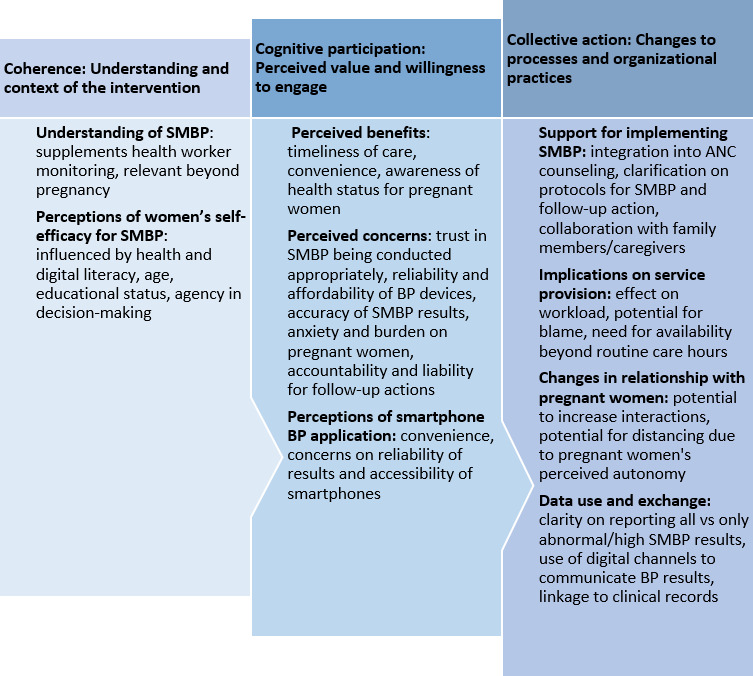
Methods: We conducted focus group discussions (FGDs) and in-depth interviews (IDIs) with community health workers, community-based midwives, facility-based midwives from primary healthcare centres, obstetrician/gynaecologists and health system managers (including heads of facilities, midwife supervisor and District Health Office administrators). Themes were grouped according to the normalisation process theory, which includes (1) coherence/understanding of the intervention, (2) cognitive participation/perceived value and (3) collective action/how the intervention will affect processes and organisational practices.
Results: We recruited 68 participants across 8 FGDs and 26 IDIs. SMBP was perceived to improve timeliness of care and detection of high BP, but health workers expressed concerns about women's ability to accurately self-monitor, reliability and affordability of BP devices, and accountability and management of SMBP results. Embedding SMBP into routine antenatal care counselling, collaboration with family members, clarification on liability implications and protocols on SMBP follow-up actions, and use of digital communication channels were cited as potential ways to facilitate uptake of SMBP.
Conclusion: For SMBP to be valued by health workers and effectively integrated into the health system as a strategy for addressing HDPs, it needs to be accompanied by clear clinical and data management protocols, referral mechanisms, reassurance on the accuracy and trust in the self-monitored measurements and demonstration of timeliness in the provision of follow-up care for pregnant women.
期刊介绍:
BMJ Global Health is an online Open Access journal from BMJ that focuses on publishing high-quality peer-reviewed content pertinent to individuals engaged in global health, including policy makers, funders, researchers, clinicians, and frontline healthcare workers. The journal encompasses all facets of global health, with a special emphasis on submissions addressing underfunded areas such as non-communicable diseases (NCDs). It welcomes research across all study phases and designs, from study protocols to phase I trials to meta-analyses, including small or specialized studies. The journal also encourages opinionated discussions on controversial topics.



 京公网安备 11010802042870号
京ICP备2023020795号-1
京公网安备 11010802042870号
京ICP备2023020795号-1

 分享
分享
 求助内容:
求助内容: 应助结果提醒方式:
 扫码关注我们
