Hongru Yuan, Yilei Liu, Chenjie Dai, Puxin Yang, Yachong Huo, Di Zhang, Hui Wang
{"title":"Predictive factors of distal pedicle screw loosening followed posterior corrective surgery for degenerative lumbar scoliosis.","authors":"Hongru Yuan, Yilei Liu, Chenjie Dai, Puxin Yang, Yachong Huo, Di Zhang, Hui Wang","doi":"10.1186/s12891-025-08519-w","DOIUrl":null,"url":null,"abstract":"<p><strong>Introduction: </strong>To explore incidence and predictive factors for distal pedicle screw loosening (DPSL) followed posterior corrective surgery for degenerative lumbar scoliosis (DLS).</p><p><strong>Methods: </strong>The diagnostic criteria for DPSL developed by X-ray including radiolucent area around screw and \"double halo\" sign. According to occurrence of DPSL at two-year follow-up, 153 patients were divided into two groups: study group (screw loosening) and control group (without screw loosening). To investigate predictive factors for DPSL, three categorized factors including general data, surgical data and radiological data were analyzed statistically.</p><p><strong>Results: </strong>DPSL was detected in 72 patients at two-year follow up (study group). Hounsfield unit (HU) value was lower in study group than that in control group. Fusion level was longer in study group than that in control group. Lower instrumented vertebrae on L5 was less in study group than that in control group. Posterolateral fusion was less in study group than that in control group. Preoperative Cobb angle, postoperative Cobb angle, Cobb angle correction, preoperative lumbosacral coronal angle (LSCA), LSCA correction, preoperative thoracolumbar junction (TL), postoperative TL were larger in study group than those in control group. Logistic regression analysis revealed that low Bone mineral density (BMD) (< 169 HU), posterolateral fusion, Cobb angle correction (> 16 degrees), LSCA correction (> 9 degrees) were independently associated with DPSL.</p><p><strong>Conclusions: </strong>The incidence of DPSL following posterior decompression and instrumented fusion for DLS is 47.1%. Low BMD, large correction of both main curve and fractional curve are predictive factors for DPSL, posterolateral fusion is a protective factor.</p>","PeriodicalId":9189,"journal":{"name":"BMC Musculoskeletal Disorders","volume":"26 1","pages":"283"},"PeriodicalIF":2.4000,"publicationDate":"2025-03-22","publicationTypes":"Journal Article","fieldsOfStudy":null,"isOpenAccess":false,"openAccessPdf":"https://www.ncbi.nlm.nih.gov/pmc/articles/PMC11929243/pdf/","citationCount":"0","resultStr":null,"platform":"Semanticscholar","paperid":null,"PeriodicalName":"BMC Musculoskeletal Disorders","FirstCategoryId":"3","ListUrlMain":"https://doi.org/10.1186/s12891-025-08519-w","RegionNum":3,"RegionCategory":"医学","ArticlePicture":[],"TitleCN":null,"AbstractTextCN":null,"PMCID":null,"EPubDate":"","PubModel":"","JCR":"Q2","JCRName":"ORTHOPEDICS","Score":null,"Total":0}
引用次数: 0
Abstract
Introduction: To explore incidence and predictive factors for distal pedicle screw loosening (DPSL) followed posterior corrective surgery for degenerative lumbar scoliosis (DLS).
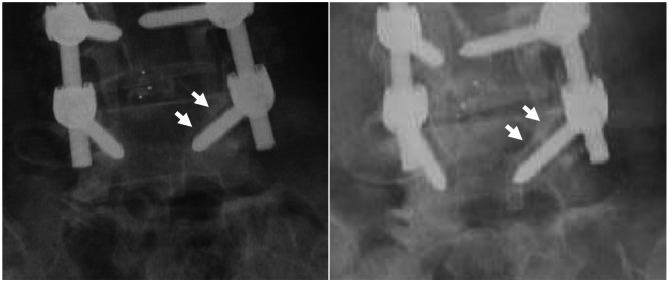
Methods: The diagnostic criteria for DPSL developed by X-ray including radiolucent area around screw and "double halo" sign. According to occurrence of DPSL at two-year follow-up, 153 patients were divided into two groups: study group (screw loosening) and control group (without screw loosening). To investigate predictive factors for DPSL, three categorized factors including general data, surgical data and radiological data were analyzed statistically.
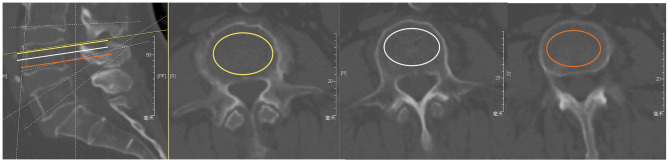
Results: DPSL was detected in 72 patients at two-year follow up (study group). Hounsfield unit (HU) value was lower in study group than that in control group. Fusion level was longer in study group than that in control group. Lower instrumented vertebrae on L5 was less in study group than that in control group. Posterolateral fusion was less in study group than that in control group. Preoperative Cobb angle, postoperative Cobb angle, Cobb angle correction, preoperative lumbosacral coronal angle (LSCA), LSCA correction, preoperative thoracolumbar junction (TL), postoperative TL were larger in study group than those in control group. Logistic regression analysis revealed that low Bone mineral density (BMD) (< 169 HU), posterolateral fusion, Cobb angle correction (> 16 degrees), LSCA correction (> 9 degrees) were independently associated with DPSL.
Conclusions: The incidence of DPSL following posterior decompression and instrumented fusion for DLS is 47.1%. Low BMD, large correction of both main curve and fractional curve are predictive factors for DPSL, posterolateral fusion is a protective factor.
前言:探讨退行性腰椎侧凸(DLS)后路矫正手术后远端椎弓根螺钉松动(DPSL)的发生率及预测因素。方法:x线诊断DPSL的标准包括螺钉周围的透光面积和“双晕”征。根据随访2年DPSL发生情况,将153例患者分为研究组(螺钉松动)和对照组(未螺钉松动)两组。为探讨DPSL的预测因素,对一般资料、手术资料和影像学资料三大类因素进行统计分析。结果:随访2年,72例患者(研究组)出现DPSL。研究组Hounsfield unit (HU)值低于对照组。研究组融合时间较对照组长。研究组L5下固定椎体少于对照组。研究组后外侧融合明显少于对照组。研究组术前Cobb角、术后Cobb角、Cobb角矫正、术前腰骶冠状角(LSCA)、LSCA矫正、术前胸腰椎结(TL)、术后TL均大于对照组。Logistic回归分析显示低骨密度(BMD)(16度)、LSCA矫正(> ~ 9度)与DPSL独立相关。结论:后路减压和固定融合术治疗DLS后发生DPSL的发生率为47.1%。低骨密度,主曲线和部分曲线的大矫正是DPSL的预测因素,后外侧融合是保护因素。
期刊介绍:
BMC Musculoskeletal Disorders is an open access, peer-reviewed journal that considers articles on all aspects of the prevention, diagnosis and management of musculoskeletal disorders, as well as related molecular genetics, pathophysiology, and epidemiology.
The scope of the Journal covers research into rheumatic diseases where the primary focus relates specifically to a component(s) of the musculoskeletal system.




 京公网安备 11010802042870号
京ICP备2023020795号-1
京公网安备 11010802042870号
京ICP备2023020795号-1

 分享
分享
 求助内容:
求助内容: 应助结果提醒方式:
 扫码关注我们
