{"title":"Development of a prognostic model for patients with extensive-stage small cell lung cancer undergoing immunotherapy and chemotherapy.","authors":"Yunbin Gao, Lixia Zhang, Meng Yan, Zongwen Sun, Haibo Zhao, Lujun Zhao","doi":"10.3389/fimmu.2025.1561333","DOIUrl":null,"url":null,"abstract":"<p><strong>Purpose: </strong>In this study, we aimed to develop a predictive model for patients receiving chemotherapy and immunotherapy for extensive-stage small cell lung cancer.</p><p><strong>Methods: </strong>We retrospectively analyzed 112 extensive-stage small cell lung cancer patients treated with first-line immunotherapy and chemotherapy. The relevant clinical data were collected to evaluate the changes during the treatment. The best subset regression, univariate analysis, and LASSO regression with cross-validation were applied for variable selection and model establishment. The nomograms for 1- and 2-year survival probabilities were established, and the calibration curve was utilized to evaluate the correspondence between actual and predicted survival. The model prediction capacity was assessed using decision curve analysis, calibration curves, and receiver operating characteristic curves. Moreover, five-fold cross-validation was conducted for internal validation. According to risk score, the patients were assigned to high- and low-risk groups, and survival curves were generated for each group.</p><p><strong>Results: </strong>The LASSO regression model was established based on the variables such as age, ECOG, metastatic sites, NLR, and immunotherapy cycles. This predictive model displayed robust performance, evidenced by the Area Under the Curve of 0.887 and concordance index of 0.759. The nomogram effectively predicted 1- and 2-year survival probabilities and demonstrated a high degree of calibration. The decision curve analysis displayed that the model possessed superior predictive capability. The risk stratification for patients with high- and low-risk categories facilitated more individualized survival assessment.</p><p><strong>Conclusion: </strong>The study successfully developed a prognostic model for extensive-stage small cell lung cancer patients undergoing immunotherapy and chemotherapy, demonstrating the good accuracy and predictability.</p>","PeriodicalId":12622,"journal":{"name":"Frontiers in Immunology","volume":"16 ","pages":"1561333"},"PeriodicalIF":5.9000,"publicationDate":"2025-03-07","publicationTypes":"Journal Article","fieldsOfStudy":null,"isOpenAccess":false,"openAccessPdf":"https://www.ncbi.nlm.nih.gov/pmc/articles/PMC11926142/pdf/","citationCount":"0","resultStr":null,"platform":"Semanticscholar","paperid":null,"PeriodicalName":"Frontiers in Immunology","FirstCategoryId":"3","ListUrlMain":"https://doi.org/10.3389/fimmu.2025.1561333","RegionNum":2,"RegionCategory":"医学","ArticlePicture":[],"TitleCN":null,"AbstractTextCN":null,"PMCID":null,"EPubDate":"2025/1/1 0:00:00","PubModel":"eCollection","JCR":"Q1","JCRName":"IMMUNOLOGY","Score":null,"Total":0}
引用次数: 0
Abstract
Purpose: In this study, we aimed to develop a predictive model for patients receiving chemotherapy and immunotherapy for extensive-stage small cell lung cancer.
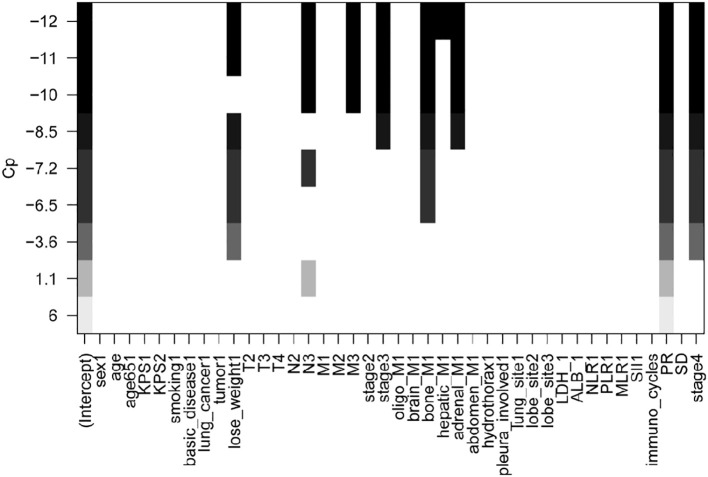
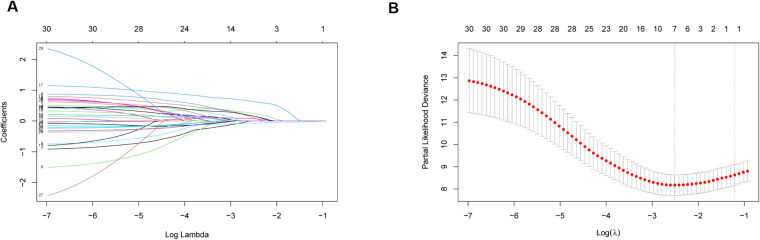
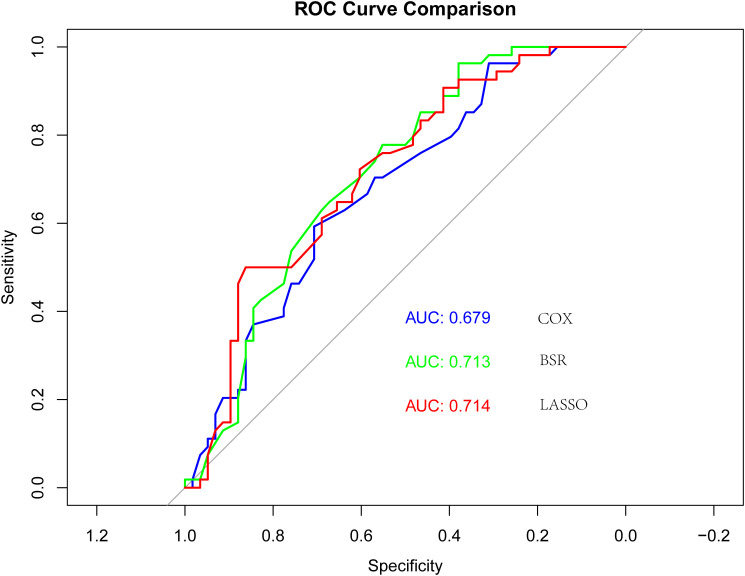
Methods: We retrospectively analyzed 112 extensive-stage small cell lung cancer patients treated with first-line immunotherapy and chemotherapy. The relevant clinical data were collected to evaluate the changes during the treatment. The best subset regression, univariate analysis, and LASSO regression with cross-validation were applied for variable selection and model establishment. The nomograms for 1- and 2-year survival probabilities were established, and the calibration curve was utilized to evaluate the correspondence between actual and predicted survival. The model prediction capacity was assessed using decision curve analysis, calibration curves, and receiver operating characteristic curves. Moreover, five-fold cross-validation was conducted for internal validation. According to risk score, the patients were assigned to high- and low-risk groups, and survival curves were generated for each group.
Results: The LASSO regression model was established based on the variables such as age, ECOG, metastatic sites, NLR, and immunotherapy cycles. This predictive model displayed robust performance, evidenced by the Area Under the Curve of 0.887 and concordance index of 0.759. The nomogram effectively predicted 1- and 2-year survival probabilities and demonstrated a high degree of calibration. The decision curve analysis displayed that the model possessed superior predictive capability. The risk stratification for patients with high- and low-risk categories facilitated more individualized survival assessment.
Conclusion: The study successfully developed a prognostic model for extensive-stage small cell lung cancer patients undergoing immunotherapy and chemotherapy, demonstrating the good accuracy and predictability.
期刊介绍:
Frontiers in Immunology is a leading journal in its field, publishing rigorously peer-reviewed research across basic, translational and clinical immunology. This multidisciplinary open-access journal is at the forefront of disseminating and communicating scientific knowledge and impactful discoveries to researchers, academics, clinicians and the public worldwide.
Frontiers in Immunology is the official Journal of the International Union of Immunological Societies (IUIS). Encompassing the entire field of Immunology, this journal welcomes papers that investigate basic mechanisms of immune system development and function, with a particular emphasis given to the description of the clinical and immunological phenotype of human immune disorders, and on the definition of their molecular basis.




 京公网安备 11010802042870号
京ICP备2023020795号-1
京公网安备 11010802042870号
京ICP备2023020795号-1

 分享
分享
 求助内容:
求助内容: 应助结果提醒方式:
 扫码关注我们
