{"title":"Inhibiting ferroptosis mitigates sheep sperm freezing damage.","authors":"Erhan Hai, Boyuan Li, Yukun Song, Jian Zhang, Jiaxin Zhang","doi":"10.3389/fvets.2025.1526474","DOIUrl":null,"url":null,"abstract":"<p><strong>Objectives: </strong>To evaluate the roles of apoptosis and ferroptosis in cryopreservation-induced damage to sheep sperm, with a focus on assessing the effectiveness of inhibitors targeting these pathways.</p><p><strong>Methods: </strong>Initial analysis compared the expression of apoptotic marker Cleaved-caspase3 (CL-caspase3) and ferroptotic marker Transferrin receptor (TFRC) between fresh and cryopreserved sheep sperm. Elevated CL-caspase3 expression and sustained high TFRC expression post-cryopreservation suggested concurrent occurrence of apoptosis and ferroptosis. Consequently, the study employed Deferoxamine Mesylate (DFO), ferrostatin-1 (Fer-1), liproxstatin-1 (Lip-1), and the apoptosis inhibitor Z-VAD-FMK (Z-VAD) at concentrations ranging from 0 to 10 μM. Post-thaw assessments encompassed plasma membrane integrity, acrosome integrity, and ferroptosis biomarkers. Additional experiments were conducted to measure the expression of GPX4, a key regulator of ferroptosis.</p><p><strong>Results: </strong>Optimal concentrations (2 μM for DFO, Fer-1, and Lip-1; 5 μM for Z-VAD) significantly improved sperm motility and membrane integrity. Among these, Fer-1 demonstrated the greatest efficacy, reducing reactive oxygen species (ROS), lipid peroxidation, and Fe<sup>2+</sup> levels. Z-VAD primarily decreased ROS but was less potent than ferroptosis inhibitors. Notably, Glutathione Peroxidase 4 (GPX4) expression was reduced post-cryopreservation, while Fer-1 supplementation restored its levels to those comparable with fresh sperm.</p><p><strong>Conclusion: </strong>Both apoptosis and ferroptosis play critical roles in sheep sperm cryopreservation. Fer-1 effectively enhanced cryopreservation outcomes by inhibiting ferroptosis, as evidenced by the restoration of GPX4 expression and improvement in sperm quality indicators. These findings highlight ferroptosis inhibition as a promising strategy for preserving genetic material, with implications for animal breeding and biodiversity conservation.</p>","PeriodicalId":12772,"journal":{"name":"Frontiers in Veterinary Science","volume":"12 ","pages":"1526474"},"PeriodicalIF":2.9000,"publicationDate":"2025-03-07","publicationTypes":"Journal Article","fieldsOfStudy":null,"isOpenAccess":false,"openAccessPdf":"https://www.ncbi.nlm.nih.gov/pmc/articles/PMC11926617/pdf/","citationCount":"0","resultStr":null,"platform":"Semanticscholar","paperid":null,"PeriodicalName":"Frontiers in Veterinary Science","FirstCategoryId":"97","ListUrlMain":"https://doi.org/10.3389/fvets.2025.1526474","RegionNum":2,"RegionCategory":"农林科学","ArticlePicture":[],"TitleCN":null,"AbstractTextCN":null,"PMCID":null,"EPubDate":"2025/1/1 0:00:00","PubModel":"eCollection","JCR":"Q1","JCRName":"VETERINARY SCIENCES","Score":null,"Total":0}
引用次数: 0
Abstract
Objectives: To evaluate the roles of apoptosis and ferroptosis in cryopreservation-induced damage to sheep sperm, with a focus on assessing the effectiveness of inhibitors targeting these pathways.
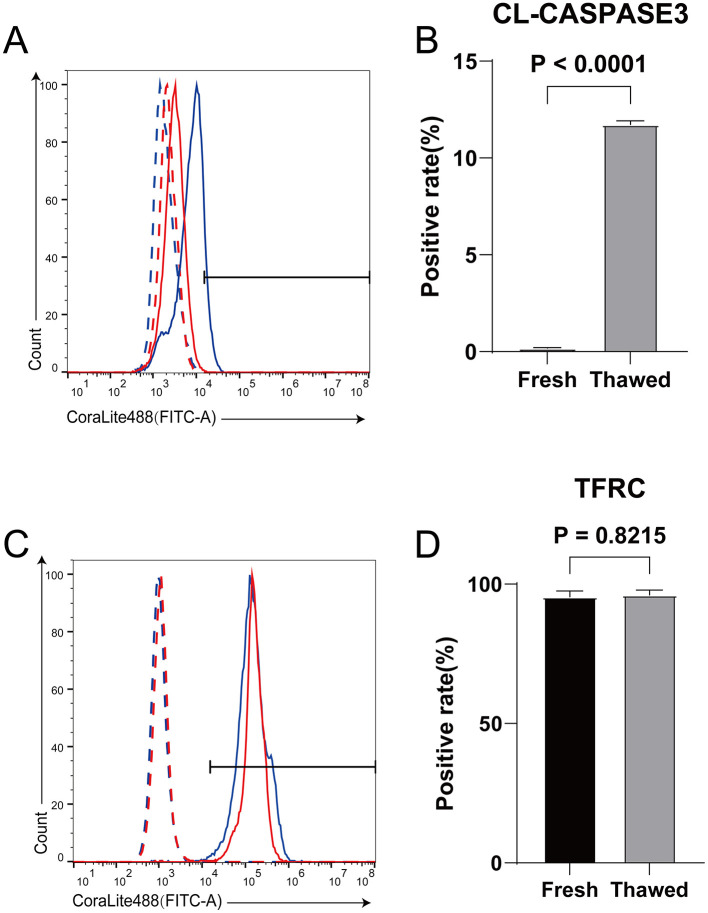
Methods: Initial analysis compared the expression of apoptotic marker Cleaved-caspase3 (CL-caspase3) and ferroptotic marker Transferrin receptor (TFRC) between fresh and cryopreserved sheep sperm. Elevated CL-caspase3 expression and sustained high TFRC expression post-cryopreservation suggested concurrent occurrence of apoptosis and ferroptosis. Consequently, the study employed Deferoxamine Mesylate (DFO), ferrostatin-1 (Fer-1), liproxstatin-1 (Lip-1), and the apoptosis inhibitor Z-VAD-FMK (Z-VAD) at concentrations ranging from 0 to 10 μM. Post-thaw assessments encompassed plasma membrane integrity, acrosome integrity, and ferroptosis biomarkers. Additional experiments were conducted to measure the expression of GPX4, a key regulator of ferroptosis.
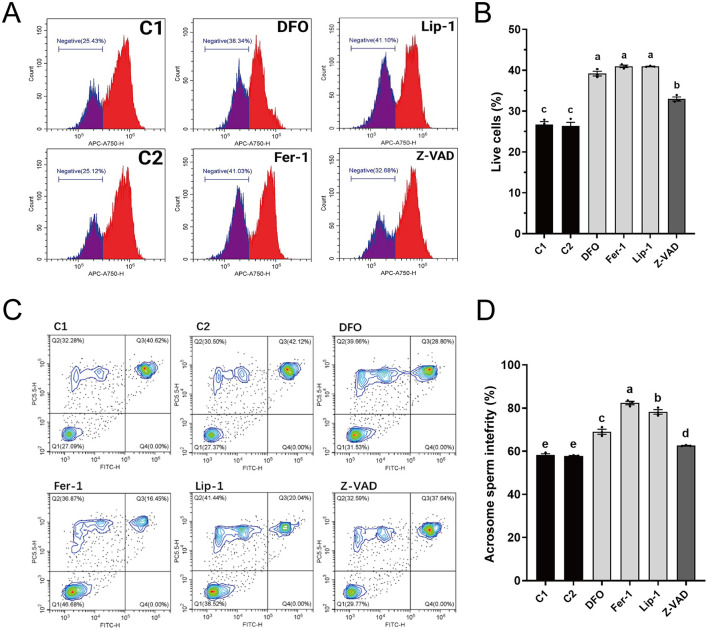
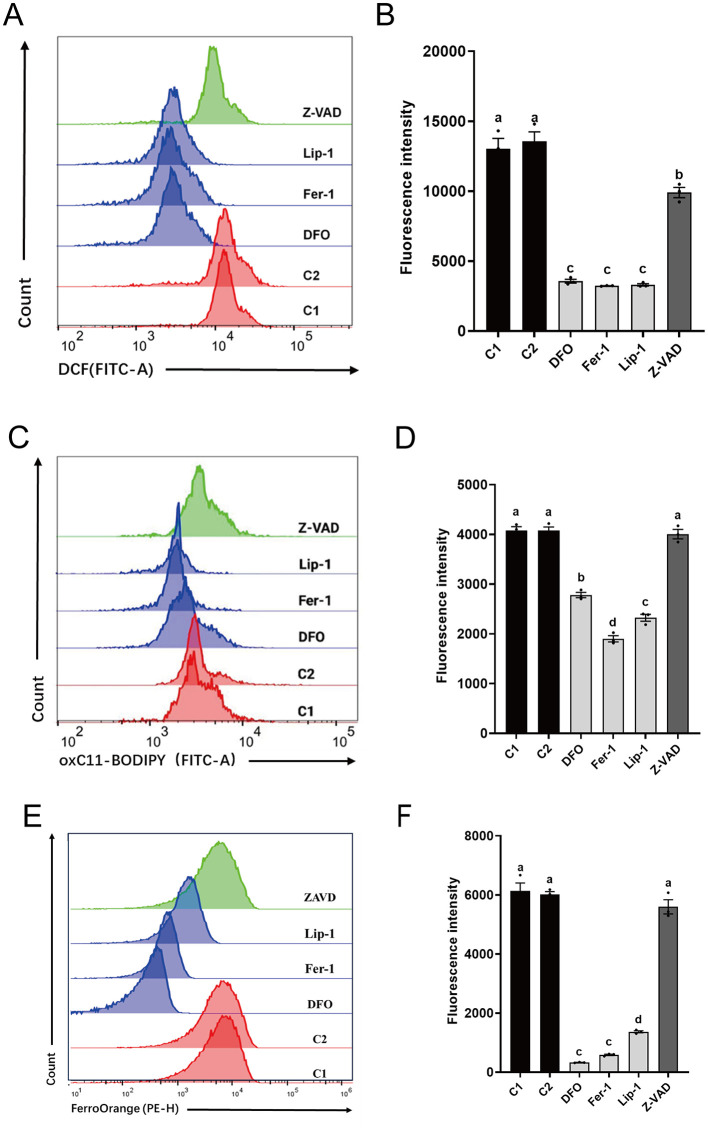
Results: Optimal concentrations (2 μM for DFO, Fer-1, and Lip-1; 5 μM for Z-VAD) significantly improved sperm motility and membrane integrity. Among these, Fer-1 demonstrated the greatest efficacy, reducing reactive oxygen species (ROS), lipid peroxidation, and Fe2+ levels. Z-VAD primarily decreased ROS but was less potent than ferroptosis inhibitors. Notably, Glutathione Peroxidase 4 (GPX4) expression was reduced post-cryopreservation, while Fer-1 supplementation restored its levels to those comparable with fresh sperm.
Conclusion: Both apoptosis and ferroptosis play critical roles in sheep sperm cryopreservation. Fer-1 effectively enhanced cryopreservation outcomes by inhibiting ferroptosis, as evidenced by the restoration of GPX4 expression and improvement in sperm quality indicators. These findings highlight ferroptosis inhibition as a promising strategy for preserving genetic material, with implications for animal breeding and biodiversity conservation.
期刊介绍:
Frontiers in Veterinary Science is a global, peer-reviewed, Open Access journal that bridges animal and human health, brings a comparative approach to medical and surgical challenges, and advances innovative biotechnology and therapy.
Veterinary research today is interdisciplinary, collaborative, and socially relevant, transforming how we understand and investigate animal health and disease. Fundamental research in emerging infectious diseases, predictive genomics, stem cell therapy, and translational modelling is grounded within the integrative social context of public and environmental health, wildlife conservation, novel biomarkers, societal well-being, and cutting-edge clinical practice and specialization. Frontiers in Veterinary Science brings a 21st-century approach—networked, collaborative, and Open Access—to communicate this progress and innovation to both the specialist and to the wider audience of readers in the field.
Frontiers in Veterinary Science publishes articles on outstanding discoveries across a wide spectrum of translational, foundational, and clinical research. The journal''s mission is to bring all relevant veterinary sciences together on a single platform with the goal of improving animal and human health.



 京公网安备 11010802042870号
京ICP备2023020795号-1
京公网安备 11010802042870号
京ICP备2023020795号-1

 分享
分享
 求助内容:
求助内容: 应助结果提醒方式:
 扫码关注我们
