Marina Marsan, Mattia Brutti, F Meloni, M Marica, C Soddu, F Lai, D Martorana, S Savasta
{"title":"A novel missense variant of <i>FBN1</i> gene in a Sardinian family with Marfan syndrome: a case report.","authors":"Marina Marsan, Mattia Brutti, F Meloni, M Marica, C Soddu, F Lai, D Martorana, S Savasta","doi":"10.3389/fped.2025.1549504","DOIUrl":null,"url":null,"abstract":"<p><strong>Background: </strong>Marfan Syndrome (MS) is a connective tissue disorder, an autosomal dominant condition mostly caused by variants in the <i>FBN1</i> gene, which encodes for fibrillin-1 protein. Anomalies in the gene lead to a wide variety of clinical manifestations, including disorders of the cardiac, ocular and musculoskeletal system. We present a case of a child belonging to a Sardinian family of four generations, with a novel variant found in the <i>FBN1</i> gene.</p><p><strong>Objective: </strong>To include this novel missense <i>FBN1</i> variant into genetic counselling for Marfan Syndrome and to discuss its genotypic-phenotypic correlation.</p><p><strong>Methods: </strong>Firstly, the proband was diagnosed with Marfan Syndrome using 2020 Revised Ghent Criteria, and she then underwent genetic testing using Next Generation sequencing.</p><p><strong>Results: </strong>The NGS revealed a novel heterozygous missense variant (c.2348A>G) in the <i>FBN1</i> gene, in exon 20. This genetic variant caused a missense substitution of a serine residue with an arginine residue in the position 783 of Fibrillin-1 protein. The variant was then evaluated in the other family members, and was eventually only found in symptomatic individuals, regardless of the severity of their phenotype, demonstrating the segregation with MS; furthermore, it showed complete penetrance with the disease.</p><p><strong>Conclusions: </strong>Our results suggest that this variant is responsible for MS and it therefore should be included in genetic diagnoses and counselling discussion.</p>","PeriodicalId":12637,"journal":{"name":"Frontiers in Pediatrics","volume":"13 ","pages":"1549504"},"PeriodicalIF":2.0000,"publicationDate":"2025-03-07","publicationTypes":"Journal Article","fieldsOfStudy":null,"isOpenAccess":false,"openAccessPdf":"https://www.ncbi.nlm.nih.gov/pmc/articles/PMC11925759/pdf/","citationCount":"0","resultStr":null,"platform":"Semanticscholar","paperid":null,"PeriodicalName":"Frontiers in Pediatrics","FirstCategoryId":"3","ListUrlMain":"https://doi.org/10.3389/fped.2025.1549504","RegionNum":3,"RegionCategory":"医学","ArticlePicture":[],"TitleCN":null,"AbstractTextCN":null,"PMCID":null,"EPubDate":"2025/1/1 0:00:00","PubModel":"eCollection","JCR":"Q2","JCRName":"PEDIATRICS","Score":null,"Total":0}
引用次数: 0
Abstract
Background: Marfan Syndrome (MS) is a connective tissue disorder, an autosomal dominant condition mostly caused by variants in the FBN1 gene, which encodes for fibrillin-1 protein. Anomalies in the gene lead to a wide variety of clinical manifestations, including disorders of the cardiac, ocular and musculoskeletal system. We present a case of a child belonging to a Sardinian family of four generations, with a novel variant found in the FBN1 gene.
Objective: To include this novel missense FBN1 variant into genetic counselling for Marfan Syndrome and to discuss its genotypic-phenotypic correlation.
Methods: Firstly, the proband was diagnosed with Marfan Syndrome using 2020 Revised Ghent Criteria, and she then underwent genetic testing using Next Generation sequencing.
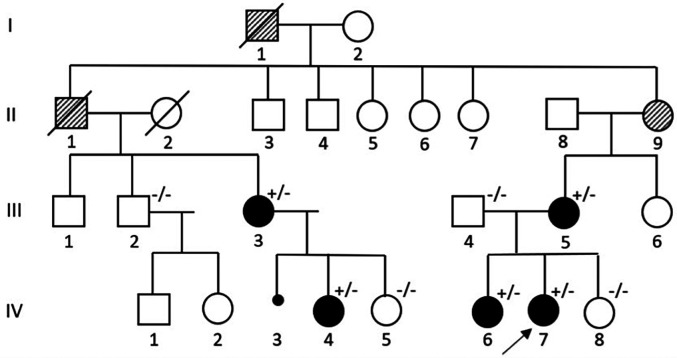
Results: The NGS revealed a novel heterozygous missense variant (c.2348A>G) in the FBN1 gene, in exon 20. This genetic variant caused a missense substitution of a serine residue with an arginine residue in the position 783 of Fibrillin-1 protein. The variant was then evaluated in the other family members, and was eventually only found in symptomatic individuals, regardless of the severity of their phenotype, demonstrating the segregation with MS; furthermore, it showed complete penetrance with the disease.
Conclusions: Our results suggest that this variant is responsible for MS and it therefore should be included in genetic diagnoses and counselling discussion.
期刊介绍:
Frontiers in Pediatrics (Impact Factor 2.33) publishes rigorously peer-reviewed research broadly across the field, from basic to clinical research that meets ongoing challenges in pediatric patient care and child health. Field Chief Editors Arjan Te Pas at Leiden University and Michael L. Moritz at the Children''s Hospital of Pittsburgh are supported by an outstanding Editorial Board of international experts. This multidisciplinary open-access journal is at the forefront of disseminating and communicating scientific knowledge and impactful discoveries to researchers, academics, clinicians and the public worldwide.
Frontiers in Pediatrics also features Research Topics, Frontiers special theme-focused issues managed by Guest Associate Editors, addressing important areas in pediatrics. In this fashion, Frontiers serves as an outlet to publish the broadest aspects of pediatrics in both basic and clinical research, including high-quality reviews, case reports, editorials and commentaries related to all aspects of pediatrics.






 京公网安备 11010802042870号
京ICP备2023020795号-1
京公网安备 11010802042870号
京ICP备2023020795号-1

 分享
分享
 求助内容:
求助内容: 应助结果提醒方式:
 扫码关注我们
