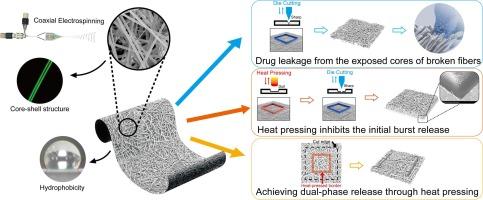
{"title":"Enhanced drug release control in coaxial electrospun fibers via heat pressing: Reducing burst release and achieving dual-phase delivery","authors":"Ji-Feng Wang, Jin-Jia Hu","doi":"10.1016/j.ijpharm.2025.125501","DOIUrl":null,"url":null,"abstract":"<div><div>Burst release is a common challenge in drug delivery systems (DDS), potentially leading to subtherapeutic or toxic drug concentrations. Coaxial electrospinning has emerged as a promising technique to address this issue by encapsulating drugs within core-sheath fiber structures, thereby preventing direct exposure of the drug to the environment and ensuring a gradual release profile. However, secondary processing of coaxial electrospun membranes, such as cutting or slicing, can damage the core-sheath structure of fibers, exposing the drug-loaded core and exacerbating burst release. In this study, we applied heat pressing along the intended cutting line prior to cutting, aiming to thermally seal the core-sheath structure of fibers and prevent drug leakage from the core at cut edges. As a result, the heat-pressed group exhibited a significantly reduced initial burst release followed by a more sustained release compared to the control group, which involved no heat pressing before cutting. The release profiles of both groups were well described by the Korsmeyer-Peppas model with n = 0.32 (R<sup>2</sup> = 0.95) for the control group and n = 0.49 (R<sup>2</sup> = 0.99) for the heat-pressed group. Notably, the release behavior of the heat-pressed group exhibited a closer approximation (R<sup>2</sup> = 0.96) to a first-order model compared to the control group (R<sup>2</sup> = 0.59). Furthermore, we successfully developed a dual-phase DDS by manipulating the ratio of unsealed (fast release) and sealed (slow release) portions of an electrospun membrane. In conclusion, heat pressing presents a simple yet effective strategy for enhancing the performance and reliability of coaxial electrospun DDS, offering potential for broader applications in controlled drug delivery.</div></div>","PeriodicalId":14187,"journal":{"name":"International Journal of Pharmaceutics","volume":"674 ","pages":"Article 125501"},"PeriodicalIF":6.0000,"publicationDate":"2025-04-15","publicationTypes":"Journal Article","fieldsOfStudy":null,"isOpenAccess":false,"openAccessPdf":"","citationCount":"0","resultStr":null,"platform":"Semanticscholar","paperid":null,"PeriodicalName":"International Journal of Pharmaceutics","FirstCategoryId":"3","ListUrlMain":"https://www.sciencedirect.com/science/article/pii/S0378517325003382","RegionNum":2,"RegionCategory":"医学","ArticlePicture":[],"TitleCN":null,"AbstractTextCN":null,"PMCID":null,"EPubDate":"2025/3/22 0:00:00","PubModel":"Epub","JCR":"Q1","JCRName":"PHARMACOLOGY & PHARMACY","Score":null,"Total":0}
引用次数: 0
Abstract
Burst release is a common challenge in drug delivery systems (DDS), potentially leading to subtherapeutic or toxic drug concentrations. Coaxial electrospinning has emerged as a promising technique to address this issue by encapsulating drugs within core-sheath fiber structures, thereby preventing direct exposure of the drug to the environment and ensuring a gradual release profile. However, secondary processing of coaxial electrospun membranes, such as cutting or slicing, can damage the core-sheath structure of fibers, exposing the drug-loaded core and exacerbating burst release. In this study, we applied heat pressing along the intended cutting line prior to cutting, aiming to thermally seal the core-sheath structure of fibers and prevent drug leakage from the core at cut edges. As a result, the heat-pressed group exhibited a significantly reduced initial burst release followed by a more sustained release compared to the control group, which involved no heat pressing before cutting. The release profiles of both groups were well described by the Korsmeyer-Peppas model with n = 0.32 (R2 = 0.95) for the control group and n = 0.49 (R2 = 0.99) for the heat-pressed group. Notably, the release behavior of the heat-pressed group exhibited a closer approximation (R2 = 0.96) to a first-order model compared to the control group (R2 = 0.59). Furthermore, we successfully developed a dual-phase DDS by manipulating the ratio of unsealed (fast release) and sealed (slow release) portions of an electrospun membrane. In conclusion, heat pressing presents a simple yet effective strategy for enhancing the performance and reliability of coaxial electrospun DDS, offering potential for broader applications in controlled drug delivery.
期刊介绍:
The International Journal of Pharmaceutics is the third most cited journal in the "Pharmacy & Pharmacology" category out of 366 journals, being the true home for pharmaceutical scientists concerned with the physical, chemical and biological properties of devices and delivery systems for drugs, vaccines and biologicals, including their design, manufacture and evaluation. This includes evaluation of the properties of drugs, excipients such as surfactants and polymers and novel materials. The journal has special sections on pharmaceutical nanotechnology and personalized medicines, and publishes research papers, reviews, commentaries and letters to the editor as well as special issues.




 京公网安备 11010802042870号
京ICP备2023020795号-1
京公网安备 11010802042870号
京ICP备2023020795号-1

 分享
分享
 求助内容:
求助内容: 应助结果提醒方式:
 扫码关注我们
