Ivan Eltsov MD , Luigi Pannone MD, PhD , Domenico Giovanni Della Rocca MD, PhD , Dhanunjaya Lakkireddy MD , Thomas M. Beaver MD , Chad R. Brodt MD , Giacomo Talevi MSc , Antonio Sorgente MD, PhD , Ingrid Overeinder MD , Rani Kronenberger MD , Gezim Bala MD, PhD , Alexandre Almorad MD , Erwin Ströker MD, PhD , Juan Sieira MD, PhD , Andrea Sarkozy MD, PhD , Pedro Brugada MD, PhD, FHRS , Ali Gharaviri PhD , Gian Battista Chierchia MD, PhD , Mark La Meir MD, PhD , Carlo de Asmundis MD, PhD, FHRS
{"title":"Endo-epicardial mapping of human sinus node in vivo: Novel electrophysiologic findings and anatomic correlations","authors":"Ivan Eltsov MD , Luigi Pannone MD, PhD , Domenico Giovanni Della Rocca MD, PhD , Dhanunjaya Lakkireddy MD , Thomas M. Beaver MD , Chad R. Brodt MD , Giacomo Talevi MSc , Antonio Sorgente MD, PhD , Ingrid Overeinder MD , Rani Kronenberger MD , Gezim Bala MD, PhD , Alexandre Almorad MD , Erwin Ströker MD, PhD , Juan Sieira MD, PhD , Andrea Sarkozy MD, PhD , Pedro Brugada MD, PhD, FHRS , Ali Gharaviri PhD , Gian Battista Chierchia MD, PhD , Mark La Meir MD, PhD , Carlo de Asmundis MD, PhD, FHRS","doi":"10.1016/j.hrthm.2025.03.1966","DOIUrl":null,"url":null,"abstract":"<div><h3>Background</h3><div>The human sinoatrial node<span> (SAN) pacemaker is a complex structure located at the right atrium (RA)–superior vena cava (SVC) junction.</span></div></div><div><h3>Objective</h3><div><span>This study aimed to perform in vivo endocardial and epicardial electroanatomic mapping of human SAN in inappropriate </span>sinus node tachycardia<span> (IST) and to correlate electrical findings with anatomic observations from thoracoscopy during hybrid SAN-sparing IST ablation.</span></div></div><div><h3>Methods</h3><div><span>All consecutive patients with diagnosis of symptomatic IST, refractory to or intolerant of drugs, and endocardial and epicardial mapping of SAN during hybrid ablation were included. Local activation time was defined by steepest −dV/dT on unipolar </span>electrogram (EGM). Exit zone (EZ) was defined as the earliest activation site on endocardial and epicardial maps. Endo-epicardial delay was the time difference between the first endo-epicardial activations. Bipolar EGM morphology and SVC sleeve extension were analyzed.</div></div><div><h3>Results</h3><div>A total of 61 patients were included. The SAN-EZ area was 1.4 ± 0.6 cm<sup>2</sup>; it was located in the superior anterior region of the RA in 46 (75.4%) patients and in the mid RA in 15 (24.6%) patients. The earliest activation occurred on epicardial SAN-EZ in all patients. The local activation time of the epicardial vs endocardial SAN-EZ was −30.8 ms vs −12.4 ms (<em>P</em> < .001). Endo-epicardial delay was 19.7 ms. Bipolar EGM reversed polarity at SAN-EZs was observed in 43 (70.5%) patients. SVC sleeve extension was 31.2 mm and inversely correlated with age.</div></div><div><h3>Conclusion</h3><div>The earliest SAN-EZ was found in the epicardium. Bipolar EGM reversed polarity is a novel electrophysiologic marker for SAN-EZs.</div></div>","PeriodicalId":12886,"journal":{"name":"Heart rhythm","volume":"23 2","pages":"Pages 234-242"},"PeriodicalIF":5.7000,"publicationDate":"2026-02-01","publicationTypes":"Journal Article","fieldsOfStudy":null,"isOpenAccess":false,"openAccessPdf":"","citationCount":"0","resultStr":null,"platform":"Semanticscholar","paperid":null,"PeriodicalName":"Heart rhythm","FirstCategoryId":"3","ListUrlMain":"https://www.sciencedirect.com/science/article/pii/S1547527125022283","RegionNum":2,"RegionCategory":"医学","ArticlePicture":[],"TitleCN":null,"AbstractTextCN":null,"PMCID":null,"EPubDate":"2025/3/20 0:00:00","PubModel":"Epub","JCR":"Q1","JCRName":"CARDIAC & CARDIOVASCULAR SYSTEMS","Score":null,"Total":0}
引用次数: 0
Abstract
Background
The human sinoatrial node (SAN) pacemaker is a complex structure located at the right atrium (RA)–superior vena cava (SVC) junction.
Objective
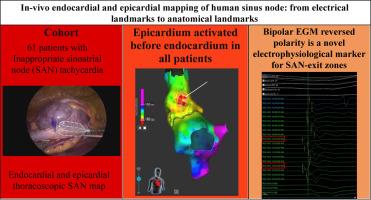
This study aimed to perform in vivo endocardial and epicardial electroanatomic mapping of human SAN in inappropriate sinus node tachycardia (IST) and to correlate electrical findings with anatomic observations from thoracoscopy during hybrid SAN-sparing IST ablation.
Methods
All consecutive patients with diagnosis of symptomatic IST, refractory to or intolerant of drugs, and endocardial and epicardial mapping of SAN during hybrid ablation were included. Local activation time was defined by steepest −dV/dT on unipolar electrogram (EGM). Exit zone (EZ) was defined as the earliest activation site on endocardial and epicardial maps. Endo-epicardial delay was the time difference between the first endo-epicardial activations. Bipolar EGM morphology and SVC sleeve extension were analyzed.
Results
A total of 61 patients were included. The SAN-EZ area was 1.4 ± 0.6 cm2; it was located in the superior anterior region of the RA in 46 (75.4%) patients and in the mid RA in 15 (24.6%) patients. The earliest activation occurred on epicardial SAN-EZ in all patients. The local activation time of the epicardial vs endocardial SAN-EZ was −30.8 ms vs −12.4 ms (P < .001). Endo-epicardial delay was 19.7 ms. Bipolar EGM reversed polarity at SAN-EZs was observed in 43 (70.5%) patients. SVC sleeve extension was 31.2 mm and inversely correlated with age.
Conclusion
The earliest SAN-EZ was found in the epicardium. Bipolar EGM reversed polarity is a novel electrophysiologic marker for SAN-EZs.
期刊介绍:
HeartRhythm, the official Journal of the Heart Rhythm Society and the Cardiac Electrophysiology Society, is a unique journal for fundamental discovery and clinical applicability.
HeartRhythm integrates the entire cardiac electrophysiology (EP) community from basic and clinical academic researchers, private practitioners, engineers, allied professionals, industry, and trainees, all of whom are vital and interdependent members of our EP community.
The Heart Rhythm Society is the international leader in science, education, and advocacy for cardiac arrhythmia professionals and patients, and the primary information resource on heart rhythm disorders. Its mission is to improve the care of patients by promoting research, education, and optimal health care policies and standards.




 京公网安备 11010802042870号
京ICP备2023020795号-1
京公网安备 11010802042870号
京ICP备2023020795号-1

 分享
分享
 求助内容:
求助内容: 应助结果提醒方式:
 扫码关注我们
