{"title":"A Visualized Nomogram to Predict the Risk of Acute Ischemic Stroke Among Patients With Cervical Artery Dissection.","authors":"Changyu Li, Jincheng Guan, Qingshi Zhao, Jiahua Li, Yuying Wang, Kui Zhao","doi":"10.2147/IJGM.S507043","DOIUrl":null,"url":null,"abstract":"<p><strong>Background: </strong>Acute ischemic stroke (AIS) is a significant global health concern, with cervical artery dissection (CAD) being a notable yet frequently overlooked cause, particularly in young adults. Despite advancements in imaging technologies, there remains a deficiency in effective methodologies for the prompt identification of AIS attributable to CAD. This research aims to create a predictive model combining clinical, imaging, and laboratory data to improve risk stratification and guide timely interventions.</p><p><strong>Methods: </strong>Between 2019 and 2024, patients diagnosed with CAD were enrolled in the study. Nomogram models were constructed utilizing a two-step methodological approach. Initially, the least absolute shrinkage and selection operator (LASSO) regression analysis was utilized to improve variable selection. Subsequently, logistic regression analysis was conducted to develop an estimation model using the significant indicators identified by the LASSO. The model's accuracy was evaluated using the application of receiver operating characteristic (ROC) curves, calibration curves, decision curve analyses, and clinical impact curves. The model underwent internal validation through bootstrap resampling with 1,000 iterations.</p><p><strong>Results: </strong>In the cohort of 102 patients, 75 individuals with CAD experienced had an acute ischemic stroke. This cohort was characterized by a significantly older median age (42 years vs 51 years, p=0.041) and a comparable proportion of males (78.7% vs 74.1%,p=0.825). The analysis identified hyperlipidemia (aOR=0.19, 95% CI=0.040-0.893, p=0.036), lumen occlusion (aOR=5.41, 95% CI=1.236-23.648, p=0.025), a lower lymphocyte-to-monocyte ratio (LMR) (aOR=0.68, 95% CI=0.476-0.797, p=0.038), and higher systemic immune-inflammation index (SII) (aOR=1.01, 95% CI=1.001-1.016, p=0.026) are independent factors linked to ischemic stroke in CAD patients. The predictive model showed strong performance with an AUC of 0.870 (95% CI=0.789-0.950) under the ROC curve. Decision curve analysis (DCA) indicated that the constructed nomogram was clinically applicable, with a risk threshold ranging from 9% to 95%.</p><p><strong>Conclusion: </strong>This study developed a dynamic and visualized nomogram model for the precise prediction of stroke risk in patients with CAD, exhibiting robust performance, calibration, and clinical utility. Future multi-center studies are anticipated to further substantiate its clinical applicability.</p>","PeriodicalId":14131,"journal":{"name":"International Journal of General Medicine","volume":"18 ","pages":"1569-1580"},"PeriodicalIF":2.0000,"publicationDate":"2025-03-19","publicationTypes":"Journal Article","fieldsOfStudy":null,"isOpenAccess":false,"openAccessPdf":"https://www.ncbi.nlm.nih.gov/pmc/articles/PMC11930252/pdf/","citationCount":"0","resultStr":null,"platform":"Semanticscholar","paperid":null,"PeriodicalName":"International Journal of General Medicine","FirstCategoryId":"3","ListUrlMain":"https://doi.org/10.2147/IJGM.S507043","RegionNum":4,"RegionCategory":"医学","ArticlePicture":[],"TitleCN":null,"AbstractTextCN":null,"PMCID":null,"EPubDate":"2025/1/1 0:00:00","PubModel":"eCollection","JCR":"Q2","JCRName":"MEDICINE, GENERAL & INTERNAL","Score":null,"Total":0}
引用次数: 0
Abstract
Background: Acute ischemic stroke (AIS) is a significant global health concern, with cervical artery dissection (CAD) being a notable yet frequently overlooked cause, particularly in young adults. Despite advancements in imaging technologies, there remains a deficiency in effective methodologies for the prompt identification of AIS attributable to CAD. This research aims to create a predictive model combining clinical, imaging, and laboratory data to improve risk stratification and guide timely interventions.
Methods: Between 2019 and 2024, patients diagnosed with CAD were enrolled in the study. Nomogram models were constructed utilizing a two-step methodological approach. Initially, the least absolute shrinkage and selection operator (LASSO) regression analysis was utilized to improve variable selection. Subsequently, logistic regression analysis was conducted to develop an estimation model using the significant indicators identified by the LASSO. The model's accuracy was evaluated using the application of receiver operating characteristic (ROC) curves, calibration curves, decision curve analyses, and clinical impact curves. The model underwent internal validation through bootstrap resampling with 1,000 iterations.
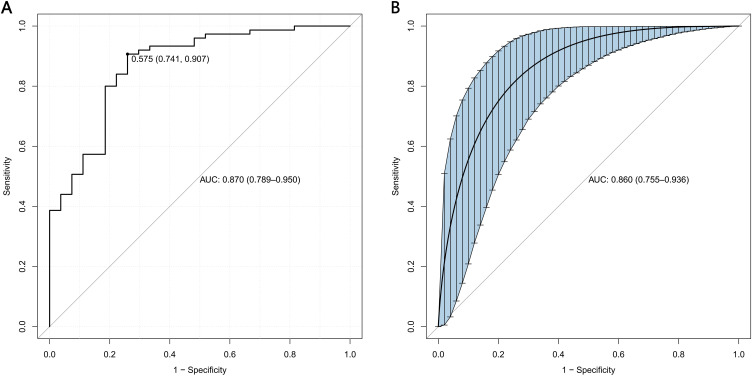
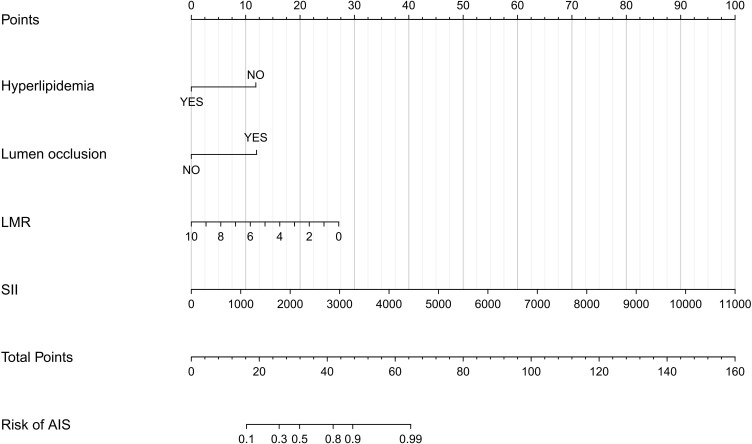
Results: In the cohort of 102 patients, 75 individuals with CAD experienced had an acute ischemic stroke. This cohort was characterized by a significantly older median age (42 years vs 51 years, p=0.041) and a comparable proportion of males (78.7% vs 74.1%,p=0.825). The analysis identified hyperlipidemia (aOR=0.19, 95% CI=0.040-0.893, p=0.036), lumen occlusion (aOR=5.41, 95% CI=1.236-23.648, p=0.025), a lower lymphocyte-to-monocyte ratio (LMR) (aOR=0.68, 95% CI=0.476-0.797, p=0.038), and higher systemic immune-inflammation index (SII) (aOR=1.01, 95% CI=1.001-1.016, p=0.026) are independent factors linked to ischemic stroke in CAD patients. The predictive model showed strong performance with an AUC of 0.870 (95% CI=0.789-0.950) under the ROC curve. Decision curve analysis (DCA) indicated that the constructed nomogram was clinically applicable, with a risk threshold ranging from 9% to 95%.
Conclusion: This study developed a dynamic and visualized nomogram model for the precise prediction of stroke risk in patients with CAD, exhibiting robust performance, calibration, and clinical utility. Future multi-center studies are anticipated to further substantiate its clinical applicability.
期刊介绍:
The International Journal of General Medicine is an international, peer-reviewed, open access journal that focuses on general and internal medicine, pathogenesis, epidemiology, diagnosis, monitoring and treatment protocols. The journal is characterized by the rapid reporting of reviews, original research and clinical studies across all disease areas.
A key focus of the journal is the elucidation of disease processes and management protocols resulting in improved outcomes for the patient. Patient perspectives such as satisfaction, quality of life, health literacy and communication and their role in developing new healthcare programs and optimizing clinical outcomes are major areas of interest for the journal.
As of 1st April 2019, the International Journal of General Medicine will no longer consider meta-analyses for publication.




 京公网安备 11010802042870号
京ICP备2023020795号-1
京公网安备 11010802042870号
京ICP备2023020795号-1

 分享
分享
 求助内容:
求助内容: 应助结果提醒方式:
 扫码关注我们
