Dragos Stefan Lazar, George Sebastian Gherlan, Simin Aysel Florescu, Corneliu Petru Popescu, Maria Nica
{"title":"Imported Typhoid Fever in Romania Between 2010 and 2024.","authors":"Dragos Stefan Lazar, George Sebastian Gherlan, Simin Aysel Florescu, Corneliu Petru Popescu, Maria Nica","doi":"10.3390/idr17020016","DOIUrl":null,"url":null,"abstract":"<p><strong>Background/objectives: </strong>Although a \"forgotten\" disease in developed countries, typhoid fever remains a significant global health problem, especially in regions with inadequate sanitation and overcrowding. Despite medical advances, this systemic bacterial infection, caused by <i>Salmonella</i> Typhi, continues to affect millions worldwide. Accurate diagnosis and timely treatment are crucial to prevent severe complications and mortality. Even though antibiotic therapy is effective, the emergence of drug-resistant strains is a growing challenge.</p><p><strong>Methods: </strong>We present a series of cases encountered in a tertiary infectious disease hospital in Romania over 15 years.</p><p><strong>Results: </strong>The hospitalised patients were mainly from Sub-Saharan Africa and the Indian subcontinent; the median time between the onset of the first symptoms and hospital admission was 15 days. The symptoms encountered along with fever were headache, chills, cough, diarrhoea and tachycardia, an unusual feature in the clinical picture of this disease. Aneosinophilia (the absence of peripheral eosinophilic granulocytes) was the most frequently encountered laboratory finding, followed by increased serum transaminases and inflammatory syndrome.</p><p><strong>Conclusions: </strong><i>S</i>. Typhi was generally identified from blood culture, demonstrating, except in one case, resistance to ciprofloxacin and, in several cases, multi-drug resistance (MDR). In this series of cases, all strains were sensitive to ceftriaxone.</p>","PeriodicalId":13579,"journal":{"name":"Infectious Disease Reports","volume":"17 2","pages":""},"PeriodicalIF":2.4000,"publicationDate":"2025-02-25","publicationTypes":"Journal Article","fieldsOfStudy":null,"isOpenAccess":false,"openAccessPdf":"https://www.ncbi.nlm.nih.gov/pmc/articles/PMC11932231/pdf/","citationCount":"0","resultStr":null,"platform":"Semanticscholar","paperid":null,"PeriodicalName":"Infectious Disease Reports","FirstCategoryId":"1085","ListUrlMain":"https://doi.org/10.3390/idr17020016","RegionNum":0,"RegionCategory":null,"ArticlePicture":[],"TitleCN":null,"AbstractTextCN":null,"PMCID":null,"EPubDate":"","PubModel":"","JCR":"Q2","JCRName":"INFECTIOUS DISEASES","Score":null,"Total":0}
引用次数: 0
Abstract
Background/objectives: Although a "forgotten" disease in developed countries, typhoid fever remains a significant global health problem, especially in regions with inadequate sanitation and overcrowding. Despite medical advances, this systemic bacterial infection, caused by Salmonella Typhi, continues to affect millions worldwide. Accurate diagnosis and timely treatment are crucial to prevent severe complications and mortality. Even though antibiotic therapy is effective, the emergence of drug-resistant strains is a growing challenge.
Methods: We present a series of cases encountered in a tertiary infectious disease hospital in Romania over 15 years.
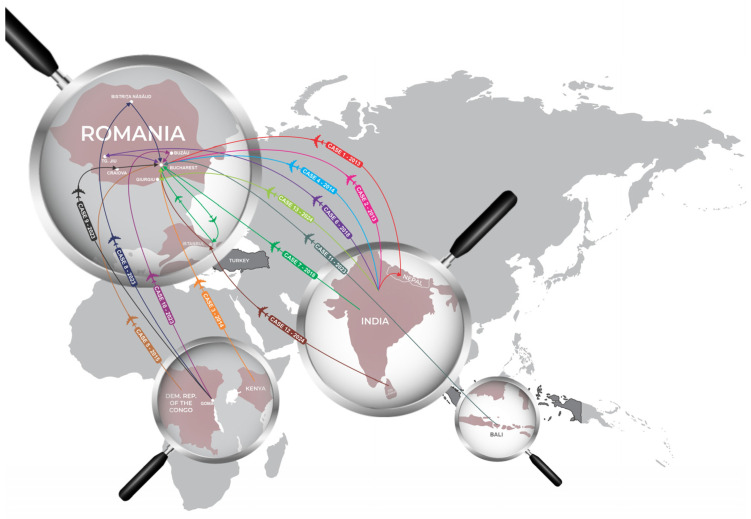
Results: The hospitalised patients were mainly from Sub-Saharan Africa and the Indian subcontinent; the median time between the onset of the first symptoms and hospital admission was 15 days. The symptoms encountered along with fever were headache, chills, cough, diarrhoea and tachycardia, an unusual feature in the clinical picture of this disease. Aneosinophilia (the absence of peripheral eosinophilic granulocytes) was the most frequently encountered laboratory finding, followed by increased serum transaminases and inflammatory syndrome.
Conclusions: S. Typhi was generally identified from blood culture, demonstrating, except in one case, resistance to ciprofloxacin and, in several cases, multi-drug resistance (MDR). In this series of cases, all strains were sensitive to ceftriaxone.





 京公网安备 11010802042870号
京ICP备2023020795号-1
京公网安备 11010802042870号
京ICP备2023020795号-1

 分享
分享
 求助内容:
求助内容: 应助结果提醒方式:
 扫码关注我们
