Gastrointestinal Transit Time Assessed Using a CT-Based Radiopaque Marker Method in Patients With Acute Pancreatitis During Methylnaltrexone Treatment.
Cecilie Siggaard Knoph, Andreas Svenstrup Hesthaven, Mathias Ellgaard Cook, Srdan Novovic, Mark Berner Hansen, Michael Bau Mortensen, Liv Bjerre Juul Nielsen, Irene Maria Høgsberg, Celina Salomon, Ole Thorlacius-Ussing, Esben Bolvig Mark, Jens Brøndum Frøkjær, Søren Schou Olesen, Asbjørn Mohr Drewes
{"title":"Gastrointestinal Transit Time Assessed Using a CT-Based Radiopaque Marker Method in Patients With Acute Pancreatitis During Methylnaltrexone Treatment.","authors":"Cecilie Siggaard Knoph, Andreas Svenstrup Hesthaven, Mathias Ellgaard Cook, Srdan Novovic, Mark Berner Hansen, Michael Bau Mortensen, Liv Bjerre Juul Nielsen, Irene Maria Høgsberg, Celina Salomon, Ole Thorlacius-Ussing, Esben Bolvig Mark, Jens Brøndum Frøkjær, Søren Schou Olesen, Asbjørn Mohr Drewes","doi":"10.1111/nmo.70027","DOIUrl":null,"url":null,"abstract":"<p><strong>Introduction: </strong>Dysmotility is common in acute pancreatitis (AP) and may be evaluated using radiopaque markers and imaging. We present a simple CT-based approach, which was employed in hospitalized patients with AP.</p><p><strong>Methods: </strong>This was a secondary analysis of a randomized, controlled trial conducted at four Danish centers. Patients admitted with AP and systemic inflammatory response syndrome were randomized to receive 5 days of intravenous methylnaltrexone or placebo (lactated ringer) added to standard management. Self-reported stool frequency was documented daily. Patients ingested a capsule containing 10 radiopaque markers on Day 3. A subsequent CT scan on Day 5 was used to identify the location of retained markers for the calculation of gastrointestinal transit, and colonic dimensions (diameters and cross-sectional areas) were measured.</p><p><strong>Results: </strong>In total, 47 patients were included. Patients receiving methylnaltrexone less often had laxative treatment (57% vs. 88%, p = 0.01) compared with placebo. Transit times were similar between the methylnaltrexone and the placebo groups (difference, -4 h (95% CI, -16 to 8), p = 0.53). Marker retention scores, colon diameters, and colon cross-sectional areas did not differ between treatment groups (all p > 0.05). Transit times (ρ = -0.53; p < 0.001), marker retention scores (ρ = -0.42; p = 0.004), diameter (ρ = -0.43; p = 0.003), and cross-sectional areas (ρ = -0.36; p = 0.01) of the descending colon were negatively correlated with self-reported stool frequency.</p><p><strong>Conclusion: </strong>Our CT-based method was feasible in hospitalized patients with AP. Methylnaltrexone did not change gastrointestinal transit compared with placebo. However, laxative therapy was more frequent with the placebo.</p>","PeriodicalId":19123,"journal":{"name":"Neurogastroenterology and Motility","volume":" ","pages":"e70027"},"PeriodicalIF":3.0000,"publicationDate":"2025-07-01","publicationTypes":"Journal Article","fieldsOfStudy":null,"isOpenAccess":false,"openAccessPdf":"https://www.ncbi.nlm.nih.gov/pmc/articles/PMC12163208/pdf/","citationCount":"0","resultStr":null,"platform":"Semanticscholar","paperid":null,"PeriodicalName":"Neurogastroenterology and Motility","FirstCategoryId":"3","ListUrlMain":"https://doi.org/10.1111/nmo.70027","RegionNum":3,"RegionCategory":"医学","ArticlePicture":[],"TitleCN":null,"AbstractTextCN":null,"PMCID":null,"EPubDate":"2025/3/24 0:00:00","PubModel":"Epub","JCR":"Q1","JCRName":"CLINICAL NEUROLOGY","Score":null,"Total":0}
引用次数: 0
Abstract
Introduction: Dysmotility is common in acute pancreatitis (AP) and may be evaluated using radiopaque markers and imaging. We present a simple CT-based approach, which was employed in hospitalized patients with AP.
Methods: This was a secondary analysis of a randomized, controlled trial conducted at four Danish centers. Patients admitted with AP and systemic inflammatory response syndrome were randomized to receive 5 days of intravenous methylnaltrexone or placebo (lactated ringer) added to standard management. Self-reported stool frequency was documented daily. Patients ingested a capsule containing 10 radiopaque markers on Day 3. A subsequent CT scan on Day 5 was used to identify the location of retained markers for the calculation of gastrointestinal transit, and colonic dimensions (diameters and cross-sectional areas) were measured.
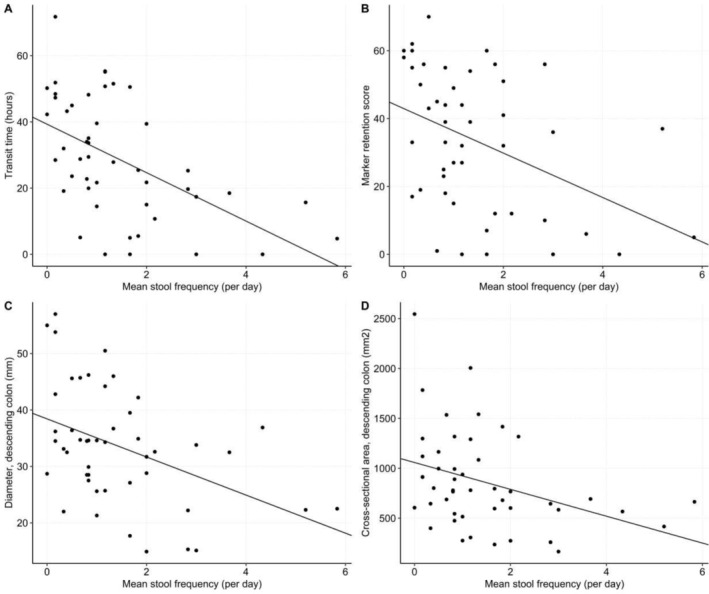
Results: In total, 47 patients were included. Patients receiving methylnaltrexone less often had laxative treatment (57% vs. 88%, p = 0.01) compared with placebo. Transit times were similar between the methylnaltrexone and the placebo groups (difference, -4 h (95% CI, -16 to 8), p = 0.53). Marker retention scores, colon diameters, and colon cross-sectional areas did not differ between treatment groups (all p > 0.05). Transit times (ρ = -0.53; p < 0.001), marker retention scores (ρ = -0.42; p = 0.004), diameter (ρ = -0.43; p = 0.003), and cross-sectional areas (ρ = -0.36; p = 0.01) of the descending colon were negatively correlated with self-reported stool frequency.
Conclusion: Our CT-based method was feasible in hospitalized patients with AP. Methylnaltrexone did not change gastrointestinal transit compared with placebo. However, laxative therapy was more frequent with the placebo.
期刊介绍:
Neurogastroenterology & Motility (NMO) is the official Journal of the European Society of Neurogastroenterology & Motility (ESNM) and the American Neurogastroenterology and Motility Society (ANMS). It is edited by James Galligan, Albert Bredenoord, and Stephen Vanner. The editorial and peer review process is independent of the societies affiliated to the journal and publisher: Neither the ANMS, the ESNM or the Publisher have editorial decision-making power. Whenever these are relevant to the content being considered or published, the editors, journal management committee and editorial board declare their interests and affiliations.





 京公网安备 11010802042870号
京ICP备2023020795号-1
京公网安备 11010802042870号
京ICP备2023020795号-1

 分享
分享
 求助内容:
求助内容: 应助结果提醒方式:
 扫码关注我们
