{"title":"RNAa: Mechanisms, therapeutic potential, and clinical progress.","authors":"Yukang Qian, Cody Liu, Xuhui Zeng, Long-Cheng Li","doi":"10.1016/j.omtn.2025.102494","DOIUrl":null,"url":null,"abstract":"<p><p>RNA activation (RNAa), a gene regulatory mechanism mediated by small activating RNAs (saRNAs) and microRNAs (miRNAs), has significant implications for therapeutic applications. Unlike small interfering RNA (siRNA), which is known for gene silencing in RNA interference (RNAi), synthetic saRNAs can stably upregulate target gene expression at the transcriptional level through the assembly of the RNA-induced transcriptional activation (RITA) complex. Moreover, the dual functionality of endogenous miRNAs in RNAa (hereafter referred to as mi-RNAa) reveals their complex role in cellular processes and disease pathology. Emerging studies suggest saRNAs' potential as a novel therapeutic modality for diseases such as metabolic disorders, hearing loss, tumors, and Alzheimer's. Notably, MTL-CEBPA, the first saRNA drug candidate, shows promise in hepatocellular carcinoma treatment, while RAG-01 is being explored for non-muscle-invasive bladder cancer, highlighting clinical advancements in RNAa. This review synthesizes our current understanding of the mechanisms of RNAa and highlights recent advancements in the study of mi-RNAa and the therapeutic development of saRNAs.</p>","PeriodicalId":18821,"journal":{"name":"Molecular Therapy. Nucleic Acids","volume":"36 2","pages":"102494"},"PeriodicalIF":6.1000,"publicationDate":"2025-02-21","publicationTypes":"Journal Article","fieldsOfStudy":null,"isOpenAccess":false,"openAccessPdf":"https://www.ncbi.nlm.nih.gov/pmc/articles/PMC11930103/pdf/","citationCount":"0","resultStr":null,"platform":"Semanticscholar","paperid":null,"PeriodicalName":"Molecular Therapy. Nucleic Acids","FirstCategoryId":"3","ListUrlMain":"https://doi.org/10.1016/j.omtn.2025.102494","RegionNum":2,"RegionCategory":"医学","ArticlePicture":[],"TitleCN":null,"AbstractTextCN":null,"PMCID":null,"EPubDate":"2025/6/10 0:00:00","PubModel":"eCollection","JCR":"Q1","JCRName":"MEDICINE, RESEARCH & EXPERIMENTAL","Score":null,"Total":0}
引用次数: 0
Abstract
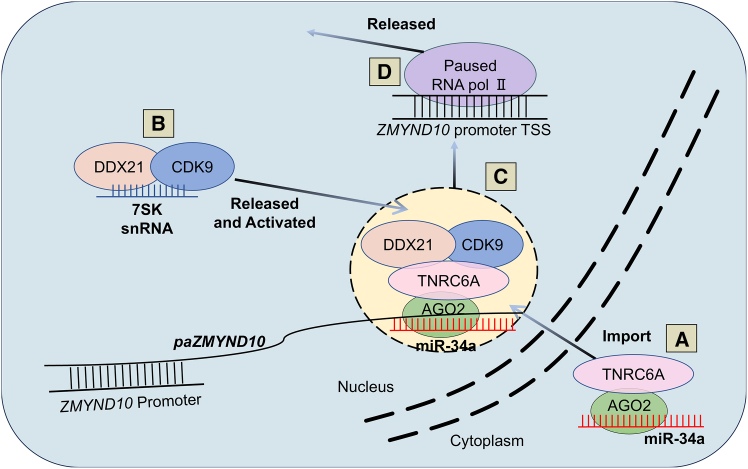
RNA activation (RNAa), a gene regulatory mechanism mediated by small activating RNAs (saRNAs) and microRNAs (miRNAs), has significant implications for therapeutic applications. Unlike small interfering RNA (siRNA), which is known for gene silencing in RNA interference (RNAi), synthetic saRNAs can stably upregulate target gene expression at the transcriptional level through the assembly of the RNA-induced transcriptional activation (RITA) complex. Moreover, the dual functionality of endogenous miRNAs in RNAa (hereafter referred to as mi-RNAa) reveals their complex role in cellular processes and disease pathology. Emerging studies suggest saRNAs' potential as a novel therapeutic modality for diseases such as metabolic disorders, hearing loss, tumors, and Alzheimer's. Notably, MTL-CEBPA, the first saRNA drug candidate, shows promise in hepatocellular carcinoma treatment, while RAG-01 is being explored for non-muscle-invasive bladder cancer, highlighting clinical advancements in RNAa. This review synthesizes our current understanding of the mechanisms of RNAa and highlights recent advancements in the study of mi-RNAa and the therapeutic development of saRNAs.
期刊介绍:
Molecular Therapy Nucleic Acids is an international, open-access journal that publishes high-quality research in nucleic-acid-based therapeutics to treat and correct genetic and acquired diseases. It is the official journal of the American Society of Gene & Cell Therapy and is built upon the success of Molecular Therapy. The journal focuses on gene- and oligonucleotide-based therapies and publishes peer-reviewed research, reviews, and commentaries. Its impact factor for 2022 is 8.8. The subject areas covered include the development of therapeutics based on nucleic acids and their derivatives, vector development for RNA-based therapeutics delivery, utilization of gene-modifying agents like Zn finger nucleases and triplex-forming oligonucleotides, pre-clinical target validation, safety and efficacy studies, and clinical trials.





 京公网安备 11010802042870号
京ICP备2023020795号-1
京公网安备 11010802042870号
京ICP备2023020795号-1

 分享
分享
 求助内容:
求助内容: 应助结果提醒方式:
 扫码关注我们
