Jinquan Liu, Jingyi Mi, Yesheng Jin, Fang Lin, Yongwei Wu, Yunhong Ma, Jun Liu, Zhonghua Xu, Li Tang, Aiping Zhu, Danfeng Jing, Yongjun Rui, Ming Zhou
{"title":"Three-Dimensional Mapping of Distal Clavicle Fractures: Displacement Patterns and Clinical Implications for Surgical Management.","authors":"Jinquan Liu, Jingyi Mi, Yesheng Jin, Fang Lin, Yongwei Wu, Yunhong Ma, Jun Liu, Zhonghua Xu, Li Tang, Aiping Zhu, Danfeng Jing, Yongjun Rui, Ming Zhou","doi":"10.1111/os.70033","DOIUrl":null,"url":null,"abstract":"<p><strong>Objective: </strong>Current classifications inadequately address distal clavicle fracture instability due to their coronal plane focus, neglecting multiplanar displacement and underestimation of complexity on routine radiographs. This study aimed to bridge this gap by employing three-dimensional (3D) fracture mapping to characterize injury patterns, offering mechanistic insights to optimize surgical strategies.</p><p><strong>Methods: </strong>A retrospective analysis was conducted on 81 patients diagnosed with acute distal clavicle fractures at Wuxi Ninth People's Hospital between 2019 and 2022. Axial and sagittal CT planes were utilized to demonstrate fracture line alignment. Manual simulated repositioning was performed for all fracture lines, which were subsequently graphically superimposed onto a standard template of the intact distal clavicle. A 3D map was generated and subsequently transformed into a heatmap. The classification of distal clavicle fractures was determined based on the updated and modified Neer classification. Two points were designated at the distal end of the fracture block and at the repositioned counterpart to assess the three-dimensional spatial position, including shortening along the x-axis, horizontal displacement along the y-axis, vertical displacement along the z-axis, as well as the displacement angles in the three planes, thereby quantifying the displacement of each distal clavicle fracture.</p><p><strong>Results: </strong>This study included 81 cases of distal clavicle fractures (43 cases on the left side and 38 cases on the right side). The distribution included 8 cases (9.88%) of Neer I, 5 cases (6.17%) of Neer IIA, 31 cases (38.27%) of Neer IIB, 11 cases (13.58%) of Neer IIC, 14 cases (17.28%) of Neer III, and 12 cases (14.81%) of Neer V. Fracture mapping revealed that the fracture lines were predominantly located in the distal one-third of the distal clavicle, with the highest concentration at the acromion end. The majority of displaced distal clavicle fractures exhibit multidirectional displacement, mainly posterior, superior, and shortening, along with angulation in the corresponding directions.</p><p><strong>Conclusions: </strong>Most displaced distal clavicle fractures involve multiple displacements and angulations, necessitating three-dimensional analysis during fracture reduction. A comprehensive 3D assessment of displacement patterns is essential for evaluating stability and guiding treatment. Fracture line analysis further enhances classification accuracy and informs imaging protocols and fixation strategies tailored to specific fracture types.</p>","PeriodicalId":19566,"journal":{"name":"Orthopaedic Surgery","volume":" ","pages":"1656-1668"},"PeriodicalIF":2.1000,"publicationDate":"2025-06-01","publicationTypes":"Journal Article","fieldsOfStudy":null,"isOpenAccess":false,"openAccessPdf":"https://www.ncbi.nlm.nih.gov/pmc/articles/PMC12146135/pdf/","citationCount":"0","resultStr":null,"platform":"Semanticscholar","paperid":null,"PeriodicalName":"Orthopaedic Surgery","FirstCategoryId":"3","ListUrlMain":"https://doi.org/10.1111/os.70033","RegionNum":2,"RegionCategory":"医学","ArticlePicture":[],"TitleCN":null,"AbstractTextCN":null,"PMCID":null,"EPubDate":"2025/3/24 0:00:00","PubModel":"Epub","JCR":"Q2","JCRName":"ORTHOPEDICS","Score":null,"Total":0}
引用次数: 0
Abstract
Objective: Current classifications inadequately address distal clavicle fracture instability due to their coronal plane focus, neglecting multiplanar displacement and underestimation of complexity on routine radiographs. This study aimed to bridge this gap by employing three-dimensional (3D) fracture mapping to characterize injury patterns, offering mechanistic insights to optimize surgical strategies.
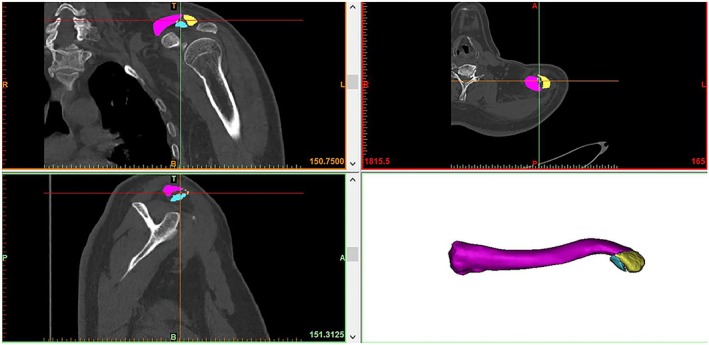
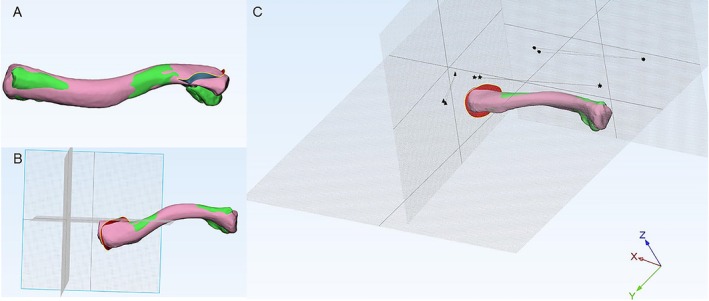
Methods: A retrospective analysis was conducted on 81 patients diagnosed with acute distal clavicle fractures at Wuxi Ninth People's Hospital between 2019 and 2022. Axial and sagittal CT planes were utilized to demonstrate fracture line alignment. Manual simulated repositioning was performed for all fracture lines, which were subsequently graphically superimposed onto a standard template of the intact distal clavicle. A 3D map was generated and subsequently transformed into a heatmap. The classification of distal clavicle fractures was determined based on the updated and modified Neer classification. Two points were designated at the distal end of the fracture block and at the repositioned counterpart to assess the three-dimensional spatial position, including shortening along the x-axis, horizontal displacement along the y-axis, vertical displacement along the z-axis, as well as the displacement angles in the three planes, thereby quantifying the displacement of each distal clavicle fracture.
Results: This study included 81 cases of distal clavicle fractures (43 cases on the left side and 38 cases on the right side). The distribution included 8 cases (9.88%) of Neer I, 5 cases (6.17%) of Neer IIA, 31 cases (38.27%) of Neer IIB, 11 cases (13.58%) of Neer IIC, 14 cases (17.28%) of Neer III, and 12 cases (14.81%) of Neer V. Fracture mapping revealed that the fracture lines were predominantly located in the distal one-third of the distal clavicle, with the highest concentration at the acromion end. The majority of displaced distal clavicle fractures exhibit multidirectional displacement, mainly posterior, superior, and shortening, along with angulation in the corresponding directions.
Conclusions: Most displaced distal clavicle fractures involve multiple displacements and angulations, necessitating three-dimensional analysis during fracture reduction. A comprehensive 3D assessment of displacement patterns is essential for evaluating stability and guiding treatment. Fracture line analysis further enhances classification accuracy and informs imaging protocols and fixation strategies tailored to specific fracture types.
期刊介绍:
Orthopaedic Surgery (OS) is the official journal of the Chinese Orthopaedic Association, focusing on all aspects of orthopaedic technique and surgery.
The journal publishes peer-reviewed articles in the following categories: Original Articles, Clinical Articles, Review Articles, Guidelines, Editorials, Commentaries, Surgical Techniques, Case Reports and Meeting Reports.





 京公网安备 11010802042870号
京ICP备2023020795号-1
京公网安备 11010802042870号
京ICP备2023020795号-1

 分享
分享
 求助内容:
求助内容: 应助结果提醒方式:
 扫码关注我们
