Comprehensive Phenotyping and Cytokine Production of Circulating B Cells Associate Resting Memory B Cells With Early Antibody-mediated Rejection in Kidney Transplant Recipients.
Dania Altulea, Joost van den Born, Theo Bijma, Carlo Bonasia, Nanthicha Inrueangsri, Rosa Lammerts, Stefan Berger, Peter Heeringa, Jan-Stephan Sanders
{"title":"Comprehensive Phenotyping and Cytokine Production of Circulating B Cells Associate Resting Memory B Cells With Early Antibody-mediated Rejection in Kidney Transplant Recipients.","authors":"Dania Altulea, Joost van den Born, Theo Bijma, Carlo Bonasia, Nanthicha Inrueangsri, Rosa Lammerts, Stefan Berger, Peter Heeringa, Jan-Stephan Sanders","doi":"10.1097/TXD.0000000000001775","DOIUrl":null,"url":null,"abstract":"<p><strong>Background: </strong>B cells play a crucial role in kidney transplantation through antibody production and cytokine secretion. To better understand their impact on kidney transplantation, this retrospective study aimed to characterize circulating B-cell phenotypes and cytokine production in a cohort of kidney transplant patients to identify whether pretransplant donor-specific antibodies (DSAs) or biopsy-proven rejection is associated with different B-cell profiles.</p><p><strong>Methods: </strong>Pretransplant cryopreserved peripheral blood mononuclear cells were obtained from 96 kidney transplant recipients, of whom 42 had pretransplant DSAs. The cells underwent surface marker staining using a 33-color spectral flow cytometry panel for B-cell phenotyping. Simultaneously, cells were stimulated for interleukin-10, tumor necrosis factor-α, and interleukin-6 production, and analyzed with a 6-color panel.</p><p><strong>Results: </strong>Rejection was linked to decreased naive B cells and increased plasmablasts, CD27<sup>+</sup> memory B cells, and memory B-cell subsets (all <i>P</i> < 0.04) compared with no rejection. Cytokine-producing B cells and immune regulatory molecule expression showed no significant differences. Multivariate analysis identified resting memory B cells (CD27<sup>+</sup>CD21<sup>+</sup>) and pretransplant DSAs as significantly associated with rejection (<i>P</i> = 0.01; odds ratio [OR], 1.07; <i>P</i> = 0.02; OR, 3.10, respectively). Cox regression analysis revealed resting memory B cells were associated with early antibody-mediated rejection (<i>P</i> = 0.04; OR, 1.05).</p><p><strong>Conclusions: </strong>B-cell subset distributions differed between patients with and without rejection. Resting memory B-cell frequency was associated with increased early antibody-mediated rejection risk, whereas cytokine production and immune checkpoint expression did not influence rejection. The results suggest that B-cell subset composition could aid in rejection risk assessment and serve as a potential pretransplant diagnostic parameter.</p>","PeriodicalId":23225,"journal":{"name":"Transplantation Direct","volume":"11 4","pages":"e1775"},"PeriodicalIF":1.9000,"publicationDate":"2025-03-20","publicationTypes":"Journal Article","fieldsOfStudy":null,"isOpenAccess":false,"openAccessPdf":"https://www.ncbi.nlm.nih.gov/pmc/articles/PMC11927649/pdf/","citationCount":"0","resultStr":null,"platform":"Semanticscholar","paperid":null,"PeriodicalName":"Transplantation Direct","FirstCategoryId":"1085","ListUrlMain":"https://doi.org/10.1097/TXD.0000000000001775","RegionNum":0,"RegionCategory":null,"ArticlePicture":[],"TitleCN":null,"AbstractTextCN":null,"PMCID":null,"EPubDate":"2025/4/1 0:00:00","PubModel":"eCollection","JCR":"Q3","JCRName":"TRANSPLANTATION","Score":null,"Total":0}
引用次数: 0
Abstract
Background: B cells play a crucial role in kidney transplantation through antibody production and cytokine secretion. To better understand their impact on kidney transplantation, this retrospective study aimed to characterize circulating B-cell phenotypes and cytokine production in a cohort of kidney transplant patients to identify whether pretransplant donor-specific antibodies (DSAs) or biopsy-proven rejection is associated with different B-cell profiles.
Methods: Pretransplant cryopreserved peripheral blood mononuclear cells were obtained from 96 kidney transplant recipients, of whom 42 had pretransplant DSAs. The cells underwent surface marker staining using a 33-color spectral flow cytometry panel for B-cell phenotyping. Simultaneously, cells were stimulated for interleukin-10, tumor necrosis factor-α, and interleukin-6 production, and analyzed with a 6-color panel.
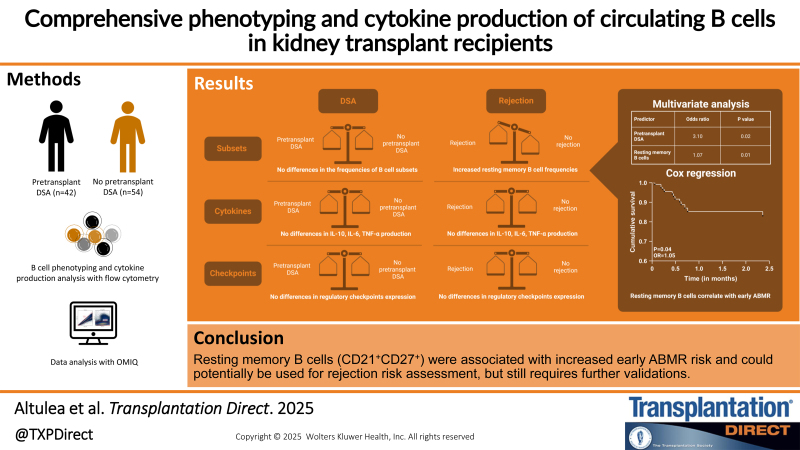
Results: Rejection was linked to decreased naive B cells and increased plasmablasts, CD27+ memory B cells, and memory B-cell subsets (all P < 0.04) compared with no rejection. Cytokine-producing B cells and immune regulatory molecule expression showed no significant differences. Multivariate analysis identified resting memory B cells (CD27+CD21+) and pretransplant DSAs as significantly associated with rejection (P = 0.01; odds ratio [OR], 1.07; P = 0.02; OR, 3.10, respectively). Cox regression analysis revealed resting memory B cells were associated with early antibody-mediated rejection (P = 0.04; OR, 1.05).
Conclusions: B-cell subset distributions differed between patients with and without rejection. Resting memory B-cell frequency was associated with increased early antibody-mediated rejection risk, whereas cytokine production and immune checkpoint expression did not influence rejection. The results suggest that B-cell subset composition could aid in rejection risk assessment and serve as a potential pretransplant diagnostic parameter.






 京公网安备 11010802042870号
京ICP备2023020795号-1
京公网安备 11010802042870号
京ICP备2023020795号-1

 分享
分享
 求助内容:
求助内容: 应助结果提醒方式:
 扫码关注我们
