Gabrielle Cognacq, Jonathan E Attwood, Gabriele C DeLuca
{"title":"Traumatic Brain Injury and Alzheimer's Disease: A Shared Neurovascular Hypothesis.","authors":"Gabrielle Cognacq, Jonathan E Attwood, Gabriele C DeLuca","doi":"10.1177/26331055251323292","DOIUrl":null,"url":null,"abstract":"<p><p>Traumatic brain injury (TBI) is a modifiable risk factor for Alzheimer's disease (AD). TBI and AD share several histopathological hallmarks: namely, beta-amyloid aggregation, tau hyperphosphorylation, and plasma protein infiltration. The relative contributions of these proteinopathies and their interplay in the pathogenesis of both conditions remains unclear although important differences are emerging. This review synthesises emerging evidence for the critical role of the neurovascular unit in mediating protein accumulation and neurotoxicity in both TBI and AD. We propose a shared pathogenic cascade centred on a neurovascular unit, in which increased blood-brain barrier permeability induces a series of noxious mechanisms leading to neuronal loss, synaptic dysfunction and ultimately cognitive dysfunction in both conditions. We explore the application of this hypothesis to outstanding research questions and potential treatments for TBI and AD, as well as other neurodegenerative and neuroinflammatory conditions. Limitations of this hypothesis, including the challenges of establishing a causal relationship between neurovascular damage and proteinopathies, are also discussed.</p>","PeriodicalId":36527,"journal":{"name":"Neuroscience Insights","volume":"20 ","pages":"26331055251323292"},"PeriodicalIF":2.6000,"publicationDate":"2025-03-20","publicationTypes":"Journal Article","fieldsOfStudy":null,"isOpenAccess":false,"openAccessPdf":"https://www.ncbi.nlm.nih.gov/pmc/articles/PMC11926848/pdf/","citationCount":"0","resultStr":null,"platform":"Semanticscholar","paperid":null,"PeriodicalName":"Neuroscience Insights","FirstCategoryId":"1085","ListUrlMain":"https://doi.org/10.1177/26331055251323292","RegionNum":0,"RegionCategory":null,"ArticlePicture":[],"TitleCN":null,"AbstractTextCN":null,"PMCID":null,"EPubDate":"2025/1/1 0:00:00","PubModel":"eCollection","JCR":"Q2","JCRName":"NEUROSCIENCES","Score":null,"Total":0}
引用次数: 0
Abstract
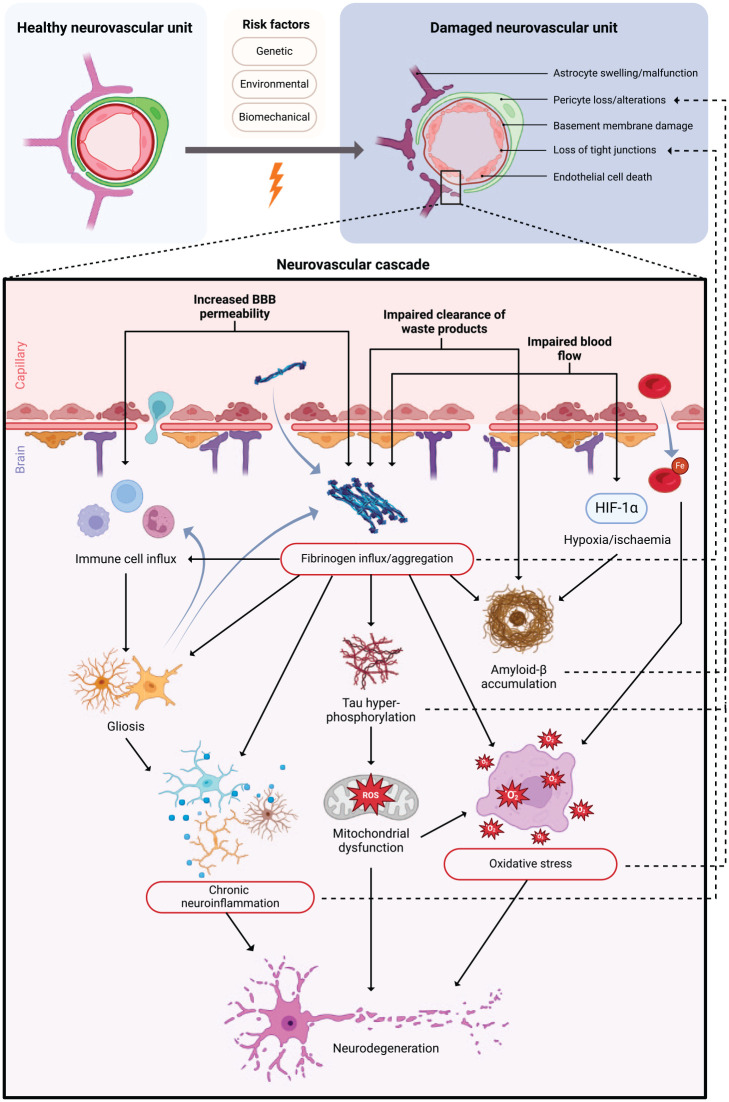
Traumatic brain injury (TBI) is a modifiable risk factor for Alzheimer's disease (AD). TBI and AD share several histopathological hallmarks: namely, beta-amyloid aggregation, tau hyperphosphorylation, and plasma protein infiltration. The relative contributions of these proteinopathies and their interplay in the pathogenesis of both conditions remains unclear although important differences are emerging. This review synthesises emerging evidence for the critical role of the neurovascular unit in mediating protein accumulation and neurotoxicity in both TBI and AD. We propose a shared pathogenic cascade centred on a neurovascular unit, in which increased blood-brain barrier permeability induces a series of noxious mechanisms leading to neuronal loss, synaptic dysfunction and ultimately cognitive dysfunction in both conditions. We explore the application of this hypothesis to outstanding research questions and potential treatments for TBI and AD, as well as other neurodegenerative and neuroinflammatory conditions. Limitations of this hypothesis, including the challenges of establishing a causal relationship between neurovascular damage and proteinopathies, are also discussed.





 京公网安备 11010802042870号
京ICP备2023020795号-1
京公网安备 11010802042870号
京ICP备2023020795号-1

 分享
分享
 求助内容:
求助内容: 应助结果提醒方式:
 扫码关注我们
