Izzet Turkalp Akbasli, Ahmet Ziya Birbilen, Ozlem Teksam
{"title":"Artificial intelligence-driven forecasting and shift optimization for pediatric emergency department crowding.","authors":"Izzet Turkalp Akbasli, Ahmet Ziya Birbilen, Ozlem Teksam","doi":"10.1093/jamiaopen/ooae138","DOIUrl":null,"url":null,"abstract":"<p><strong>Objective: </strong>This study aimed to develop and evaluate an artificial intelligence (AI)-driven system for forecasting Pediatric Emergency Department (PED) overcrowding and optimizing physician shift schedules using machine learning operations (MLOps).</p><p><strong>Materials and methods: </strong>Data from 352 843 PED admissions between January 2018 and May 2023 were analyzed. Twenty time-series forecasting models-including classical methods and advanced deep learning architectures like Temporal Convolutional Network, Time-series Dense Encoder and Reversible Instance Normalization, Neural High-order Time Series model, and Neural Basis Expansion Analysis-were developed and compared using Python 3.8. Starting in January 2023, an MLOps simulation automated data updates and model retraining. Shift schedules were optimized based on forecasted patient volumes using integer linear programming.</p><p><strong>Results: </strong>Advanced deep learning models outperformed traditional models, achieving initial R<sup>2</sup> scores up to 75%. Throughout the simulation, the median R<sup>2</sup> score for all models was 44% after MLOps-based model selection, the median R<sup>2</sup> improved to 60%. The MLOps architecture facilitated continuous model updates, enhancing forecast accuracy. Shift optimization adjusted staffing in 69 out of 84 shifts, increasing physician allocation by up to 30.4% during peak hours. This adjustment reduced the patient-to-physician ratio by an average of 4.32 patients during the 8-16 shift and 4.40 patients during the 16-24 shift.</p><p><strong>Discussion: </strong>The integration of advanced deep learning models with MLOps architecture allowed for continuous model updates, enhancing the accuracy of PED overcrowding forecasts and outperforming traditional methods. The AI-driven system demonstrated resilience against data drift caused by events like the COVID-19 pandemic, adapting to changing conditions. Optimizing physician shifts based on these forecasts improved workforce distribution without increasing staff numbers, reducing patient load per physician during peak hours. However, limitations include the single-center design and a fixed staffing model, indicating the need for multicenter validation and implementation in settings with dynamic staffing practices. Future research should focus on expanding datasets through multicenter collaborations and developing forecasting models that provide longer lead times without compromising accuracy.</p><p><strong>Conclusions: </strong>The AI-driven forecasting and shift optimization system demonstrated the efficacy of integrating AI and MLOps in predicting PED overcrowding and optimizing physician shifts. This approach outperformed traditional methods, highlighting its potential for managing overcrowding in emergency departments. Future research should focus on multicenter validation and real-world implementation to fully leverage the benefits of this innovative system.</p>","PeriodicalId":36278,"journal":{"name":"JAMIA Open","volume":"8 2","pages":"ooae138"},"PeriodicalIF":3.4000,"publicationDate":"2025-03-21","publicationTypes":"Journal Article","fieldsOfStudy":null,"isOpenAccess":false,"openAccessPdf":"https://www.ncbi.nlm.nih.gov/pmc/articles/PMC11927529/pdf/","citationCount":"0","resultStr":null,"platform":"Semanticscholar","paperid":null,"PeriodicalName":"JAMIA Open","FirstCategoryId":"1085","ListUrlMain":"https://doi.org/10.1093/jamiaopen/ooae138","RegionNum":0,"RegionCategory":null,"ArticlePicture":[],"TitleCN":null,"AbstractTextCN":null,"PMCID":null,"EPubDate":"2025/4/1 0:00:00","PubModel":"eCollection","JCR":"Q2","JCRName":"HEALTH CARE SCIENCES & SERVICES","Score":null,"Total":0}
引用次数: 0
Abstract
Objective: This study aimed to develop and evaluate an artificial intelligence (AI)-driven system for forecasting Pediatric Emergency Department (PED) overcrowding and optimizing physician shift schedules using machine learning operations (MLOps).
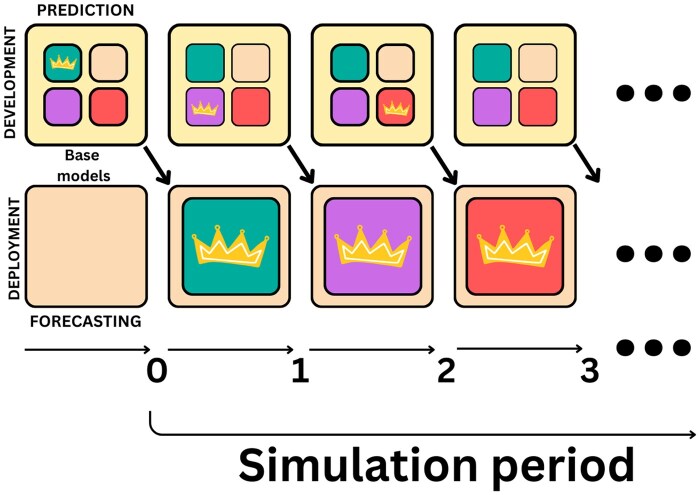
Materials and methods: Data from 352 843 PED admissions between January 2018 and May 2023 were analyzed. Twenty time-series forecasting models-including classical methods and advanced deep learning architectures like Temporal Convolutional Network, Time-series Dense Encoder and Reversible Instance Normalization, Neural High-order Time Series model, and Neural Basis Expansion Analysis-were developed and compared using Python 3.8. Starting in January 2023, an MLOps simulation automated data updates and model retraining. Shift schedules were optimized based on forecasted patient volumes using integer linear programming.
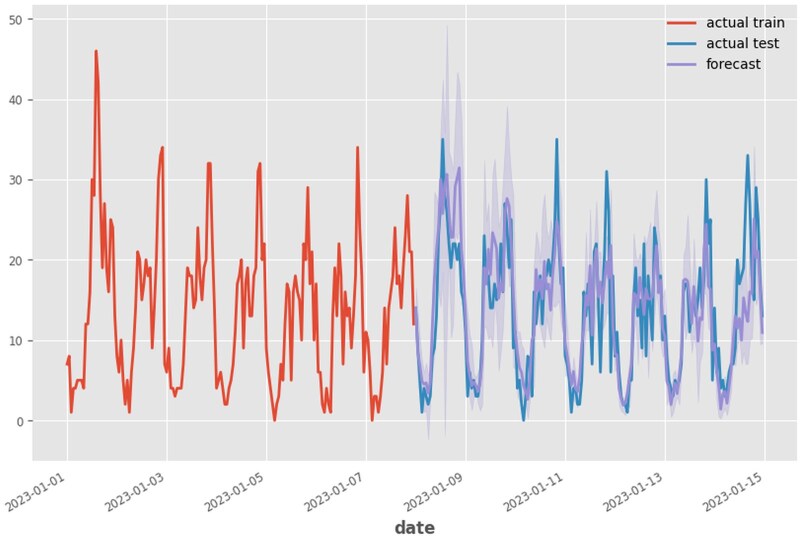
Results: Advanced deep learning models outperformed traditional models, achieving initial R2 scores up to 75%. Throughout the simulation, the median R2 score for all models was 44% after MLOps-based model selection, the median R2 improved to 60%. The MLOps architecture facilitated continuous model updates, enhancing forecast accuracy. Shift optimization adjusted staffing in 69 out of 84 shifts, increasing physician allocation by up to 30.4% during peak hours. This adjustment reduced the patient-to-physician ratio by an average of 4.32 patients during the 8-16 shift and 4.40 patients during the 16-24 shift.
Discussion: The integration of advanced deep learning models with MLOps architecture allowed for continuous model updates, enhancing the accuracy of PED overcrowding forecasts and outperforming traditional methods. The AI-driven system demonstrated resilience against data drift caused by events like the COVID-19 pandemic, adapting to changing conditions. Optimizing physician shifts based on these forecasts improved workforce distribution without increasing staff numbers, reducing patient load per physician during peak hours. However, limitations include the single-center design and a fixed staffing model, indicating the need for multicenter validation and implementation in settings with dynamic staffing practices. Future research should focus on expanding datasets through multicenter collaborations and developing forecasting models that provide longer lead times without compromising accuracy.
Conclusions: The AI-driven forecasting and shift optimization system demonstrated the efficacy of integrating AI and MLOps in predicting PED overcrowding and optimizing physician shifts. This approach outperformed traditional methods, highlighting its potential for managing overcrowding in emergency departments. Future research should focus on multicenter validation and real-world implementation to fully leverage the benefits of this innovative system.





 京公网安备 11010802042870号
京ICP备2023020795号-1
京公网安备 11010802042870号
京ICP备2023020795号-1

 分享
分享
 求助内容:
求助内容: 应助结果提醒方式:
 扫码关注我们
