Niklas von Kalckreuth, Marvin Kopka, Christine Schmid, Cornelia Kratzer, Anna Reptuschenko, Markus A Feufel
{"title":"Trustworthiness of the electronic health record in Germany: an exploratory, user-centered analysis.","authors":"Niklas von Kalckreuth, Marvin Kopka, Christine Schmid, Cornelia Kratzer, Anna Reptuschenko, Markus A Feufel","doi":"10.3389/fdgth.2025.1473326","DOIUrl":null,"url":null,"abstract":"<p><strong>Introduction: </strong>The integration of Electronic Health Records (EHRs) offers significant potential to improve patient care and reduce costs. In Germany, every patient will be provided with an EHR starting January 2025. However, the success of EHRs depends on patient trust and usage. Understanding the factors that shape perceived trustworthiness is crucial, yet EHR-specific research remains limited.</p><p><strong>Methods: </strong>To explore key factors influencing initial trust, 30 German participants interacted with a functionally realistic EHR prototype. Semi-structured interviews were conducted to evaluate its trustworthiness and suggest improvements.</p><p><strong>Results: </strong>Thematic analysis identified five key themes: Provider Reputation, User Feedback, User Experience of Contents, User Experience of Functions, and User Data Control.</p><p><strong>Discussion: </strong>Fostering trust in the German EHR requires attention to technical features and contextual factors. Beyond provider reputation, three aspects emerged as central: (a) professional visual and user experience design to enhance usability and signal reliability; (b) accurate, clear content to foster transparency; and (c) user empowerment through intuitive data control and accessible support. Transparent communication about GDPR compliance further strengthens trust and supports adoption. In Germany's tightly regulated environment, clearly conveying EHR security standards, providing robust support, and leveraging social proof can significantly enhance trust and drive adoption of digital health solutions.</p>","PeriodicalId":73078,"journal":{"name":"Frontiers in digital health","volume":"7 ","pages":"1473326"},"PeriodicalIF":3.2000,"publicationDate":"2025-03-07","publicationTypes":"Journal Article","fieldsOfStudy":null,"isOpenAccess":false,"openAccessPdf":"https://www.ncbi.nlm.nih.gov/pmc/articles/PMC11926143/pdf/","citationCount":"0","resultStr":null,"platform":"Semanticscholar","paperid":null,"PeriodicalName":"Frontiers in digital health","FirstCategoryId":"1085","ListUrlMain":"https://doi.org/10.3389/fdgth.2025.1473326","RegionNum":0,"RegionCategory":null,"ArticlePicture":[],"TitleCN":null,"AbstractTextCN":null,"PMCID":null,"EPubDate":"2025/1/1 0:00:00","PubModel":"eCollection","JCR":"Q1","JCRName":"HEALTH CARE SCIENCES & SERVICES","Score":null,"Total":0}
引用次数: 0
Abstract
Introduction: The integration of Electronic Health Records (EHRs) offers significant potential to improve patient care and reduce costs. In Germany, every patient will be provided with an EHR starting January 2025. However, the success of EHRs depends on patient trust and usage. Understanding the factors that shape perceived trustworthiness is crucial, yet EHR-specific research remains limited.
Methods: To explore key factors influencing initial trust, 30 German participants interacted with a functionally realistic EHR prototype. Semi-structured interviews were conducted to evaluate its trustworthiness and suggest improvements.
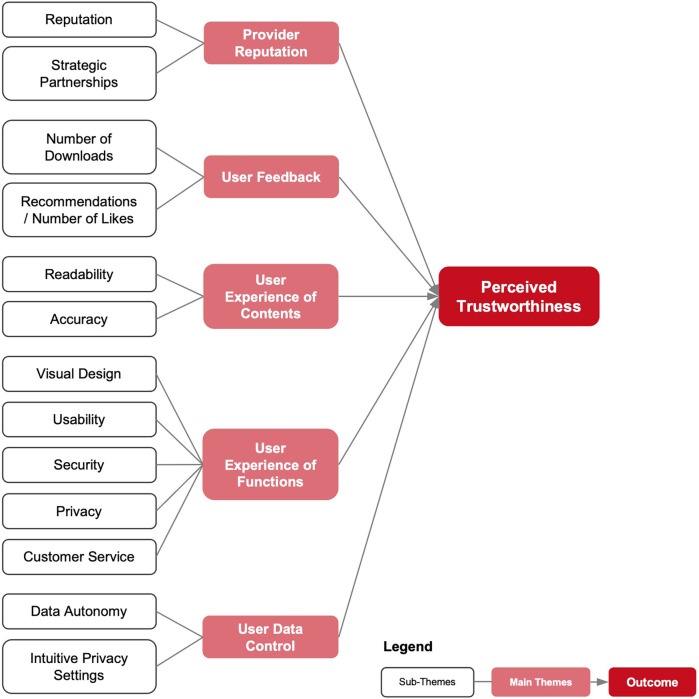
Results: Thematic analysis identified five key themes: Provider Reputation, User Feedback, User Experience of Contents, User Experience of Functions, and User Data Control.
Discussion: Fostering trust in the German EHR requires attention to technical features and contextual factors. Beyond provider reputation, three aspects emerged as central: (a) professional visual and user experience design to enhance usability and signal reliability; (b) accurate, clear content to foster transparency; and (c) user empowerment through intuitive data control and accessible support. Transparent communication about GDPR compliance further strengthens trust and supports adoption. In Germany's tightly regulated environment, clearly conveying EHR security standards, providing robust support, and leveraging social proof can significantly enhance trust and drive adoption of digital health solutions.




 京公网安备 11010802042870号
京ICP备2023020795号-1
京公网安备 11010802042870号
京ICP备2023020795号-1

 分享
分享

 求助内容:
求助内容: 应助结果提醒方式:
 扫码关注我们
