{"title":"Recent trends in National Institutes of Health funding for cerebral palsy lifespan research","authors":"","doi":"10.1111/dmcn.16313","DOIUrl":null,"url":null,"abstract":"<p>The National Institutes of Health (NIH) are the largest funders of health-related research in the United States. Due to advances in research and improvements in clinical care, a large proportion of children with cerebral palsy (CP) can expect to live normal life expectancies, and yet CP is still largely considered a pediatric condition. In the US and globally, there are now more adults living with CP than there are children, and healthcare needs among adults living with CP are poorly understood. Unfortunately, there has been comparatively little research into lifespan issues in the population with CP and, to our knowledge, no specific mandate or plan of the recent NIH funding for these lifespan issues.</p><p>By analyzing a publicly available NIH grant database, our team found a total of 580 NIH-funded grants from 2014 to 2023 specifically related to CP. Of these, only 19 were dedicated to adult or lifespan issues, representing less than 3.3% of the entire CP portfolio grants. The $5.2 million awarded represents 2.3% of the total monetary amount of $226.7 million. The vast majority of funding went toward Causes, Mechanisms, and Risk Factors of CP, as well as towards research for Treatments and Early Interventions. Funding did increase from $18.2 to $26.4 million during the time period from 2014 to 2023.</p>","PeriodicalId":50587,"journal":{"name":"Developmental Medicine and Child Neurology","volume":"67 5","pages":"e102"},"PeriodicalIF":4.3000,"publicationDate":"2025-03-24","publicationTypes":"Journal Article","fieldsOfStudy":null,"isOpenAccess":false,"openAccessPdf":"https://onlinelibrary.wiley.com/doi/epdf/10.1111/dmcn.16313","citationCount":"0","resultStr":null,"platform":"Semanticscholar","paperid":null,"PeriodicalName":"Developmental Medicine and Child Neurology","FirstCategoryId":"3","ListUrlMain":"https://onlinelibrary.wiley.com/doi/10.1111/dmcn.16313","RegionNum":2,"RegionCategory":"医学","ArticlePicture":[],"TitleCN":null,"AbstractTextCN":null,"PMCID":null,"EPubDate":"","PubModel":"","JCR":"Q1","JCRName":"CLINICAL NEUROLOGY","Score":null,"Total":0}
引用次数: 0
Abstract
The National Institutes of Health (NIH) are the largest funders of health-related research in the United States. Due to advances in research and improvements in clinical care, a large proportion of children with cerebral palsy (CP) can expect to live normal life expectancies, and yet CP is still largely considered a pediatric condition. In the US and globally, there are now more adults living with CP than there are children, and healthcare needs among adults living with CP are poorly understood. Unfortunately, there has been comparatively little research into lifespan issues in the population with CP and, to our knowledge, no specific mandate or plan of the recent NIH funding for these lifespan issues.
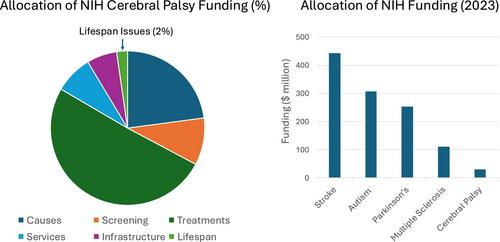
By analyzing a publicly available NIH grant database, our team found a total of 580 NIH-funded grants from 2014 to 2023 specifically related to CP. Of these, only 19 were dedicated to adult or lifespan issues, representing less than 3.3% of the entire CP portfolio grants. The $5.2 million awarded represents 2.3% of the total monetary amount of $226.7 million. The vast majority of funding went toward Causes, Mechanisms, and Risk Factors of CP, as well as towards research for Treatments and Early Interventions. Funding did increase from $18.2 to $26.4 million during the time period from 2014 to 2023.
期刊介绍:
Wiley-Blackwell is pleased to publish Developmental Medicine & Child Neurology (DMCN), a Mac Keith Press publication and official journal of the American Academy for Cerebral Palsy and Developmental Medicine (AACPDM) and the British Paediatric Neurology Association (BPNA).
For over 50 years, DMCN has defined the field of paediatric neurology and neurodisability and is one of the world’s leading journals in the whole field of paediatrics. DMCN disseminates a range of information worldwide to improve the lives of disabled children and their families. The high quality of published articles is maintained by expert review, including independent statistical assessment, before acceptance.



 京公网安备 11010802042870号
京ICP备2023020795号-1
京公网安备 11010802042870号
京ICP备2023020795号-1

 分享
分享
 求助内容:
求助内容: 应助结果提醒方式:
 扫码关注我们
