{"title":"First clinical pregnancy and delivery achieved after using a new 3D imaging technology for sperm selection: a case report.","authors":"Yulia Michailov, Shevach Friedler, Bozhena Saar-Ryss","doi":"10.3389/frph.2025.1559684","DOIUrl":null,"url":null,"abstract":"<p><strong>Objective: </strong>To report a case of a patient who, after experiencing recurrent failed implantations, underwent a novel technological intervention-using the Q300 device-which successfully led to a pregnancy and delivery of a healthy baby.</p><p><strong>Design: </strong>Case report.</p><p><strong>Setting: </strong>Barzilai University Medical Center.</p><p><strong>Patient s: </strong>A 33-year-old woman with primary infertility experienced recurrent implantation failure (RIF), while her 32-year-old male partner was diagnosed with severe oligo-astheno-teratozoospermia (OTA) syndrome.</p><p><strong>Intervention: </strong>Using Q300 device for selection of the morphologically compliant sperm cells for intracytoplasmic sperm injection (ICSI).</p><p><strong>Main outcome measures: </strong>Successful pregnancy and delivery.</p><p><strong>Results: </strong>A unique case of clinical pregnancy and delivery involving a couple facing RIF and severe OTA. In this case, a new technology for sperm selection was used. The semen sample was examined using the Q300 device to choose WHO2021-morphologically compliant sperm cells for micro-injection. The resulting embryos were developed and then frozen. Later, a frozen-thawed embryo transfer was performed during the following natural menstrual cycle, leading to successful pregnancy and delivery.</p><p><strong>Conclusion: </strong>The utilization of this new 3D imaging technology underscores the evolving landscape of reproductive medicine and the potential it holds for transforming outcomes in challenging cases. By documenting such cases, we contribute to the ongoing dialogue to refine assisted reproductive technology (ART) protocols and improve reproductive outcomes for individuals facing similar challenges.</p><p><strong>Trial registration: </strong>NCT06232720 https://clinicaltrials.gov/study/NCT06232720. Date of registration: 15 Feb 2023. Date of enrollment of the first subject: 20 August 2023.</p>","PeriodicalId":73103,"journal":{"name":"Frontiers in reproductive health","volume":"7 ","pages":"1559684"},"PeriodicalIF":2.9000,"publicationDate":"2025-03-07","publicationTypes":"Journal Article","fieldsOfStudy":null,"isOpenAccess":false,"openAccessPdf":"https://www.ncbi.nlm.nih.gov/pmc/articles/PMC11925932/pdf/","citationCount":"0","resultStr":null,"platform":"Semanticscholar","paperid":null,"PeriodicalName":"Frontiers in reproductive health","FirstCategoryId":"1085","ListUrlMain":"https://doi.org/10.3389/frph.2025.1559684","RegionNum":0,"RegionCategory":null,"ArticlePicture":[],"TitleCN":null,"AbstractTextCN":null,"PMCID":null,"EPubDate":"2025/1/1 0:00:00","PubModel":"eCollection","JCR":"Q2","JCRName":"PUBLIC, ENVIRONMENTAL & OCCUPATIONAL HEALTH","Score":null,"Total":0}
引用次数: 0
Abstract
Objective: To report a case of a patient who, after experiencing recurrent failed implantations, underwent a novel technological intervention-using the Q300 device-which successfully led to a pregnancy and delivery of a healthy baby.
Design: Case report.
Setting: Barzilai University Medical Center.
Patient s: A 33-year-old woman with primary infertility experienced recurrent implantation failure (RIF), while her 32-year-old male partner was diagnosed with severe oligo-astheno-teratozoospermia (OTA) syndrome.
Intervention: Using Q300 device for selection of the morphologically compliant sperm cells for intracytoplasmic sperm injection (ICSI).
Main outcome measures: Successful pregnancy and delivery.
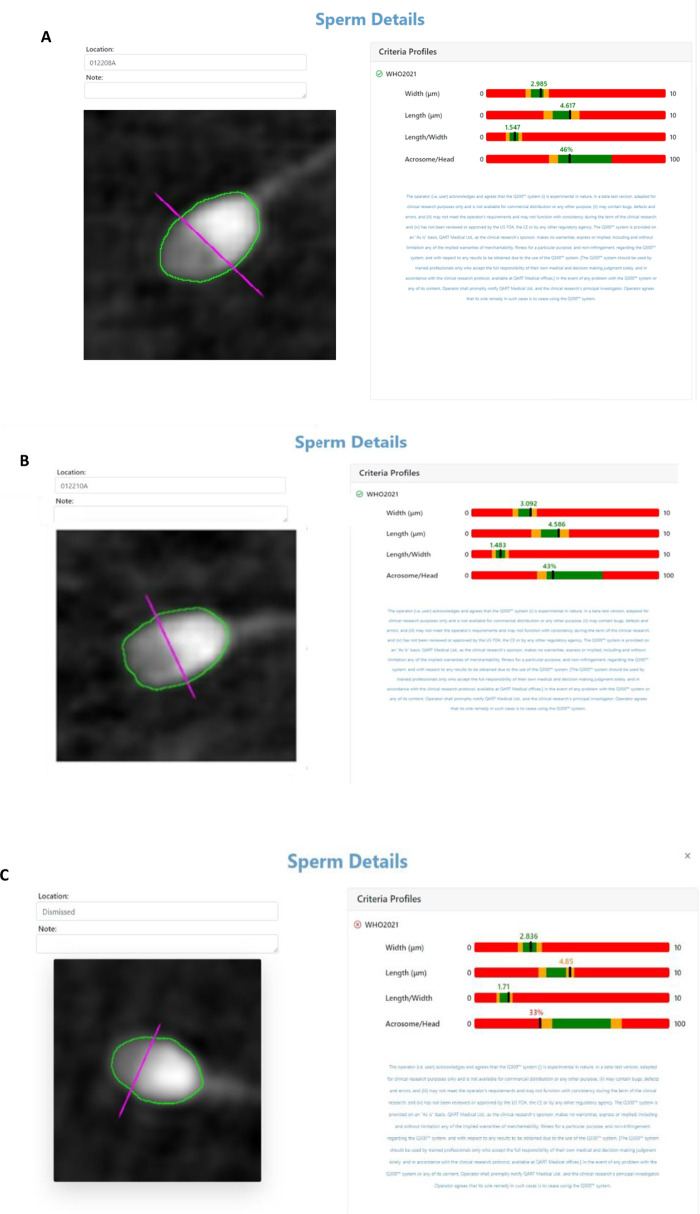
Results: A unique case of clinical pregnancy and delivery involving a couple facing RIF and severe OTA. In this case, a new technology for sperm selection was used. The semen sample was examined using the Q300 device to choose WHO2021-morphologically compliant sperm cells for micro-injection. The resulting embryos were developed and then frozen. Later, a frozen-thawed embryo transfer was performed during the following natural menstrual cycle, leading to successful pregnancy and delivery.
Conclusion: The utilization of this new 3D imaging technology underscores the evolving landscape of reproductive medicine and the potential it holds for transforming outcomes in challenging cases. By documenting such cases, we contribute to the ongoing dialogue to refine assisted reproductive technology (ART) protocols and improve reproductive outcomes for individuals facing similar challenges.
Trial registration: NCT06232720 https://clinicaltrials.gov/study/NCT06232720. Date of registration: 15 Feb 2023. Date of enrollment of the first subject: 20 August 2023.





 京公网安备 11010802042870号
京ICP备2023020795号-1
京公网安备 11010802042870号
京ICP备2023020795号-1

 分享
分享

 求助内容:
求助内容: 应助结果提醒方式:
 扫码关注我们
