Norbert Gleicher, Sonia Gayete-Lafuente, David H Barad, Pasquale Patrizio, David F Albertini
{"title":"Why the hypothesis of embryo selection in IVF/ICSI must finally be reconsidered.","authors":"Norbert Gleicher, Sonia Gayete-Lafuente, David H Barad, Pasquale Patrizio, David F Albertini","doi":"10.1093/hropen/hoaf011","DOIUrl":null,"url":null,"abstract":"<p><p>Embryo selection (ES) during IVF is expected to select the 'best' embryo(s) from among a cycle's embryo cohort and has been a core concept of IVF for over 40 years. However, among 36 492 articles on ES in a recent PubMed search, we were unable to locate even a single one questioning the concept that, beyond standard oocyte and embryo morphology, ES has remained an unproven hypothesis. In unselected patient populations, attempts at ES have universally, indeed, failed to improve cumulative pregnancy and live birth rates. The only benefit ES appears to offer is a marginal shortening in time to pregnancy, and even this benefit manifests only in best-prognosis patients with large oocyte and embryo numbers. Excluding <i>in vitro</i> maturation efforts, oocytes, once retrieved, and their resulting embryos have predetermined finite cumulative pregnancy and live birth chances that cannot be further improved. The hypothesis of ES has, however, remained a driving force for research and the introduction of a multitude of 'add-ons' to IVF. Enormous investments over decades in ES, therefore, should be better redirected from post- to pre-retrieval efforts.</p>","PeriodicalId":73264,"journal":{"name":"Human reproduction open","volume":"2025 2","pages":"hoaf011"},"PeriodicalIF":11.1000,"publicationDate":"2025-03-20","publicationTypes":"Journal Article","fieldsOfStudy":null,"isOpenAccess":false,"openAccessPdf":"https://www.ncbi.nlm.nih.gov/pmc/articles/PMC11928228/pdf/","citationCount":"0","resultStr":null,"platform":"Semanticscholar","paperid":null,"PeriodicalName":"Human reproduction open","FirstCategoryId":"1085","ListUrlMain":"https://doi.org/10.1093/hropen/hoaf011","RegionNum":0,"RegionCategory":null,"ArticlePicture":[],"TitleCN":null,"AbstractTextCN":null,"PMCID":null,"EPubDate":"2025/1/1 0:00:00","PubModel":"eCollection","JCR":"Q1","JCRName":"OBSTETRICS & GYNECOLOGY","Score":null,"Total":0}
引用次数: 0
Abstract
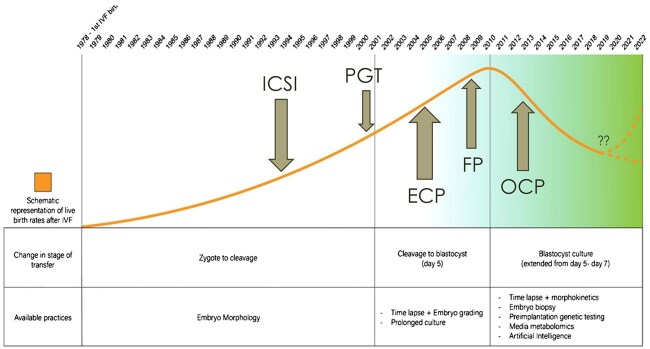
Embryo selection (ES) during IVF is expected to select the 'best' embryo(s) from among a cycle's embryo cohort and has been a core concept of IVF for over 40 years. However, among 36 492 articles on ES in a recent PubMed search, we were unable to locate even a single one questioning the concept that, beyond standard oocyte and embryo morphology, ES has remained an unproven hypothesis. In unselected patient populations, attempts at ES have universally, indeed, failed to improve cumulative pregnancy and live birth rates. The only benefit ES appears to offer is a marginal shortening in time to pregnancy, and even this benefit manifests only in best-prognosis patients with large oocyte and embryo numbers. Excluding in vitro maturation efforts, oocytes, once retrieved, and their resulting embryos have predetermined finite cumulative pregnancy and live birth chances that cannot be further improved. The hypothesis of ES has, however, remained a driving force for research and the introduction of a multitude of 'add-ons' to IVF. Enormous investments over decades in ES, therefore, should be better redirected from post- to pre-retrieval efforts.



 京公网安备 11010802042870号
京ICP备2023020795号-1
京公网安备 11010802042870号
京ICP备2023020795号-1

 分享
分享

 求助内容:
求助内容: 应助结果提醒方式:
 扫码关注我们
