{"title":"A shadow in the treatment of acute leukemia: lineage switch.","authors":"Qiaoyi Zhou, Ying Wang","doi":"10.1097/BS9.0000000000000220","DOIUrl":null,"url":null,"abstract":"<p><p>Lineage switch is a rare phenomenon in which acute myeloid leukemia (AML) transforms into acute lymphoblastic leukemia (ALL) and vice versa, sharing the same clonal origin. It is more common for AML to relapse as ALL. Cytogenetics, microenvironment, and preceding therapies are associated with lineage switch. Since the etiology of lineage switch is unclear, presumptions include clonal selection, pluripotent stem cells, and differentiated cell trans-differentiation or re-differentiation. The key point for diagnosing lineage switch is that the relapsed tumor originates from the common cell of the primary leukemia, although it is occasionally derived via clonal evolution. It is very important to distinguish lineage switch from other illnesses, such as secondary leukemia or the blast phase of chronic leukemia. Although direct treatment of the present lineage results in an improved prognosis, the outcome of these patients remains poor, with low survival and rapid progression. Hematopoietic stem cell transplantation can extend survival. Lineage switch risk-adapted management stratification may be beneficial for detecting relapse and more promptly provide suitable therapy. Efficient and toxicity-restricted therapy is being developed to improve the very poor prognosis.</p>","PeriodicalId":67343,"journal":{"name":"血液科学(英文)","volume":"7 2","pages":"e00220"},"PeriodicalIF":2.7000,"publicationDate":"2025-03-20","publicationTypes":"Journal Article","fieldsOfStudy":null,"isOpenAccess":false,"openAccessPdf":"https://www.ncbi.nlm.nih.gov/pmc/articles/PMC11927657/pdf/","citationCount":"0","resultStr":null,"platform":"Semanticscholar","paperid":null,"PeriodicalName":"血液科学(英文)","FirstCategoryId":"3","ListUrlMain":"https://doi.org/10.1097/BS9.0000000000000220","RegionNum":0,"RegionCategory":null,"ArticlePicture":[],"TitleCN":null,"AbstractTextCN":null,"PMCID":null,"EPubDate":"2025/6/1 0:00:00","PubModel":"eCollection","JCR":"Q3","JCRName":"HEMATOLOGY","Score":null,"Total":0}
引用次数: 0
Abstract
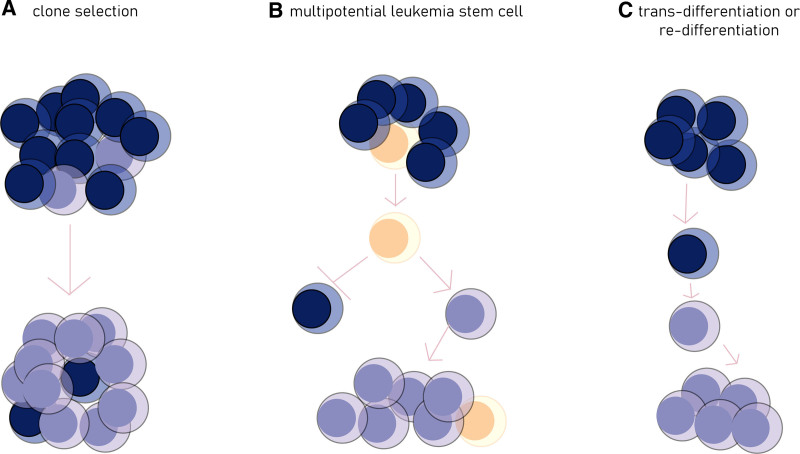
Lineage switch is a rare phenomenon in which acute myeloid leukemia (AML) transforms into acute lymphoblastic leukemia (ALL) and vice versa, sharing the same clonal origin. It is more common for AML to relapse as ALL. Cytogenetics, microenvironment, and preceding therapies are associated with lineage switch. Since the etiology of lineage switch is unclear, presumptions include clonal selection, pluripotent stem cells, and differentiated cell trans-differentiation or re-differentiation. The key point for diagnosing lineage switch is that the relapsed tumor originates from the common cell of the primary leukemia, although it is occasionally derived via clonal evolution. It is very important to distinguish lineage switch from other illnesses, such as secondary leukemia or the blast phase of chronic leukemia. Although direct treatment of the present lineage results in an improved prognosis, the outcome of these patients remains poor, with low survival and rapid progression. Hematopoietic stem cell transplantation can extend survival. Lineage switch risk-adapted management stratification may be beneficial for detecting relapse and more promptly provide suitable therapy. Efficient and toxicity-restricted therapy is being developed to improve the very poor prognosis.




 京公网安备 11010802042870号
京ICP备2023020795号-1
京公网安备 11010802042870号
京ICP备2023020795号-1

 分享
分享

 求助内容:
求助内容: 应助结果提醒方式:
 扫码关注我们
