Christian Beger, Dominik Rüegger, Anna Lenz, Steffen Wagner, Kai Martin Schmidt-Ott, Dirk Volland, Florian P Limbourg
{"title":"Effect of a digital blood pressure coach on hypertension management in primary care practices-a pragmatic, randomised controlled trial.","authors":"Christian Beger, Dominik Rüegger, Anna Lenz, Steffen Wagner, Kai Martin Schmidt-Ott, Dirk Volland, Florian P Limbourg","doi":"10.3389/fdgth.2025.1516600","DOIUrl":null,"url":null,"abstract":"<p><strong>Importance: </strong>Smartphone medical applications (apps) may improve blood pressure (BP) control in the primary care setting in patients with hypertension. However, real-world evidence from primary care is largely lacking.</p><p><strong>Objective: </strong>To analyse, in primary care practices in Germany, the effect of a smartphone app on systolic BP compared to standard of care.</p><p><strong>Design: </strong>A pragmatic, non-blinded randomized controlled trial with patients with a diagnosis of hypertension was conducted across 23 general practices in Germany, with a follow-up period of 3 months. Recruitment occurred from January 2022 to May 2023.</p><p><strong>Intervention: </strong>The intervention group received access to the Manoa app, a smartphone coach integrating guideline-compliant home BP monitoring and lifestyle-coaching. All study participants received standard treatment for arterial hypertension at the discretion of the treating physician.</p><p><strong>Main outcomes: </strong>The primary outcome was office systolic BP (oSBP) after 90-150 days in participants with uncontrolled hypertension (oSBP ≥140 mmHg). Secondary outcomes included changes in systolic and diastolic BP, BP control and adherence to home blood pressure monitoring.</p><p><strong>Results: </strong>A total of 606 participants from 23 general practices were randomized, after data clearance and review, 249 participants were assigned to the control group and 259 to the intervention group for analysis. The mean age (SD) of participants in the intervention group was 55.9 (12.9) years. At baseline, participants with uncontrolled hypertension had a mean oSBP (SD) of 152.6 (14.2) mmHg in the intervention group (<i>n</i> = 162) and 152.6 (14.1) mmHg in the control group (<i>n</i> = 147). After 120 ± 14 days, oSBP decreased to 137.4 (14.4) mmHg in the intervention group and to 137.7 (14.5) mmHg in the control group, with a between-group mean difference of -0.2 mmHg [95% CI (-3.9,3.5); <i>P</i> =.9]. At the follow-up appointment, 69.1% of participants in the intervention group submitted a BP-diary, compared to 36.1% in the control group [OR = 3.95; 95% CI (2.73,5.72); <i>P</i> = <0.001].</p><p><strong>Conclusions and relevance: </strong>Participants with uncontrolled hypertension randomized to an app in primary care achieved similar decreases in systolic BP but higher adherence to home BP monitoring compared to standard care. In this open-label, pragmatic trial, variability in hypertension management strategies and limited standardization across practices may have confounded the precise evaluation of digital intervention benefits.</p><p><strong>Clinical trial registration: </strong>ClinicalTrials.gov, identifier, (DRKS00027964).</p>","PeriodicalId":73078,"journal":{"name":"Frontiers in digital health","volume":"7 ","pages":"1516600"},"PeriodicalIF":3.2000,"publicationDate":"2025-03-07","publicationTypes":"Journal Article","fieldsOfStudy":null,"isOpenAccess":false,"openAccessPdf":"https://www.ncbi.nlm.nih.gov/pmc/articles/PMC11925922/pdf/","citationCount":"0","resultStr":null,"platform":"Semanticscholar","paperid":null,"PeriodicalName":"Frontiers in digital health","FirstCategoryId":"1085","ListUrlMain":"https://doi.org/10.3389/fdgth.2025.1516600","RegionNum":0,"RegionCategory":null,"ArticlePicture":[],"TitleCN":null,"AbstractTextCN":null,"PMCID":null,"EPubDate":"2025/1/1 0:00:00","PubModel":"eCollection","JCR":"Q1","JCRName":"HEALTH CARE SCIENCES & SERVICES","Score":null,"Total":0}
引用次数: 0
Abstract
Importance: Smartphone medical applications (apps) may improve blood pressure (BP) control in the primary care setting in patients with hypertension. However, real-world evidence from primary care is largely lacking.
Objective: To analyse, in primary care practices in Germany, the effect of a smartphone app on systolic BP compared to standard of care.
Design: A pragmatic, non-blinded randomized controlled trial with patients with a diagnosis of hypertension was conducted across 23 general practices in Germany, with a follow-up period of 3 months. Recruitment occurred from January 2022 to May 2023.
Intervention: The intervention group received access to the Manoa app, a smartphone coach integrating guideline-compliant home BP monitoring and lifestyle-coaching. All study participants received standard treatment for arterial hypertension at the discretion of the treating physician.
Main outcomes: The primary outcome was office systolic BP (oSBP) after 90-150 days in participants with uncontrolled hypertension (oSBP ≥140 mmHg). Secondary outcomes included changes in systolic and diastolic BP, BP control and adherence to home blood pressure monitoring.
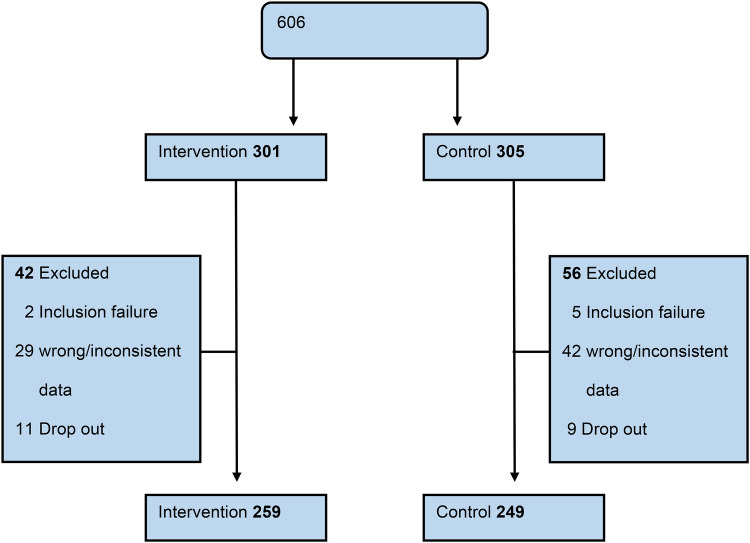
Results: A total of 606 participants from 23 general practices were randomized, after data clearance and review, 249 participants were assigned to the control group and 259 to the intervention group for analysis. The mean age (SD) of participants in the intervention group was 55.9 (12.9) years. At baseline, participants with uncontrolled hypertension had a mean oSBP (SD) of 152.6 (14.2) mmHg in the intervention group (n = 162) and 152.6 (14.1) mmHg in the control group (n = 147). After 120 ± 14 days, oSBP decreased to 137.4 (14.4) mmHg in the intervention group and to 137.7 (14.5) mmHg in the control group, with a between-group mean difference of -0.2 mmHg [95% CI (-3.9,3.5); P =.9]. At the follow-up appointment, 69.1% of participants in the intervention group submitted a BP-diary, compared to 36.1% in the control group [OR = 3.95; 95% CI (2.73,5.72); P = <0.001].
Conclusions and relevance: Participants with uncontrolled hypertension randomized to an app in primary care achieved similar decreases in systolic BP but higher adherence to home BP monitoring compared to standard care. In this open-label, pragmatic trial, variability in hypertension management strategies and limited standardization across practices may have confounded the precise evaluation of digital intervention benefits.



 京公网安备 11010802042870号
京ICP备2023020795号-1
京公网安备 11010802042870号
京ICP备2023020795号-1

 分享
分享

 求助内容:
求助内容: 应助结果提醒方式:
 扫码关注我们
