Xichao Chen, Honglei Zhang, Dongyang Liu, Jingxuan Ma, Lijie Jin, Yuqing Ma, Jing Li, Gengshen Song and Juxian Wang
{"title":"Injection site-retained lipid nanoparticles for targeted intramuscular delivery of mRNA RSV prefusion-F vaccine†","authors":"Xichao Chen, Honglei Zhang, Dongyang Liu, Jingxuan Ma, Lijie Jin, Yuqing Ma, Jing Li, Gengshen Song and Juxian Wang","doi":"10.1039/D5TB00117J","DOIUrl":null,"url":null,"abstract":"<p >mRNA therapeutics, particularly mRNA vaccines, hold significant promise for a wide range of medical applications. Lipid nanoparticles (LNPs) are the most clinically advanced delivery vehicles for mRNA, but issues such as off-target effects and liver accumulation hinder their broader clinical adoption. In this study, we designed and synthesized a library of 26 novel ionizable lipids to screen for better delivery efficiency and tissue specificity. After formulating into LNPs, these ionizable lipids exhibited favorable physicochemical properties. <em>In vitro</em> transfection and cytotoxicity assays revealed that LNPs formulated with YK-201, YK-202, and YK-209 showed superior transfection efficiency and low cytotoxicity. In a mouse model, intramuscular injection of Fluc mRNA-LNPs resulted in sustained and localized protein expression at the injection site. When applied to prepare RSV preF-mRNA vaccines, these novel LNPs elicited robust humoral immune responses and reduced lung damage, outperforming the clinically used SM-102. The safety of the LNP formulations was subsequently demonstrated in a mouse model. Collectively, these findings highlight the potential of these novel ionizable lipids as effective injection site-retained mRNA vaccine delivery vehicles.</p>","PeriodicalId":83,"journal":{"name":"Journal of Materials Chemistry B","volume":" 18","pages":" 5290-5296"},"PeriodicalIF":6.1000,"publicationDate":"2025-03-13","publicationTypes":"Journal Article","fieldsOfStudy":null,"isOpenAccess":false,"openAccessPdf":"","citationCount":"0","resultStr":null,"platform":"Semanticscholar","paperid":null,"PeriodicalName":"Journal of Materials Chemistry B","FirstCategoryId":"1","ListUrlMain":"https://pubs.rsc.org/en/content/articlelanding/2025/tb/d5tb00117j","RegionNum":3,"RegionCategory":"医学","ArticlePicture":[],"TitleCN":null,"AbstractTextCN":null,"PMCID":null,"EPubDate":"","PubModel":"","JCR":"Q1","JCRName":"MATERIALS SCIENCE, BIOMATERIALS","Score":null,"Total":0}
引用次数: 0
Abstract
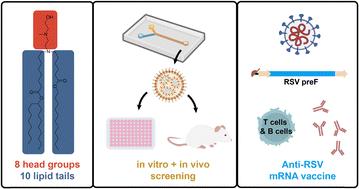
mRNA therapeutics, particularly mRNA vaccines, hold significant promise for a wide range of medical applications. Lipid nanoparticles (LNPs) are the most clinically advanced delivery vehicles for mRNA, but issues such as off-target effects and liver accumulation hinder their broader clinical adoption. In this study, we designed and synthesized a library of 26 novel ionizable lipids to screen for better delivery efficiency and tissue specificity. After formulating into LNPs, these ionizable lipids exhibited favorable physicochemical properties. In vitro transfection and cytotoxicity assays revealed that LNPs formulated with YK-201, YK-202, and YK-209 showed superior transfection efficiency and low cytotoxicity. In a mouse model, intramuscular injection of Fluc mRNA-LNPs resulted in sustained and localized protein expression at the injection site. When applied to prepare RSV preF-mRNA vaccines, these novel LNPs elicited robust humoral immune responses and reduced lung damage, outperforming the clinically used SM-102. The safety of the LNP formulations was subsequently demonstrated in a mouse model. Collectively, these findings highlight the potential of these novel ionizable lipids as effective injection site-retained mRNA vaccine delivery vehicles.
期刊介绍:
Journal of Materials Chemistry A, B & C cover high quality studies across all fields of materials chemistry. The journals focus on those theoretical or experimental studies that report new understanding, applications, properties and synthesis of materials. Journal of Materials Chemistry A, B & C are separated by the intended application of the material studied. Broadly, applications in energy and sustainability are of interest to Journal of Materials Chemistry A, applications in biology and medicine are of interest to Journal of Materials Chemistry B, and applications in optical, magnetic and electronic devices are of interest to Journal of Materials Chemistry C.Journal of Materials Chemistry B is a Transformative Journal and Plan S compliant. Example topic areas within the scope of Journal of Materials Chemistry B are listed below. This list is neither exhaustive nor exclusive:
Antifouling coatings
Biocompatible materials
Bioelectronics
Bioimaging
Biomimetics
Biomineralisation
Bionics
Biosensors
Diagnostics
Drug delivery
Gene delivery
Immunobiology
Nanomedicine
Regenerative medicine & Tissue engineering
Scaffolds
Soft robotics
Stem cells
Therapeutic devices



 京公网安备 11010802042870号
京ICP备2023020795号-1
京公网安备 11010802042870号
京ICP备2023020795号-1

 分享
分享
 求助内容:
求助内容: 应助结果提醒方式:
 扫码关注我们
