{"title":"Excellent hardening effect in lead-free piezoceramics by embedding local Cu-doped defect dipoles in phase boundary engineering","authors":"Xinyue Qiu, Chao Wu, Daniel Q. Tan, Ruihong Liang, Chen Liu, Yinchang Ma, Xi-xiang Zhang, Shiyang Wei, Junwei Zhang, Zhi Tan, Zhipeng Wang, Xiang Lv, Jiagang Wu","doi":"10.1038/s41467-025-58269-5","DOIUrl":null,"url":null,"abstract":"<p>Piezoceramics for high-power applications require both high piezoelectric coefficient (<i>d</i><sub>33</sub>) and mechanical quality factor (<i>Q</i><sub>m</sub>). However, the trade-off between them poses a significant challenge in achieving high values simultaneously, which is more prominent in lead-free piezoceramics. Here, we propose a new strategy, local Cu-acceptor defect dipoles embedded orthorhombic-tetragonal phase boundary engineering (O-T PBE), to balance <i>d</i><sub>33</sub> and <i>Q</i><sub>m</sub> in potassium sodium niobate piezoceramics. This is validated in 0.95(K<sub>0.48</sub>Na<sub>0.52</sub>)NbO<sub>3</sub>-0.05(Bi<sub>0.5</sub>Na<sub>0.5</sub>)HfO<sub>3</sub>-0.2%molFe<sub>2</sub>O<sub>3</sub>-<i>x</i>mol%CuO ceramics. Our strategy simultaneously maintains the O-T PBE and introduces local dimeric <span>\\({({{Cu}}_{{Nb}}^{{\\prime} {\\prime} {\\prime} }-{V}_{O}^{\\bullet \\bullet })}^{{\\prime} }\\)</span> and trimeric <span>\\({\\left({V}_{O}^{\\bullet \\bullet }-{{Cu}}_{{Nb}}^{{\\prime} {\\prime} {\\prime} }-{V}_{O}^{\\bullet \\bullet }\\right)}^{\\bullet }\\)</span> defects. The dimeric defects form defect dipole polarization that pins domain wall motion, while the trimeric ones introduce the local structural heterogeneity that leads to nano-scale multi-phase coexistence and abundant nano-domains. Encouragingly, for the Cu-doped sample with <i>x</i> = 1, <i>Q</i><sub>m</sub> increases by a factor of 4, but <i>d</i><sub>33</sub> only decreases by 1/5 (i.e., achieving a <i>d</i><sub>33</sub> of 340 pC/N and a <i>Q</i><sub>m</sub> of 256). Our research provides a new paradigm for balancing <i>d</i><sub>33</sub> and <i>Q</i><sub>m</sub> in lead-free piezoceramics, which holds promise for high-power applications.</p>","PeriodicalId":19066,"journal":{"name":"Nature Communications","volume":"33 1","pages":""},"PeriodicalIF":15.7000,"publicationDate":"2025-03-25","publicationTypes":"Journal Article","fieldsOfStudy":null,"isOpenAccess":false,"openAccessPdf":"","citationCount":"0","resultStr":null,"platform":"Semanticscholar","paperid":null,"PeriodicalName":"Nature Communications","FirstCategoryId":"103","ListUrlMain":"https://doi.org/10.1038/s41467-025-58269-5","RegionNum":1,"RegionCategory":"综合性期刊","ArticlePicture":[],"TitleCN":null,"AbstractTextCN":null,"PMCID":null,"EPubDate":"","PubModel":"","JCR":"Q1","JCRName":"MULTIDISCIPLINARY SCIENCES","Score":null,"Total":0}
引用次数: 0
Abstract
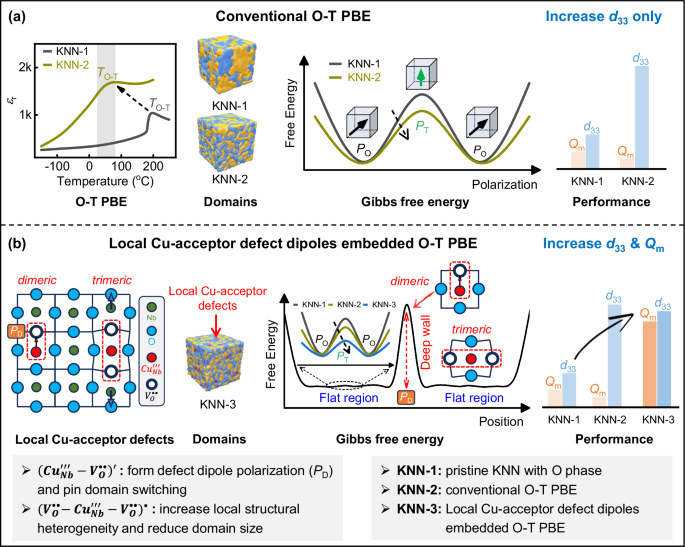
Piezoceramics for high-power applications require both high piezoelectric coefficient (d33) and mechanical quality factor (Qm). However, the trade-off between them poses a significant challenge in achieving high values simultaneously, which is more prominent in lead-free piezoceramics. Here, we propose a new strategy, local Cu-acceptor defect dipoles embedded orthorhombic-tetragonal phase boundary engineering (O-T PBE), to balance d33 and Qm in potassium sodium niobate piezoceramics. This is validated in 0.95(K0.48Na0.52)NbO3-0.05(Bi0.5Na0.5)HfO3-0.2%molFe2O3-xmol%CuO ceramics. Our strategy simultaneously maintains the O-T PBE and introduces local dimeric \({({{Cu}}_{{Nb}}^{{\prime} {\prime} {\prime} }-{V}_{O}^{\bullet \bullet })}^{{\prime} }\) and trimeric \({\left({V}_{O}^{\bullet \bullet }-{{Cu}}_{{Nb}}^{{\prime} {\prime} {\prime} }-{V}_{O}^{\bullet \bullet }\right)}^{\bullet }\) defects. The dimeric defects form defect dipole polarization that pins domain wall motion, while the trimeric ones introduce the local structural heterogeneity that leads to nano-scale multi-phase coexistence and abundant nano-domains. Encouragingly, for the Cu-doped sample with x = 1, Qm increases by a factor of 4, but d33 only decreases by 1/5 (i.e., achieving a d33 of 340 pC/N and a Qm of 256). Our research provides a new paradigm for balancing d33 and Qm in lead-free piezoceramics, which holds promise for high-power applications.
用于大功率应用的压电陶瓷需要高压电系数(d33)和机械质量因子(Qm)。然而,它们之间的权衡对同时实现高值提出了重大挑战,这在无铅压电陶瓷中更为突出。在此,我们提出了一种新的策略,局部铜受体缺陷偶极子嵌入正交四方相边界工程(O-T PBE),以平衡d33和Qm在铌酸钾钠压电陶瓷。这在0.95(K0.48Na0.52)NbO3-0.05(Bi0.5Na0.5)HfO3-0.2中得到了验证%molFe2O3-xmol%CuO ceramics. Our strategy simultaneously maintains the O-T PBE and introduces local dimeric \({({{Cu}}_{{Nb}}^{{\prime} {\prime} {\prime} }-{V}_{O}^{\bullet \bullet })}^{{\prime} }\) and trimeric \({\left({V}_{O}^{\bullet \bullet }-{{Cu}}_{{Nb}}^{{\prime} {\prime} {\prime} }-{V}_{O}^{\bullet \bullet }\right)}^{\bullet }\) defects. The dimeric defects form defect dipole polarization that pins domain wall motion, while the trimeric ones introduce the local structural heterogeneity that leads to nano-scale multi-phase coexistence and abundant nano-domains. Encouragingly, for the Cu-doped sample with x = 1, Qm increases by a factor of 4, but d33 only decreases by 1/5 (i.e., achieving a d33 of 340 pC/N and a Qm of 256). Our research provides a new paradigm for balancing d33 and Qm in lead-free piezoceramics, which holds promise for high-power applications.
期刊介绍:
Nature Communications, an open-access journal, publishes high-quality research spanning all areas of the natural sciences. Papers featured in the journal showcase significant advances relevant to specialists in each respective field. With a 2-year impact factor of 16.6 (2022) and a median time of 8 days from submission to the first editorial decision, Nature Communications is committed to rapid dissemination of research findings. As a multidisciplinary journal, it welcomes contributions from biological, health, physical, chemical, Earth, social, mathematical, applied, and engineering sciences, aiming to highlight important breakthroughs within each domain.



 京公网安备 11010802042870号
京ICP备2023020795号-1
京公网安备 11010802042870号
京ICP备2023020795号-1

 分享
分享
 求助内容:
求助内容: 应助结果提醒方式:
 扫码关注我们
