{"title":"Polymer–metal nanocomposites with bi- or tri-metallic compositions exhibiting catalytic properties†","authors":"Nicholas Kai Shiang Teo , Yi Huang , San H. Thang","doi":"10.1039/d5py00113g","DOIUrl":null,"url":null,"abstract":"<div><div>The use of hybrid materials such as polymer–metal nanocomposites (PMNCs) in heterogeneous catalysis has rapidly gained attention in recent years due to their enhanced catalytic performance and significantly different physicochemical properties compared to their larger counterparts. Traditional techniques for preparing PMNCs involve the use of capping/stabilising agents that wrap around metal nanoparticles (MNPs), forming a barrier that limits active site availability and reduces catalytic efficiency. This paper presents an approach for preparing gold (Au), palladium (Pd) and silver (Ag)-based PMNCs <em>in situ via</em> ultrasonic treatment with unobstructed MNPs attached to amine functionalities located on the surface of polymeric chains synthesised from reversible addition–fragmentation chain-transfer (RAFT) polymerisation-induced self-assembly (RAFT-PISA). High resolution transmission electron microscopy (HR-TEM) imaging and energy-dispersive X-ray (EDX) mapping confirmed the successful preparation of these PMNCs. The catalytic performances of these PMNCs are evaluated against well-known organic reactions such as the aerobic oxidation of 1-phenylethanol and the Suzuki–Miyaura cross-coupling reaction between 4-iodophenol and phenylboronic acid, where the performance of the bimetallic Au–Pd PMNC and the bimetallic Ag–Au PMNC reached as high as 94% and 98.5% for each respective reaction at a concentration of 0.02 mol%. Additionally, the catalytic performance of the trimetallic Ag–Au–Pd PMNC was discovered to be 39.8% and 96.0%, respectively, for both reactions at the same concentration. This work aims to expand the knowledge of PMNCs and promote their utility as advanced heterogeneous catalysts in organic reactions.</div></div>","PeriodicalId":100,"journal":{"name":"Polymer Chemistry","volume":"16 17","pages":"Pages 1969-1980"},"PeriodicalIF":3.9000,"publicationDate":"2025-03-19","publicationTypes":"Journal Article","fieldsOfStudy":null,"isOpenAccess":false,"openAccessPdf":"","citationCount":"0","resultStr":null,"platform":"Semanticscholar","paperid":null,"PeriodicalName":"Polymer Chemistry","FirstCategoryId":"92","ListUrlMain":"https://www.sciencedirect.com/org/science/article/pii/S1759995425001172","RegionNum":2,"RegionCategory":"化学","ArticlePicture":[],"TitleCN":null,"AbstractTextCN":null,"PMCID":null,"EPubDate":"2025/3/25 0:00:00","PubModel":"Epub","JCR":"Q2","JCRName":"POLYMER SCIENCE","Score":null,"Total":0}
引用次数: 0
Abstract
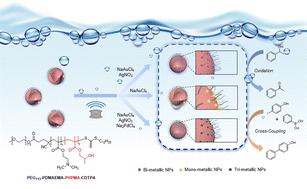
The use of hybrid materials such as polymer–metal nanocomposites (PMNCs) in heterogeneous catalysis has rapidly gained attention in recent years due to their enhanced catalytic performance and significantly different physicochemical properties compared to their larger counterparts. Traditional techniques for preparing PMNCs involve the use of capping/stabilising agents that wrap around metal nanoparticles (MNPs), forming a barrier that limits active site availability and reduces catalytic efficiency. This paper presents an approach for preparing gold (Au), palladium (Pd) and silver (Ag)-based PMNCs in situ via ultrasonic treatment with unobstructed MNPs attached to amine functionalities located on the surface of polymeric chains synthesised from reversible addition–fragmentation chain-transfer (RAFT) polymerisation-induced self-assembly (RAFT-PISA). High resolution transmission electron microscopy (HR-TEM) imaging and energy-dispersive X-ray (EDX) mapping confirmed the successful preparation of these PMNCs. The catalytic performances of these PMNCs are evaluated against well-known organic reactions such as the aerobic oxidation of 1-phenylethanol and the Suzuki–Miyaura cross-coupling reaction between 4-iodophenol and phenylboronic acid, where the performance of the bimetallic Au–Pd PMNC and the bimetallic Ag–Au PMNC reached as high as 94% and 98.5% for each respective reaction at a concentration of 0.02 mol%. Additionally, the catalytic performance of the trimetallic Ag–Au–Pd PMNC was discovered to be 39.8% and 96.0%, respectively, for both reactions at the same concentration. This work aims to expand the knowledge of PMNCs and promote their utility as advanced heterogeneous catalysts in organic reactions.
期刊介绍:
Polymer Chemistry welcomes submissions in all areas of polymer science that have a strong focus on macromolecular chemistry. Manuscripts may cover a broad range of fields, yet no direct application focus is required.



 京公网安备 11010802042870号
京ICP备2023020795号-1
京公网安备 11010802042870号
京ICP备2023020795号-1

 分享
分享
 求助内容:
求助内容: 应助结果提醒方式:
 扫码关注我们
