Ashley P. Akerman, Nora Al-Roub, Constance Angell-James, Madeline A. Cassidy, Rasheed Thompson, Lorenzo Bosque, Katharine Rainer, William Hawkes, Hania Piotrowska, Paul Leeson, Gary Woodward, Patricia A. Pellikka, Ross Upton, Jordan B. Strom
{"title":"External validation of artificial intelligence for detection of heart failure with preserved ejection fraction","authors":"Ashley P. Akerman, Nora Al-Roub, Constance Angell-James, Madeline A. Cassidy, Rasheed Thompson, Lorenzo Bosque, Katharine Rainer, William Hawkes, Hania Piotrowska, Paul Leeson, Gary Woodward, Patricia A. Pellikka, Ross Upton, Jordan B. Strom","doi":"10.1038/s41467-025-58283-7","DOIUrl":null,"url":null,"abstract":"<p>Artificial intelligence (AI) models to identify heart failure (HF) with preserved ejection fraction (HFpEF) based on deep-learning of echocardiograms could help address under-recognition in clinical practice, but they require extensive validation, particularly in representative and complex clinical cohorts for which they could provide most value. In this study enrolling patients with HFpEF (cases; n = 240), and age, sex, and year of echocardiogram matched controls (n = 256), we compare the diagnostic performance (discrimination, calibration, classification, and clinical utility) and prognostic associations (mortality and HF hospitalization) between an updated AI HFpEF model (EchoGo Heart Failure v2) and existing clinical scores (H2FPEF and HFA-PEFF). The AI HFpEF model and H2FPEF score demonstrate similar discrimination and calibration, but classification is higher with AI than H2FPEF and HFA-PEFF, attributable to fewer intermediate scores, due to discordant multivariable inputs. The continuous AI HFpEF model output adds information beyond the H2FPEF, and integration with existing scores increases correct management decisions. Those with a diagnostic positive result from AI have a two-fold increased risk of the composite outcome. We conclude that integrating an AI HFpEF model into the existing clinical diagnostic pathway would improve identification of HFpEF in complex clinical cohorts, and patients at risk of adverse outcomes.</p>","PeriodicalId":19066,"journal":{"name":"Nature Communications","volume":"26 1","pages":""},"PeriodicalIF":15.7000,"publicationDate":"2025-03-25","publicationTypes":"Journal Article","fieldsOfStudy":null,"isOpenAccess":false,"openAccessPdf":"","citationCount":"0","resultStr":null,"platform":"Semanticscholar","paperid":null,"PeriodicalName":"Nature Communications","FirstCategoryId":"103","ListUrlMain":"https://doi.org/10.1038/s41467-025-58283-7","RegionNum":1,"RegionCategory":"综合性期刊","ArticlePicture":[],"TitleCN":null,"AbstractTextCN":null,"PMCID":null,"EPubDate":"","PubModel":"","JCR":"Q1","JCRName":"MULTIDISCIPLINARY SCIENCES","Score":null,"Total":0}
引用次数: 0
Abstract
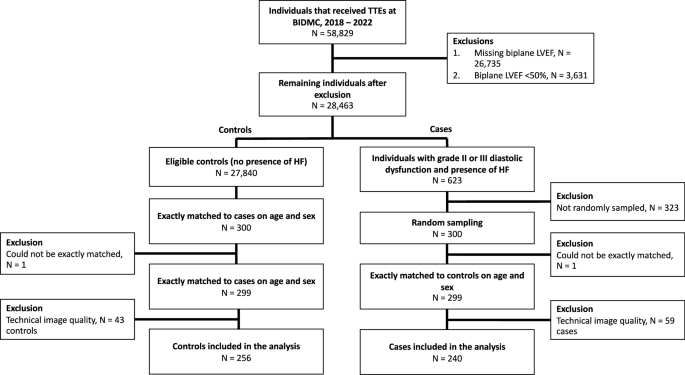
Artificial intelligence (AI) models to identify heart failure (HF) with preserved ejection fraction (HFpEF) based on deep-learning of echocardiograms could help address under-recognition in clinical practice, but they require extensive validation, particularly in representative and complex clinical cohorts for which they could provide most value. In this study enrolling patients with HFpEF (cases; n = 240), and age, sex, and year of echocardiogram matched controls (n = 256), we compare the diagnostic performance (discrimination, calibration, classification, and clinical utility) and prognostic associations (mortality and HF hospitalization) between an updated AI HFpEF model (EchoGo Heart Failure v2) and existing clinical scores (H2FPEF and HFA-PEFF). The AI HFpEF model and H2FPEF score demonstrate similar discrimination and calibration, but classification is higher with AI than H2FPEF and HFA-PEFF, attributable to fewer intermediate scores, due to discordant multivariable inputs. The continuous AI HFpEF model output adds information beyond the H2FPEF, and integration with existing scores increases correct management decisions. Those with a diagnostic positive result from AI have a two-fold increased risk of the composite outcome. We conclude that integrating an AI HFpEF model into the existing clinical diagnostic pathway would improve identification of HFpEF in complex clinical cohorts, and patients at risk of adverse outcomes.
期刊介绍:
Nature Communications, an open-access journal, publishes high-quality research spanning all areas of the natural sciences. Papers featured in the journal showcase significant advances relevant to specialists in each respective field. With a 2-year impact factor of 16.6 (2022) and a median time of 8 days from submission to the first editorial decision, Nature Communications is committed to rapid dissemination of research findings. As a multidisciplinary journal, it welcomes contributions from biological, health, physical, chemical, Earth, social, mathematical, applied, and engineering sciences, aiming to highlight important breakthroughs within each domain.




 京公网安备 11010802042870号
京ICP备2023020795号-1
京公网安备 11010802042870号
京ICP备2023020795号-1

 分享
分享
 求助内容:
求助内容: 应助结果提醒方式:
 扫码关注我们
