Yao Tong, Luxin Feng, Jiayu Li, Heng Liu, Cunbin An, Shouke Yan, Bowei Xu
{"title":"Anode Engineering with pH-Neutral Conjugated Polyelectrolyte Enabling Over 19% Efficiency in Organic Solar Cells","authors":"Yao Tong, Luxin Feng, Jiayu Li, Heng Liu, Cunbin An, Shouke Yan, Bowei Xu","doi":"10.1002/anie.202504085","DOIUrl":null,"url":null,"abstract":"<p>The lack of effective hole-transporting layers (HTLs) materials has become a significant bottleneck in the advancement of organic solar cells (OSCs). Particularly, to obtain sufficient doping properties, most HTLs have to be used by mixing with substantial amounts of acid, which causes serious corrosion problems. Herein, by optimizing molecular conformation, we designed and synthesized two conjugated polyelectrolytes (CPEs) that exhibited superior hole-transporting capability without involving acid addition. The PEP-BT features a planar conjugated backbone constructed from the nonfused segment, which leads to an enhanced doping effect and highly ordered molecular arrangement. and reduced π–π stacking from 4.13 to 3.85 Å. These contributed to the outstanding hole collection performance of polyoxometalate-doped PEP-BT:POM4 while maintaining a neutral pH. The binary OSC showed a photovoltaic efficiency of 19.16%, illustrating an unprecedented example that a CPE-based HTL can provide a photovoltaic efficiency exceeding 19% in OSCs. Moreover, as another evidence of high-performance HTL, the organic light-emitting diode incorporating PEP-BT:POM4 exhibited a superior luminous efficiency to the reference device, along with a decrease of 0.4 V for turn-on voltage. The results from this work demonstrate the great potential of CPEs as HTL materials.</p>","PeriodicalId":125,"journal":{"name":"Angewandte Chemie International Edition","volume":"64 22","pages":""},"PeriodicalIF":16.9000,"publicationDate":"2025-03-25","publicationTypes":"Journal Article","fieldsOfStudy":null,"isOpenAccess":false,"openAccessPdf":"","citationCount":"0","resultStr":null,"platform":"Semanticscholar","paperid":null,"PeriodicalName":"Angewandte Chemie International Edition","FirstCategoryId":"92","ListUrlMain":"https://onlinelibrary.wiley.com/doi/10.1002/anie.202504085","RegionNum":1,"RegionCategory":"化学","ArticlePicture":[],"TitleCN":null,"AbstractTextCN":null,"PMCID":null,"EPubDate":"","PubModel":"","JCR":"Q1","JCRName":"CHEMISTRY, MULTIDISCIPLINARY","Score":null,"Total":0}
引用次数: 0
Abstract
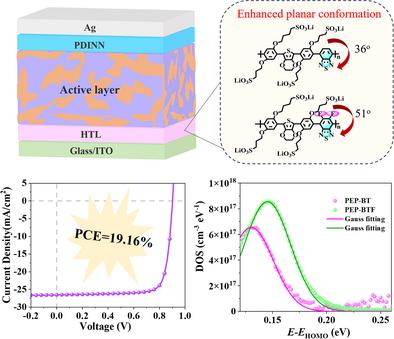
The lack of effective hole-transporting layers (HTLs) materials has become a significant bottleneck in the advancement of organic solar cells (OSCs). Particularly, to obtain sufficient doping properties, most HTLs have to be used by mixing with substantial amounts of acid, which causes serious corrosion problems. Herein, by optimizing molecular conformation, we designed and synthesized two conjugated polyelectrolytes (CPEs) that exhibited superior hole-transporting capability without involving acid addition. The PEP-BT features a planar conjugated backbone constructed from the nonfused segment, which leads to an enhanced doping effect and highly ordered molecular arrangement. and reduced π–π stacking from 4.13 to 3.85 Å. These contributed to the outstanding hole collection performance of polyoxometalate-doped PEP-BT:POM4 while maintaining a neutral pH. The binary OSC showed a photovoltaic efficiency of 19.16%, illustrating an unprecedented example that a CPE-based HTL can provide a photovoltaic efficiency exceeding 19% in OSCs. Moreover, as another evidence of high-performance HTL, the organic light-emitting diode incorporating PEP-BT:POM4 exhibited a superior luminous efficiency to the reference device, along with a decrease of 0.4 V for turn-on voltage. The results from this work demonstrate the great potential of CPEs as HTL materials.
期刊介绍:
Angewandte Chemie, a journal of the German Chemical Society (GDCh), maintains a leading position among scholarly journals in general chemistry with an impressive Impact Factor of 16.6 (2022 Journal Citation Reports, Clarivate, 2023). Published weekly in a reader-friendly format, it features new articles almost every day. Established in 1887, Angewandte Chemie is a prominent chemistry journal, offering a dynamic blend of Review-type articles, Highlights, Communications, and Research Articles on a weekly basis, making it unique in the field.



 京公网安备 11010802042870号
京ICP备2023020795号-1
京公网安备 11010802042870号
京ICP备2023020795号-1

 分享
分享
 求助内容:
求助内容: 应助结果提醒方式:
 扫码关注我们
