Kinetically activating nanovaccine mimicking multidimensional immunomodulation of natural infection for broad protection against heterologous viruses in animal models
Sang Nam Lee, Young-Il Kim, Jaemoo Kim, D. K. Haluwana, Ryounho Eun, Sei Hyun Park, Janghun Heo, Juryeon Gil, Yebin Seong, Min-Ho Lee, Young-Woock Noh, Jong-Soo Lee, Young Ki Choi, Yong Taik Lim
{"title":"Kinetically activating nanovaccine mimicking multidimensional immunomodulation of natural infection for broad protection against heterologous viruses in animal models","authors":"Sang Nam Lee, Young-Il Kim, Jaemoo Kim, D. K. Haluwana, Ryounho Eun, Sei Hyun Park, Janghun Heo, Juryeon Gil, Yebin Seong, Min-Ho Lee, Young-Woock Noh, Jong-Soo Lee, Young Ki Choi, Yong Taik Lim","doi":"10.1038/s41467-025-58006-y","DOIUrl":null,"url":null,"abstract":"<p>Immunity by vaccination can protect human against heterologous viruses. However, protective abilities of artificial vaccines are still weaker than natural infections. Here we develop a kinetically engineered vaccine (KE-VAC) that mimics the multidimensional immunomodulation in natural infections via dynamic activation of antigen presenting cells with masked TLR7/8 agonist and sustained supplies of antigens and adjuvants to lymph nodes, leading to follicular helper T and germinal centre B cell activation in vaccinated mice. KE-VAC demonstrates superior efficacy than traditional alum and mRNA vaccines, achieving a 100% survival rate with increased neutralizing antibodies titers and polyfunctional CD8<sup>+</sup> T cells, recognizing heterologous SARS-CoV-2 variants, and inducing broad and long-term protection against multiple strains of influenza viruses. Prime/boost vaccination with KE-VAC also protect aged ferrets from severe fever with thrombocytopenia syndrome virus infection, with no virus detected in any organs at day 6 p.i. The efficacy of KE-VAC across various pathogens thus highlights its potential as an effective vaccine against emerging infectious risks.</p>","PeriodicalId":19066,"journal":{"name":"Nature Communications","volume":"96 1","pages":""},"PeriodicalIF":15.7000,"publicationDate":"2025-03-25","publicationTypes":"Journal Article","fieldsOfStudy":null,"isOpenAccess":false,"openAccessPdf":"","citationCount":"0","resultStr":null,"platform":"Semanticscholar","paperid":null,"PeriodicalName":"Nature Communications","FirstCategoryId":"103","ListUrlMain":"https://doi.org/10.1038/s41467-025-58006-y","RegionNum":1,"RegionCategory":"综合性期刊","ArticlePicture":[],"TitleCN":null,"AbstractTextCN":null,"PMCID":null,"EPubDate":"","PubModel":"","JCR":"Q1","JCRName":"MULTIDISCIPLINARY SCIENCES","Score":null,"Total":0}
引用次数: 0
Abstract
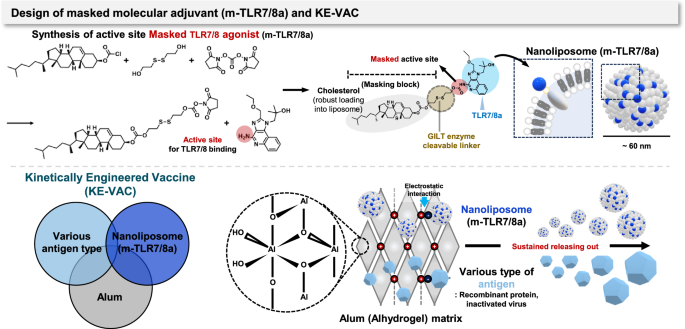
Immunity by vaccination can protect human against heterologous viruses. However, protective abilities of artificial vaccines are still weaker than natural infections. Here we develop a kinetically engineered vaccine (KE-VAC) that mimics the multidimensional immunomodulation in natural infections via dynamic activation of antigen presenting cells with masked TLR7/8 agonist and sustained supplies of antigens and adjuvants to lymph nodes, leading to follicular helper T and germinal centre B cell activation in vaccinated mice. KE-VAC demonstrates superior efficacy than traditional alum and mRNA vaccines, achieving a 100% survival rate with increased neutralizing antibodies titers and polyfunctional CD8+ T cells, recognizing heterologous SARS-CoV-2 variants, and inducing broad and long-term protection against multiple strains of influenza viruses. Prime/boost vaccination with KE-VAC also protect aged ferrets from severe fever with thrombocytopenia syndrome virus infection, with no virus detected in any organs at day 6 p.i. The efficacy of KE-VAC across various pathogens thus highlights its potential as an effective vaccine against emerging infectious risks.
期刊介绍:
Nature Communications, an open-access journal, publishes high-quality research spanning all areas of the natural sciences. Papers featured in the journal showcase significant advances relevant to specialists in each respective field. With a 2-year impact factor of 16.6 (2022) and a median time of 8 days from submission to the first editorial decision, Nature Communications is committed to rapid dissemination of research findings. As a multidisciplinary journal, it welcomes contributions from biological, health, physical, chemical, Earth, social, mathematical, applied, and engineering sciences, aiming to highlight important breakthroughs within each domain.



 京公网安备 11010802042870号
京ICP备2023020795号-1
京公网安备 11010802042870号
京ICP备2023020795号-1

 分享
分享
 求助内容:
求助内容: 应助结果提醒方式:
 扫码关注我们
