Chuannan Fan, Qian Wang, Peter H. L. Krijger, Davy Cats, Miriam Selle, Olga Khorosjutina, Soniya Dhanjal, Bernhard Schmierer, Hailiang Mei, Wouter de Laat, Peter ten Dijke
{"title":"Identification of a SNAI1 enhancer RNA that drives cancer cell plasticity","authors":"Chuannan Fan, Qian Wang, Peter H. L. Krijger, Davy Cats, Miriam Selle, Olga Khorosjutina, Soniya Dhanjal, Bernhard Schmierer, Hailiang Mei, Wouter de Laat, Peter ten Dijke","doi":"10.1038/s41467-025-58032-w","DOIUrl":null,"url":null,"abstract":"<p>Enhancer RNAs (eRNAs) are a pivotal class of enhancer-derived non-coding RNAs that drive gene expression. Here we identify the <i>SNAI1 enhancer RNA</i> (<i>SNAI1e</i>; <i>SCREEM2</i>) as a key activator of <i>SNAI1</i> expression and a potent enforcer of transforming growth factor-β (TGF-β)/SMAD signaling in cancer cells. <i>SNAI1e</i> depletion impairs TGF-β-induced epithelial-mesenchymal transition (EMT), migration, in vivo extravasation, stemness, and chemotherapy resistance in breast cancer cells. <i>SNAI1e</i> functions as an eRNA to <i>cis</i>-regulate <i>SNAI1</i> enhancer activity by binding to and strengthening the enrichment of the transcriptional co-activator bromodomain containing protein 4 (BRD4) at the local enhancer. <i>SNAI1e</i> selectively promotes the expression of <i>SNAI1</i>, which encodes the EMT transcription factor SNAI1. Furthermore, we reveal that SNAI1 interacts with and anchors the inhibitory SMAD7 in the nucleus, and thereby prevents TGF-β type I receptor (TβRI) polyubiquitination and proteasomal degradation. Our findings establish <i>SNAI1e</i> as a critical driver of <i>SNAI1</i> expression and TGF-β-induced cell plasticity.</p>","PeriodicalId":19066,"journal":{"name":"Nature Communications","volume":"41 1","pages":""},"PeriodicalIF":15.7000,"publicationDate":"2025-03-25","publicationTypes":"Journal Article","fieldsOfStudy":null,"isOpenAccess":false,"openAccessPdf":"","citationCount":"0","resultStr":null,"platform":"Semanticscholar","paperid":null,"PeriodicalName":"Nature Communications","FirstCategoryId":"103","ListUrlMain":"https://doi.org/10.1038/s41467-025-58032-w","RegionNum":1,"RegionCategory":"综合性期刊","ArticlePicture":[],"TitleCN":null,"AbstractTextCN":null,"PMCID":null,"EPubDate":"","PubModel":"","JCR":"Q1","JCRName":"MULTIDISCIPLINARY SCIENCES","Score":null,"Total":0}
引用次数: 0
Abstract
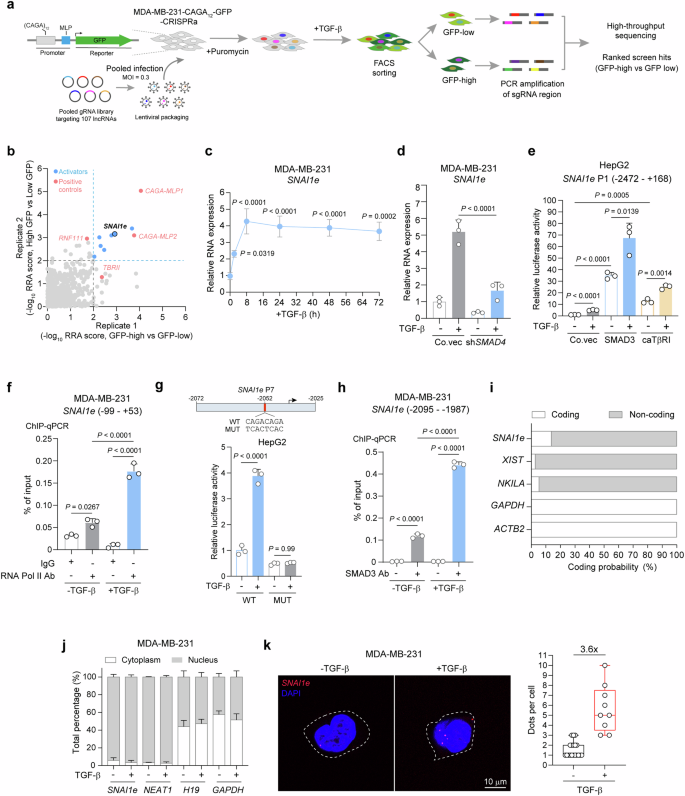
Enhancer RNAs (eRNAs) are a pivotal class of enhancer-derived non-coding RNAs that drive gene expression. Here we identify the SNAI1 enhancer RNA (SNAI1e; SCREEM2) as a key activator of SNAI1 expression and a potent enforcer of transforming growth factor-β (TGF-β)/SMAD signaling in cancer cells. SNAI1e depletion impairs TGF-β-induced epithelial-mesenchymal transition (EMT), migration, in vivo extravasation, stemness, and chemotherapy resistance in breast cancer cells. SNAI1e functions as an eRNA to cis-regulate SNAI1 enhancer activity by binding to and strengthening the enrichment of the transcriptional co-activator bromodomain containing protein 4 (BRD4) at the local enhancer. SNAI1e selectively promotes the expression of SNAI1, which encodes the EMT transcription factor SNAI1. Furthermore, we reveal that SNAI1 interacts with and anchors the inhibitory SMAD7 in the nucleus, and thereby prevents TGF-β type I receptor (TβRI) polyubiquitination and proteasomal degradation. Our findings establish SNAI1e as a critical driver of SNAI1 expression and TGF-β-induced cell plasticity.
期刊介绍:
Nature Communications, an open-access journal, publishes high-quality research spanning all areas of the natural sciences. Papers featured in the journal showcase significant advances relevant to specialists in each respective field. With a 2-year impact factor of 16.6 (2022) and a median time of 8 days from submission to the first editorial decision, Nature Communications is committed to rapid dissemination of research findings. As a multidisciplinary journal, it welcomes contributions from biological, health, physical, chemical, Earth, social, mathematical, applied, and engineering sciences, aiming to highlight important breakthroughs within each domain.



 京公网安备 11010802042870号
京ICP备2023020795号-1
京公网安备 11010802042870号
京ICP备2023020795号-1

 分享
分享
 求助内容:
求助内容: 应助结果提醒方式:
 扫码关注我们
