Xue Yu MD , Jiangdong Liu MS , Peng Yin PhD , Ya Gao MS , Cheng He PhD , Haidong Kan PhD , Maigeng Zhou PhD , Yong Huo MD , Renjie Chen PhD
{"title":"Nonlinear Relation Between Cardiac Mortality and Excess Temperature in Heatwaves","authors":"Xue Yu MD , Jiangdong Liu MS , Peng Yin PhD , Ya Gao MS , Cheng He PhD , Haidong Kan PhD , Maigeng Zhou PhD , Yong Huo MD , Renjie Chen PhD","doi":"10.1016/j.jacc.2025.01.034","DOIUrl":null,"url":null,"abstract":"<div><h3>Background</h3><div>Short-term exposure to heatwaves has been associated with elevated heart disease (HD) mortality; however, the exposure-response relationship curves remain unexplored due to conventional binary heatwave definitions.</div></div><div><h3>Objectives</h3><div>This study aimed to explore exposure-response curves for the associations between heatwaves and mortality from various cardiac causes using excess cumulative temperatures in heatwaves (ECT-HW).</div></div><div><h3>Methods</h3><div>This nationwide, individual-level, case-crossover study collected HD death records of all individuals across Mainland China from 2013 to 2019. We first defined daytime-only, nighttime-only, and day–night compound heatwaves using a bivariate approach, and then calculated the ECT-HW metric. We applied conditional logistic regressions with distributed lag nonlinear models to explore exposure-response curves, which were then used to estimate the corresponding mortality burden. Effects estimated using the traditional binary heatwave definition were compared with those derived from our ECT-HW metric.</div></div><div><h3>Results</h3><div>We evaluated 2,392,254 HD deaths. Mortality risks associated with compound heatwaves exhibited a steady increase across the entire range of ECT-HW, without discernible thresholds. By contrast, risks from nighttime-only heatwaves emerged beyond the 25th percentile of ECT-HW and stabilized after the 90th percentile, whereas risks from daytime-only heatwaves plateaued between the 50th and 95th percentiles before rising again. Compound heatwaves demonstrated a significantly higher HD mortality risk (OR: 1.86) than nighttime-only (OR: 1.16) and daytime-only (OR: 1.19) heatwaves. A total of 41,869, 9,092, and 9,809 excess cardiac deaths were estimated to be associated with compound, nighttime-only, and daytime-only heatwaves, accounting for 1.75%, 0.38%, and 0.41% of total HD deaths, respectively. These estimates exceeded those derived from the traditional heatwave metric, which were 27,036, 2,871, and 4,785, respectively. Sudden cardiac arrest, acute myocardial infarction, and heart failure showed the highest sensitivity to compound heatwaves, whereas pulmonary heart disease exhibited the lowest.</div></div><div><h3>Conclusions</h3><div>The heatwave–HD relationships show nonlinear trends with risk thresholds for daytime-only and nighttime-only heatwaves, but a near-linear pattern for compound heatwaves. Amid global warming, the use of a traditional binary definition could underestimate the mortality risk and burden of HD patients associated with heatwaves. These findings highlight the need for disease-specific health care measures tailored to different heatwave types to better manage cardiac risks in a warming climate.</div></div>","PeriodicalId":17187,"journal":{"name":"Journal of the American College of Cardiology","volume":"85 13","pages":"Pages 1403-1416"},"PeriodicalIF":22.3000,"publicationDate":"2025-04-08","publicationTypes":"Journal Article","fieldsOfStudy":null,"isOpenAccess":false,"openAccessPdf":"","citationCount":"0","resultStr":null,"platform":"Semanticscholar","paperid":null,"PeriodicalName":"Journal of the American College of Cardiology","FirstCategoryId":"3","ListUrlMain":"https://www.sciencedirect.com/science/article/pii/S0735109725003390","RegionNum":1,"RegionCategory":"医学","ArticlePicture":[],"TitleCN":null,"AbstractTextCN":null,"PMCID":null,"EPubDate":"2025/3/25 0:00:00","PubModel":"Epub","JCR":"Q1","JCRName":"CARDIAC & CARDIOVASCULAR SYSTEMS","Score":null,"Total":0}
引用次数: 0
Abstract
Background
Short-term exposure to heatwaves has been associated with elevated heart disease (HD) mortality; however, the exposure-response relationship curves remain unexplored due to conventional binary heatwave definitions.
Objectives
This study aimed to explore exposure-response curves for the associations between heatwaves and mortality from various cardiac causes using excess cumulative temperatures in heatwaves (ECT-HW).
Methods
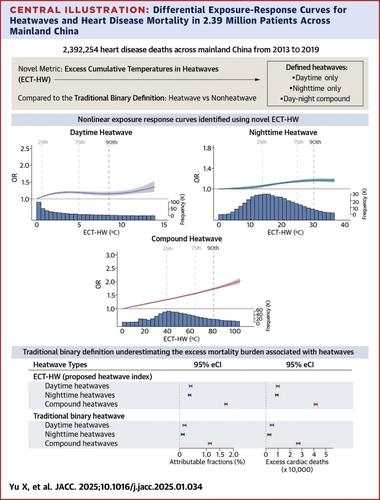
This nationwide, individual-level, case-crossover study collected HD death records of all individuals across Mainland China from 2013 to 2019. We first defined daytime-only, nighttime-only, and day–night compound heatwaves using a bivariate approach, and then calculated the ECT-HW metric. We applied conditional logistic regressions with distributed lag nonlinear models to explore exposure-response curves, which were then used to estimate the corresponding mortality burden. Effects estimated using the traditional binary heatwave definition were compared with those derived from our ECT-HW metric.
Results
We evaluated 2,392,254 HD deaths. Mortality risks associated with compound heatwaves exhibited a steady increase across the entire range of ECT-HW, without discernible thresholds. By contrast, risks from nighttime-only heatwaves emerged beyond the 25th percentile of ECT-HW and stabilized after the 90th percentile, whereas risks from daytime-only heatwaves plateaued between the 50th and 95th percentiles before rising again. Compound heatwaves demonstrated a significantly higher HD mortality risk (OR: 1.86) than nighttime-only (OR: 1.16) and daytime-only (OR: 1.19) heatwaves. A total of 41,869, 9,092, and 9,809 excess cardiac deaths were estimated to be associated with compound, nighttime-only, and daytime-only heatwaves, accounting for 1.75%, 0.38%, and 0.41% of total HD deaths, respectively. These estimates exceeded those derived from the traditional heatwave metric, which were 27,036, 2,871, and 4,785, respectively. Sudden cardiac arrest, acute myocardial infarction, and heart failure showed the highest sensitivity to compound heatwaves, whereas pulmonary heart disease exhibited the lowest.
Conclusions
The heatwave–HD relationships show nonlinear trends with risk thresholds for daytime-only and nighttime-only heatwaves, but a near-linear pattern for compound heatwaves. Amid global warming, the use of a traditional binary definition could underestimate the mortality risk and burden of HD patients associated with heatwaves. These findings highlight the need for disease-specific health care measures tailored to different heatwave types to better manage cardiac risks in a warming climate.
期刊介绍:
The Journal of the American College of Cardiology (JACC) publishes peer-reviewed articles highlighting all aspects of cardiovascular disease, including original clinical studies, experimental investigations with clear clinical relevance, state-of-the-art papers and viewpoints.
Content Profile:
-Original Investigations
-JACC State-of-the-Art Reviews
-JACC Review Topics of the Week
-Guidelines & Clinical Documents
-JACC Guideline Comparisons
-JACC Scientific Expert Panels
-Cardiovascular Medicine & Society
-Editorial Comments (accompanying every Original Investigation)
-Research Letters
-Fellows-in-Training/Early Career Professional Pages
-Editor’s Pages from the Editor-in-Chief or other invited thought leaders



 京公网安备 11010802042870号
京ICP备2023020795号-1
京公网安备 11010802042870号
京ICP备2023020795号-1

 分享
分享
 求助内容:
求助内容: 应助结果提醒方式:
 扫码关注我们
