Wenhui Yang, Chensi Zhan, Qiang Zhu, Lei Liu, Baiming Su, Haoxiang Yu, Liyuan Zhang, Lei Yan and Jie Shu
{"title":"Proton coordination chemistry in pyrene-based anodes for ultralong-life aqueous proton batteries†","authors":"Wenhui Yang, Chensi Zhan, Qiang Zhu, Lei Liu, Baiming Su, Haoxiang Yu, Liyuan Zhang, Lei Yan and Jie Shu","doi":"10.1039/D5QI00269A","DOIUrl":null,"url":null,"abstract":"<p >Sustainable and safe aqueous proton batteries (APBs) have attracted significant attention owing to their unique “Grotthuss mechanism”. Although organic small molecules with stable and adjustable frameworks are promising electrode materials, their easy dissolution in electrolytes and unsatisfactory intrinsic conductivity hinder their broad application in APB devices. Herein, 2,7-diammonio-4,5,9,10-tetraone (PTO-NH<small><sub>3</sub></small><small><sup>+</sup></small>) with stable intermolecular hydrogen-bond networks was designed <em>via</em> an <em>in situ</em> electrochemical reduction strategy. The optimized molecule structure endows low charge transport barriers, high chemical reactivity, and prominent charge affinity. The fast kinetics of proton coordination/de-coordination behavior in PTO-NH<small><sub>3</sub></small><small><sup>+</sup></small> electrodes is corroborated by <em>ex situ</em> characterization techniques and theoretical calculations. As a result, the robust four-step 4e<small><sup>−</sup></small> H<small><sup>+</sup></small> coordination with PTO-NH<small><sub>3</sub></small><small><sup>+</sup></small> electrode achieves an excellent rate performance (214.3 mA h g<small><sup>−1</sup></small> at 0.05 A g<small><sup>−1</sup></small> and112.9 mA h g<small><sup>−1</sup></small> at 40 A g<small><sup>−1</sup></small>), along with a long lifespan (10 000 cycles). These findings shed light on further avenues towards advanced proton batteries.</p>","PeriodicalId":79,"journal":{"name":"Inorganic Chemistry Frontiers","volume":" 13","pages":" 4213-4222"},"PeriodicalIF":6.4000,"publicationDate":"2025-03-25","publicationTypes":"Journal Article","fieldsOfStudy":null,"isOpenAccess":false,"openAccessPdf":"","citationCount":"0","resultStr":null,"platform":"Semanticscholar","paperid":null,"PeriodicalName":"Inorganic Chemistry Frontiers","FirstCategoryId":"92","ListUrlMain":"https://pubs.rsc.org/en/content/articlelanding/2025/qi/d5qi00269a","RegionNum":1,"RegionCategory":"化学","ArticlePicture":[],"TitleCN":null,"AbstractTextCN":null,"PMCID":null,"EPubDate":"","PubModel":"","JCR":"Q1","JCRName":"CHEMISTRY, INORGANIC & NUCLEAR","Score":null,"Total":0}
引用次数: 0
Abstract
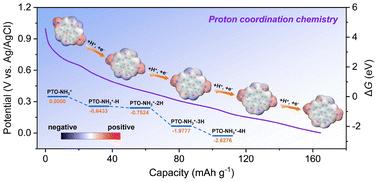
Sustainable and safe aqueous proton batteries (APBs) have attracted significant attention owing to their unique “Grotthuss mechanism”. Although organic small molecules with stable and adjustable frameworks are promising electrode materials, their easy dissolution in electrolytes and unsatisfactory intrinsic conductivity hinder their broad application in APB devices. Herein, 2,7-diammonio-4,5,9,10-tetraone (PTO-NH3+) with stable intermolecular hydrogen-bond networks was designed via an in situ electrochemical reduction strategy. The optimized molecule structure endows low charge transport barriers, high chemical reactivity, and prominent charge affinity. The fast kinetics of proton coordination/de-coordination behavior in PTO-NH3+ electrodes is corroborated by ex situ characterization techniques and theoretical calculations. As a result, the robust four-step 4e− H+ coordination with PTO-NH3+ electrode achieves an excellent rate performance (214.3 mA h g−1 at 0.05 A g−1 and112.9 mA h g−1 at 40 A g−1), along with a long lifespan (10 000 cycles). These findings shed light on further avenues towards advanced proton batteries.
由于其独特的“Grotthuss机制”,可持续和安全的水质子电池(APBs)引起了人们的广泛关注。虽然具有稳定和可调节框架的有机小分子是很有前途的电极材料,但其易在电解质中溶解和不理想的固有电导率阻碍了其在APB器件中的广泛应用。本文通过原位电化学还原策略设计了具有稳定分子间氢键网络的2,7-二氨基-4,5,9,10-四酮(PTO-NH3+),优化后的分子结构具有低电荷输运势、高化学反应活性和突出的电荷亲和力。通过非原位表征技术和理论计算证实了PTO-NH3+电极中质子配位/脱配行为的快速动力学。因此,与PTO-NH3+电极的稳健的四步4e- H+配位实现了优异的倍率性能(0.05 a g-1时214.3 mAh g-1, 40 a g-1时112.9 mAh g-1),以及长寿命(10000次循环)。这些发现为进一步发展先进质子电池指明了方向。



 京公网安备 11010802042870号
京ICP备2023020795号-1
京公网安备 11010802042870号
京ICP备2023020795号-1

 分享
分享
 求助内容:
求助内容: 应助结果提醒方式:
 扫码关注我们
