Jiaqian Xu, Shu Chen, Ka-Yan Ng, Xianfeng Chen, Wai Chung Fu and Guangyu Zhu
{"title":"A platinated prodrug leveraging PROTAC technology for targeted protein degradation and enhanced antitumor efficacy†","authors":"Jiaqian Xu, Shu Chen, Ka-Yan Ng, Xianfeng Chen, Wai Chung Fu and Guangyu Zhu","doi":"10.1039/D5QI00605H","DOIUrl":null,"url":null,"abstract":"<p >Proteolysis targeting chimeras (PROTACs), which catalytically degrade disease-related proteins, can overcome the limitations of traditional small-molecule inhibitors and thus have revolutionized the field of targeted therapy. Building on this advancement, we present platinated PROTAC [PROTAC–Pt(<small>IV</small>)], a new class of “dual-action” prodrug that leverages the ubiquitin–proteasome system-mediated degradation capabilities of PROTAC and exhibits the advantages of Pt-based anticancer prodrugs. PROTAC–Pt(<small>IV</small>) exhibits exceptional cytotoxicity, with half-maximal inhibitory concentration values in the nanomolar range. It outperformed conventional inhibitor-based Pt(<small>IV</small>) prodrugs by up to three orders of magnitude by efficiently degrading the target protein BRD4 in a range of human cancer cells. PROTAC–Pt(<small>IV</small>) induces cancer cell death through mechanisms including augmented apoptosis, p21-mediated cell cycle arrest, and immune activation <em>via</em> PD–L1 downregulation. Compared with PROTAC alone, PROTAC–Pt(<small>IV</small>) more effectively suppressed the growth of tumor xenografts in a mouse model <em>via</em> its altered pharmacokinetic properties. Collectively, the development of PROTAC–Pt(<small>IV</small>) marks a revolution in dual-action Pt(<small>IV</small>) anticancer prodrugs and offers a promising avenue for enhanced and targeted cancer therapies.</p>","PeriodicalId":79,"journal":{"name":"Inorganic Chemistry Frontiers","volume":" 12","pages":" 3981-3987"},"PeriodicalIF":6.4000,"publicationDate":"2025-03-25","publicationTypes":"Journal Article","fieldsOfStudy":null,"isOpenAccess":false,"openAccessPdf":"","citationCount":"0","resultStr":null,"platform":"Semanticscholar","paperid":null,"PeriodicalName":"Inorganic Chemistry Frontiers","FirstCategoryId":"92","ListUrlMain":"https://pubs.rsc.org/en/content/articlelanding/2025/qi/d5qi00605h","RegionNum":1,"RegionCategory":"化学","ArticlePicture":[],"TitleCN":null,"AbstractTextCN":null,"PMCID":null,"EPubDate":"","PubModel":"","JCR":"Q1","JCRName":"CHEMISTRY, INORGANIC & NUCLEAR","Score":null,"Total":0}
引用次数: 0
Abstract
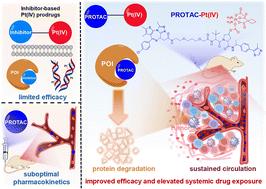
Proteolysis targeting chimeras (PROTACs), which catalytically degrade disease-related proteins, can overcome the limitations of traditional small-molecule inhibitors and thus have revolutionized the field of targeted therapy. Building on this advancement, we present platinated PROTAC [PROTAC–Pt(IV)], a new class of “dual-action” prodrug that leverages the ubiquitin–proteasome system-mediated degradation capabilities of PROTAC and exhibits the advantages of Pt-based anticancer prodrugs. PROTAC–Pt(IV) exhibits exceptional cytotoxicity, with half-maximal inhibitory concentration values in the nanomolar range. It outperformed conventional inhibitor-based Pt(IV) prodrugs by up to three orders of magnitude by efficiently degrading the target protein BRD4 in a range of human cancer cells. PROTAC–Pt(IV) induces cancer cell death through mechanisms including augmented apoptosis, p21-mediated cell cycle arrest, and immune activation via PD–L1 downregulation. Compared with PROTAC alone, PROTAC–Pt(IV) more effectively suppressed the growth of tumor xenografts in a mouse model via its altered pharmacokinetic properties. Collectively, the development of PROTAC–Pt(IV) marks a revolution in dual-action Pt(IV) anticancer prodrugs and offers a promising avenue for enhanced and targeted cancer therapies.



 京公网安备 11010802042870号
京ICP备2023020795号-1
京公网安备 11010802042870号
京ICP备2023020795号-1

 分享
分享
 求助内容:
求助内容: 应助结果提醒方式:
 扫码关注我们
