Raz Ben-Uri, Lior Ben Shabat, Dana Shainshein, Omer Bar-Tal, Yuval Bussi, Noa Maimon, Tal Keidar Haran, Idan Milo, Inna Goliand, Yoseph Addadi, Tomer Meir Salame, Alexander Rochwarger, Christian M. Schürch, Shai Bagon, Ofer Elhanani, Leeat Keren
{"title":"High-dimensional imaging using combinatorial channel multiplexing and deep learning","authors":"Raz Ben-Uri, Lior Ben Shabat, Dana Shainshein, Omer Bar-Tal, Yuval Bussi, Noa Maimon, Tal Keidar Haran, Idan Milo, Inna Goliand, Yoseph Addadi, Tomer Meir Salame, Alexander Rochwarger, Christian M. Schürch, Shai Bagon, Ofer Elhanani, Leeat Keren","doi":"10.1038/s41587-025-02585-0","DOIUrl":null,"url":null,"abstract":"Understanding tissue structure and function requires tools that quantify the expression of multiple proteins at single-cell resolution while preserving spatial information. Current imaging technologies use a separate channel for each protein, limiting throughput and scalability. Here, we present combinatorial multiplexing (CombPlex), a combinatorial staining platform coupled with an algorithmic framework to exponentially increase the number of measured proteins. Every protein can be imaged in several channels and every channel contains agglomerated images of several proteins. These combinatorically compressed images are then decompressed to individual protein images using deep learning. We achieve accurate reconstruction when compressing the stains of 22 proteins to five imaging channels. We demonstrate the approach both in fluorescence microscopy and in mass-based imaging and show successful application across multiple tissues and cancer types. CombPlex can escalate the number of proteins measured by any imaging modality, without the need for specialized instrumentation. Protein imaging is multiplexed using combinatorial staining and deep learning decompression.","PeriodicalId":19084,"journal":{"name":"Nature biotechnology","volume":"44 2","pages":"233-246"},"PeriodicalIF":41.7000,"publicationDate":"2025-03-25","publicationTypes":"Journal Article","fieldsOfStudy":null,"isOpenAccess":false,"openAccessPdf":"","citationCount":"0","resultStr":null,"platform":"Semanticscholar","paperid":null,"PeriodicalName":"Nature biotechnology","FirstCategoryId":"5","ListUrlMain":"https://www.nature.com/articles/s41587-025-02585-0","RegionNum":1,"RegionCategory":"生物学","ArticlePicture":[],"TitleCN":null,"AbstractTextCN":null,"PMCID":null,"EPubDate":"","PubModel":"","JCR":"Q1","JCRName":"BIOTECHNOLOGY & APPLIED MICROBIOLOGY","Score":null,"Total":0}
引用次数: 0
Abstract
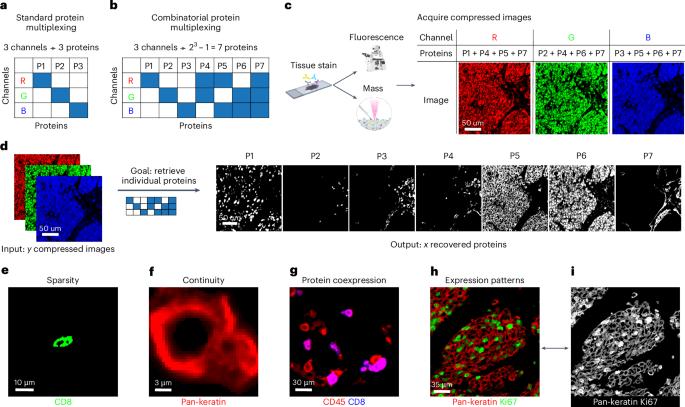
Understanding tissue structure and function requires tools that quantify the expression of multiple proteins at single-cell resolution while preserving spatial information. Current imaging technologies use a separate channel for each protein, limiting throughput and scalability. Here, we present combinatorial multiplexing (CombPlex), a combinatorial staining platform coupled with an algorithmic framework to exponentially increase the number of measured proteins. Every protein can be imaged in several channels and every channel contains agglomerated images of several proteins. These combinatorically compressed images are then decompressed to individual protein images using deep learning. We achieve accurate reconstruction when compressing the stains of 22 proteins to five imaging channels. We demonstrate the approach both in fluorescence microscopy and in mass-based imaging and show successful application across multiple tissues and cancer types. CombPlex can escalate the number of proteins measured by any imaging modality, without the need for specialized instrumentation. Protein imaging is multiplexed using combinatorial staining and deep learning decompression.
期刊介绍:
Nature Biotechnology is a monthly journal that focuses on the science and business of biotechnology. It covers a wide range of topics including technology/methodology advancements in the biological, biomedical, agricultural, and environmental sciences. The journal also explores the commercial, political, ethical, legal, and societal aspects of this research.
The journal serves researchers by providing peer-reviewed research papers in the field of biotechnology. It also serves the business community by delivering news about research developments. This approach ensures that both the scientific and business communities are well-informed and able to stay up-to-date on the latest advancements and opportunities in the field.
Some key areas of interest in which the journal actively seeks research papers include molecular engineering of nucleic acids and proteins, molecular therapy, large-scale biology, computational biology, regenerative medicine, imaging technology, analytical biotechnology, applied immunology, food and agricultural biotechnology, and environmental biotechnology.
In summary, Nature Biotechnology is a comprehensive journal that covers both the scientific and business aspects of biotechnology. It strives to provide researchers with valuable research papers and news while also delivering important scientific advancements to the business community.




 京公网安备 11010802042870号
京ICP备2023020795号-1
京公网安备 11010802042870号
京ICP备2023020795号-1

 分享
分享
 求助内容:
求助内容: 应助结果提醒方式:
 扫码关注我们
