{"title":"Decoding YOD1: Insights into tumour regulation and translational opportunities","authors":"Chong Zhi-Xiong","doi":"10.1016/j.bcp.2025.116889","DOIUrl":null,"url":null,"abstract":"<div><div>YOD1 deubiquitinase is a 38 kDa protein that belongs to the ovarian tumour protease (OTU) family, and its dysregulation can precipitate cancer development. Still, an up-to-date review article that can summarize its detailed tumour-regulatory function and translational potentials in different cancer types is lacking. To fill this literature gap, this review aims to discuss the tumour-modulatory role of YOD1 based on findings from different pre-clinical and clinical studies, followed by exploring the potential translational values of YOD1 as a tumour biomarker or therapeutic target. Overall, YOD1 could control the development of at least 15 tumour types by deubiquitinating or targeting different cellular proteins to modulate the activities of the cell cycle, p53, β-catenin, extracellular-regulated signal kinase (ERK), and YES-associated pathway (YAP) activities. Additionally, four long non-coding RNAs (lncRNAs), 12 microRNAs (miRNAs), and a few compounds can also directly or indirectly alter the expression and activity of YOD1, mediating tumourigenesis across different cancer types. Cellular expression data showed that YOD1 expression is dysregulated in eight cancer types, giving YOD1 the potential to be used as a diagnostic biomarker. Besides, YOD1 dysregulation can affect the clinical outcomes of various cancers. Hence, targeting YOD1 could potentially help slow tumourigenesis. The major drawback of considering YOD1 as a biomarker or therapeutic target is that its tumour-regulatory role is mainly based on the findings from single-center studies with relatively small sample sizes. Hence, future large-scale and in-depth clinical trials should be conducted to further verify the translational values of YOD1 as a biomarker or therapeutic target.</div></div>","PeriodicalId":8806,"journal":{"name":"Biochemical pharmacology","volume":"236 ","pages":"Article 116889"},"PeriodicalIF":5.6000,"publicationDate":"2025-03-23","publicationTypes":"Journal Article","fieldsOfStudy":null,"isOpenAccess":false,"openAccessPdf":"","citationCount":"0","resultStr":null,"platform":"Semanticscholar","paperid":null,"PeriodicalName":"Biochemical pharmacology","FirstCategoryId":"3","ListUrlMain":"https://www.sciencedirect.com/science/article/pii/S0006295225001510","RegionNum":2,"RegionCategory":"医学","ArticlePicture":[],"TitleCN":null,"AbstractTextCN":null,"PMCID":null,"EPubDate":"","PubModel":"","JCR":"Q1","JCRName":"PHARMACOLOGY & PHARMACY","Score":null,"Total":0}
引用次数: 0
Abstract
YOD1 deubiquitinase is a 38 kDa protein that belongs to the ovarian tumour protease (OTU) family, and its dysregulation can precipitate cancer development. Still, an up-to-date review article that can summarize its detailed tumour-regulatory function and translational potentials in different cancer types is lacking. To fill this literature gap, this review aims to discuss the tumour-modulatory role of YOD1 based on findings from different pre-clinical and clinical studies, followed by exploring the potential translational values of YOD1 as a tumour biomarker or therapeutic target. Overall, YOD1 could control the development of at least 15 tumour types by deubiquitinating or targeting different cellular proteins to modulate the activities of the cell cycle, p53, β-catenin, extracellular-regulated signal kinase (ERK), and YES-associated pathway (YAP) activities. Additionally, four long non-coding RNAs (lncRNAs), 12 microRNAs (miRNAs), and a few compounds can also directly or indirectly alter the expression and activity of YOD1, mediating tumourigenesis across different cancer types. Cellular expression data showed that YOD1 expression is dysregulated in eight cancer types, giving YOD1 the potential to be used as a diagnostic biomarker. Besides, YOD1 dysregulation can affect the clinical outcomes of various cancers. Hence, targeting YOD1 could potentially help slow tumourigenesis. The major drawback of considering YOD1 as a biomarker or therapeutic target is that its tumour-regulatory role is mainly based on the findings from single-center studies with relatively small sample sizes. Hence, future large-scale and in-depth clinical trials should be conducted to further verify the translational values of YOD1 as a biomarker or therapeutic target.
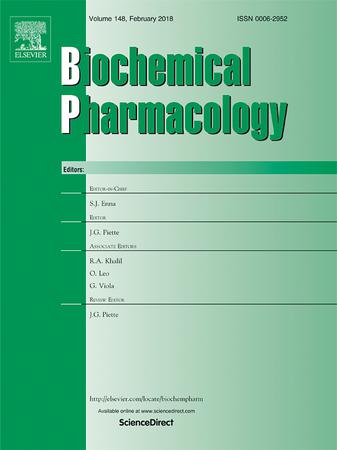
期刊介绍:
Biochemical Pharmacology publishes original research findings, Commentaries and review articles related to the elucidation of cellular and tissue function(s) at the biochemical and molecular levels, the modification of cellular phenotype(s) by genetic, transcriptional/translational or drug/compound-induced modifications, as well as the pharmacodynamics and pharmacokinetics of xenobiotics and drugs, the latter including both small molecules and biologics.
The journal''s target audience includes scientists engaged in the identification and study of the mechanisms of action of xenobiotics, biologics and drugs and in the drug discovery and development process.
All areas of cellular biology and cellular, tissue/organ and whole animal pharmacology fall within the scope of the journal. Drug classes covered include anti-infectives, anti-inflammatory agents, chemotherapeutics, cardiovascular, endocrinological, immunological, metabolic, neurological and psychiatric drugs, as well as research on drug metabolism and kinetics. While medicinal chemistry is a topic of complimentary interest, manuscripts in this area must contain sufficient biological data to characterize pharmacologically the compounds reported. Submissions describing work focused predominately on chemical synthesis and molecular modeling will not be considered for review.
While particular emphasis is placed on reporting the results of molecular and biochemical studies, research involving the use of tissue and animal models of human pathophysiology and toxicology is of interest to the extent that it helps define drug mechanisms of action, safety and efficacy.




 京公网安备 11010802042870号
京ICP备2023020795号-1
京公网安备 11010802042870号
京ICP备2023020795号-1

 分享
分享
 求助内容:
求助内容: 应助结果提醒方式:
 扫码关注我们
