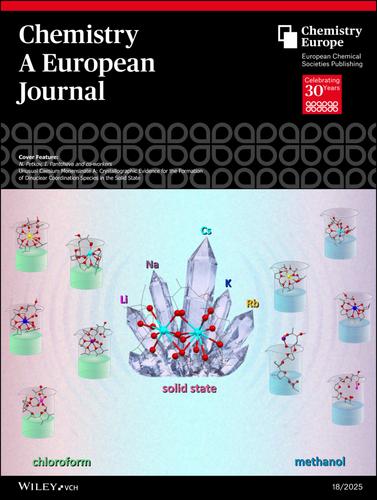
Cover Feature: Unusual Caesium Monensinate A: Crystallographic Evidence for the Formation of Dinuclear Coordination Species in the Solid State (Chem. Eur. J. 18/2025)
Nikolay Petkov, Prof. Anela Ivanova, Prof. Miroslava Nedyalkova, Prof. Svetlana Simova, Petar Dorkov, Prof. Angel Ugrinov, Prof. Ivayla Pantcheva
{"title":"Cover Feature: Unusual Caesium Monensinate A: Crystallographic Evidence for the Formation of Dinuclear Coordination Species in the Solid State (Chem. Eur. J. 18/2025)","authors":"Nikolay Petkov, Prof. Anela Ivanova, Prof. Miroslava Nedyalkova, Prof. Svetlana Simova, Petar Dorkov, Prof. Angel Ugrinov, Prof. Ivayla Pantcheva","doi":"10.1002/chem.202581803","DOIUrl":null,"url":null,"abstract":"<p><b>The Cover Feature</b> shows the crystal structure of a caesium complex of the polyether ionophorous antibiotic monensin. It features two bridging Cs<sup>+</sup> ions trapped in the hydrophilic cavity of two monensinate anions, in contrast to the mononuclear “closed” constructs of the other alkali ions. MD modelling unveils the effect of solvent polarity (methanol vs. chloroform) on monensin cyclization and its ability to form “open”, “semi-open” and “closed” structures with alkali ions, thus explaining the behaviour of the complexes in the two solvents. More information can be found in the Research Article by N. Petkov, I. Pantcheva and co-workers (DOI: 10.1002/chem.202404453).\n <figure>\n <div><picture>\n <source></source></picture><p></p>\n </div>\n </figure>\n </p>","PeriodicalId":144,"journal":{"name":"Chemistry - A European Journal","volume":"31 18","pages":""},"PeriodicalIF":3.7000,"publicationDate":"2025-03-26","publicationTypes":"Journal Article","fieldsOfStudy":null,"isOpenAccess":false,"openAccessPdf":"https://onlinelibrary.wiley.com/doi/epdf/10.1002/chem.202581803","citationCount":"0","resultStr":null,"platform":"Semanticscholar","paperid":null,"PeriodicalName":"Chemistry - A European Journal","FirstCategoryId":"92","ListUrlMain":"https://chemistry-europe.onlinelibrary.wiley.com/doi/10.1002/chem.202581803","RegionNum":2,"RegionCategory":"化学","ArticlePicture":[],"TitleCN":null,"AbstractTextCN":null,"PMCID":null,"EPubDate":"","PubModel":"","JCR":"Q2","JCRName":"CHEMISTRY, MULTIDISCIPLINARY","Score":null,"Total":0}
引用次数: 0
Abstract
The Cover Feature shows the crystal structure of a caesium complex of the polyether ionophorous antibiotic monensin. It features two bridging Cs+ ions trapped in the hydrophilic cavity of two monensinate anions, in contrast to the mononuclear “closed” constructs of the other alkali ions. MD modelling unveils the effect of solvent polarity (methanol vs. chloroform) on monensin cyclization and its ability to form “open”, “semi-open” and “closed” structures with alkali ions, thus explaining the behaviour of the complexes in the two solvents. More information can be found in the Research Article by N. Petkov, I. Pantcheva and co-workers (DOI: 10.1002/chem.202404453).
封面特征显示了聚醚离子抗生素莫能菌素的铯配合物的晶体结构。它的特点是两个桥接的Cs+离子被困在两个monensinate阴离子的亲水腔中,与其他碱离子的单核“封闭”结构形成鲜明对比。MD模型揭示了溶剂极性(甲醇vs氯仿)对莫能菌素环化及其与碱离子形成“开放”、“半开放”和“封闭”结构的能力的影响,从而解释了配合物在两种溶剂中的行为。更多信息可以在N. Petkov, I. Pantcheva及其同事的研究文章中找到(DOI: 10.1002/chem.202404453)。
期刊介绍:
Chemistry—A European Journal is a truly international journal with top quality contributions (2018 ISI Impact Factor: 5.16). It publishes a wide range of outstanding Reviews, Minireviews, Concepts, Full Papers, and Communications from all areas of chemistry and related fields.
Based in Europe Chemistry—A European Journal provides an excellent platform for increasing the visibility of European chemistry as well as for featuring the best research from authors from around the world.
All manuscripts are peer-reviewed, and electronic processing ensures accurate reproduction of text and data, plus short publication times.
The Concepts section provides nonspecialist readers with a useful conceptual guide to unfamiliar areas and experts with new angles on familiar problems.
Chemistry—A European Journal is published on behalf of ChemPubSoc Europe, a group of 16 national chemical societies from within Europe, and supported by the Asian Chemical Editorial Societies. The ChemPubSoc Europe family comprises: Angewandte Chemie, Chemistry—A European Journal, European Journal of Organic Chemistry, European Journal of Inorganic Chemistry, ChemPhysChem, ChemBioChem, ChemMedChem, ChemCatChem, ChemSusChem, ChemPlusChem, ChemElectroChem, and ChemistryOpen.





 京公网安备 11010802042870号
京ICP备2023020795号-1
京公网安备 11010802042870号
京ICP备2023020795号-1

 分享
分享
 求助内容:
求助内容: 应助结果提醒方式:
 扫码关注我们
