Vojtěch Ettler, Tereza Křížová, Martin Mihaljevič, Petr Drahota, Martin Racek, Bohdan Kříbek, Aleš Vaněk, Vít Penížek, Tereza Zádorová, Ondra Sracek and Ben Mapani
{"title":"Contaminant bioaccessibility in abandoned mine tailings in Namibia changes along a climatic gradient†","authors":"Vojtěch Ettler, Tereza Křížová, Martin Mihaljevič, Petr Drahota, Martin Racek, Bohdan Kříbek, Aleš Vaněk, Vít Penížek, Tereza Zádorová, Ondra Sracek and Ben Mapani","doi":"10.1039/D5EM00060B","DOIUrl":null,"url":null,"abstract":"<p >Fine-grained dust from tailing storage facilities in abandoned sulfide-ore mining areas represents an important source of environmental contamination. Fine fractions (<48 μm and <10 μm) of tailings from three old mining sites situated along a climatic gradient from hot semiarid to cold desert conditions in Namibia were studied: Kombat (Cu–Pb–Zn; rainfall ∼500 mm), Oamites (Cu; ∼120 mm), Namib Lead & Zinc (Pb–Zn; ∼0 mm). Multi-method mineralogical and geochemical investigations were adopted to assess the binding and gastric bioaccessibility of the metal(loid)s and to evaluate the associated human health risks. The total concentrations of contaminants in the tailings generally increased with the decreasing particle size (up to 134 mg As kg<small><sup>−1</sup></small>, 14 900 mg Cu kg<small><sup>−1</sup></small>, 8880 mg Pb kg<small><sup>−1</sup></small>, 13 300 mg Zn kg<small><sup>−1</sup></small>). The mean bioaccessible fractions varied substantially between the sites and were significantly higher for the tailings from the sites with a higher rainfall (73–82% <em>versus</em> 22%). The mineralogical composition of the tailings, reflecting the original mineralogy and the degree of the weathering process, is the main driver controlling the bioaccessibility of the metal(loid)s. In desert environments, metal(loid)s in tailings are bound in sulfides or sequestered in secondary Fe oxyhydroxides and/or Fe hydroxysulfates, all of which are insoluble in simulated gastric fluid. In contrast, tailings from areas with higher precipitation contain metal(loid)s hosted in carbonate phases (malachite, cerussite), which are highly soluble under gastric conditions. Based on the higher contaminant bioaccessibility, the vicinity of the settlement and farmlands, and a higher percentage of wind-erodible fine particles, a higher risk for human health has thus been identified for the Kombat site, where further remediation of the existing tailings storage facility is highly recommended.</p>","PeriodicalId":74,"journal":{"name":"Environmental Science: Processes & Impacts","volume":" 4","pages":" 1088-1102"},"PeriodicalIF":3.9000,"publicationDate":"2025-03-21","publicationTypes":"Journal Article","fieldsOfStudy":null,"isOpenAccess":false,"openAccessPdf":"https://pubs.rsc.org/en/content/articlepdf/2025/em/d5em00060b?page=search","citationCount":"0","resultStr":null,"platform":"Semanticscholar","paperid":null,"PeriodicalName":"Environmental Science: Processes & Impacts","FirstCategoryId":"93","ListUrlMain":"https://pubs.rsc.org/en/content/articlelanding/2025/em/d5em00060b","RegionNum":3,"RegionCategory":"环境科学与生态学","ArticlePicture":[],"TitleCN":null,"AbstractTextCN":null,"PMCID":null,"EPubDate":"","PubModel":"","JCR":"Q1","JCRName":"CHEMISTRY, ANALYTICAL","Score":null,"Total":0}
引用次数: 0
Abstract
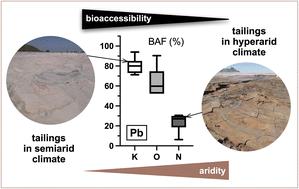
Fine-grained dust from tailing storage facilities in abandoned sulfide-ore mining areas represents an important source of environmental contamination. Fine fractions (<48 μm and <10 μm) of tailings from three old mining sites situated along a climatic gradient from hot semiarid to cold desert conditions in Namibia were studied: Kombat (Cu–Pb–Zn; rainfall ∼500 mm), Oamites (Cu; ∼120 mm), Namib Lead & Zinc (Pb–Zn; ∼0 mm). Multi-method mineralogical and geochemical investigations were adopted to assess the binding and gastric bioaccessibility of the metal(loid)s and to evaluate the associated human health risks. The total concentrations of contaminants in the tailings generally increased with the decreasing particle size (up to 134 mg As kg−1, 14 900 mg Cu kg−1, 8880 mg Pb kg−1, 13 300 mg Zn kg−1). The mean bioaccessible fractions varied substantially between the sites and were significantly higher for the tailings from the sites with a higher rainfall (73–82% versus 22%). The mineralogical composition of the tailings, reflecting the original mineralogy and the degree of the weathering process, is the main driver controlling the bioaccessibility of the metal(loid)s. In desert environments, metal(loid)s in tailings are bound in sulfides or sequestered in secondary Fe oxyhydroxides and/or Fe hydroxysulfates, all of which are insoluble in simulated gastric fluid. In contrast, tailings from areas with higher precipitation contain metal(loid)s hosted in carbonate phases (malachite, cerussite), which are highly soluble under gastric conditions. Based on the higher contaminant bioaccessibility, the vicinity of the settlement and farmlands, and a higher percentage of wind-erodible fine particles, a higher risk for human health has thus been identified for the Kombat site, where further remediation of the existing tailings storage facility is highly recommended.
期刊介绍:
Environmental Science: Processes & Impacts publishes high quality papers in all areas of the environmental chemical sciences, including chemistry of the air, water, soil and sediment. We welcome studies on the environmental fate and effects of anthropogenic and naturally occurring contaminants, both chemical and microbiological, as well as related natural element cycling processes.



 京公网安备 11010802042870号
京ICP备2023020795号-1
京公网安备 11010802042870号
京ICP备2023020795号-1

 分享
分享
 求助内容:
求助内容: 应助结果提醒方式:
 扫码关注我们
