Ahmed Th. Abdulghaffar , Pei Hu , Yifan Hu , Chenxu Liu , Yanrong Ren , Zhongyan Cao , Yuanqing Xu , Min Jiang , Hao Xu
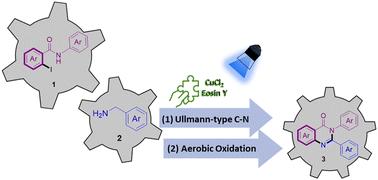
{"title":"Visible-light-driven copper(ii) catalysis for 2,3-disubstituted quinazolinone synthesis via Ullmann N-arylation and C–H oxidative amidation†","authors":"Ahmed Th. Abdulghaffar , Pei Hu , Yifan Hu , Chenxu Liu , Yanrong Ren , Zhongyan Cao , Yuanqing Xu , Min Jiang , Hao Xu","doi":"10.1039/d5ob00063g","DOIUrl":null,"url":null,"abstract":"<div><div>A novel visible-light-driven method for the synthesis of 2,3-disubstituted quinazolinones has been developed, employing copper(<span>ii</span>) as a catalyst in a sequential Ullmann <em>N</em>-arylation and C–H oxidative amidation process. This methodology utilizes <em>o</em>-iodo-<em>N</em>-substituted benzamides and benzylamines as substrates, with molecular oxygen sourced from ambient air functioning as the oxidant. The reaction is conducted under mild conditions, utilizing cost-effective copper(<span>ii</span>) chloride as the catalytic agent and Eosin Y as a photosensitizer, facilitated by blue LED irradiation. A broad compatibility with various substrates is demonstrated, yielding products in the range of 30% to 84%. Additionally, mechanistic studies elucidate a single-electron transfer pathway that incorporates aryl radical intermediates. This research presents a sustainable and efficient strategy for the synthesis of quinazolinones, with considerable synthetic and mechanistic implications.</div></div>","PeriodicalId":96,"journal":{"name":"Organic & Biomolecular Chemistry","volume":"23 16","pages":"Pages 3800-3805"},"PeriodicalIF":2.7000,"publicationDate":"2024-11-21","publicationTypes":"Journal Article","fieldsOfStudy":null,"isOpenAccess":false,"openAccessPdf":"","citationCount":"0","resultStr":null,"platform":"Semanticscholar","paperid":null,"PeriodicalName":"Organic & Biomolecular Chemistry","FirstCategoryId":"92","ListUrlMain":"https://www.sciencedirect.com/org/science/article/pii/S1477052025002162","RegionNum":3,"RegionCategory":"化学","ArticlePicture":[],"TitleCN":null,"AbstractTextCN":null,"PMCID":null,"EPubDate":"2025/3/19 0:00:00","PubModel":"Epub","JCR":"Q1","JCRName":"CHEMISTRY, ORGANIC","Score":null,"Total":0}
引用次数: 0
Abstract
A novel visible-light-driven method for the synthesis of 2,3-disubstituted quinazolinones has been developed, employing copper(ii) as a catalyst in a sequential Ullmann N-arylation and C–H oxidative amidation process. This methodology utilizes o-iodo-N-substituted benzamides and benzylamines as substrates, with molecular oxygen sourced from ambient air functioning as the oxidant. The reaction is conducted under mild conditions, utilizing cost-effective copper(ii) chloride as the catalytic agent and Eosin Y as a photosensitizer, facilitated by blue LED irradiation. A broad compatibility with various substrates is demonstrated, yielding products in the range of 30% to 84%. Additionally, mechanistic studies elucidate a single-electron transfer pathway that incorporates aryl radical intermediates. This research presents a sustainable and efficient strategy for the synthesis of quinazolinones, with considerable synthetic and mechanistic implications.
以铜(II)为催化剂,通过Ullmann n -芳基化和C-H氧化酰胺化反应,在可见光驱动下合成2,3-二取代喹唑啉酮类化合物。该方法利用o-碘- n取代的苯酰胺和苄胺作为底物,来自环境空气的分子氧作为氧化剂。该反应在温和的条件下进行,采用低成本的氯化铜(II)作为催化剂,伊红Y作为光敏剂,在蓝色LED照射下促进。与各种基材具有广泛的相容性,产率在30%至84%之间。此外,机制研究阐明了包含芳基自由基中间体的单电子转移途径。本研究提出了一种可持续和高效的合成喹唑啉酮的策略,具有相当大的合成和机械意义。
期刊介绍:
Organic & Biomolecular Chemistry is an international journal using integrated research in chemistry-organic chemistry. Founded in 2003 by the Royal Society of Chemistry, the journal is published in Semimonthly issues and has been indexed by SCIE, a leading international database. The journal focuses on the key research and cutting-edge progress in the field of chemistry-organic chemistry, publishes and reports the research results in this field in a timely manner, and is committed to becoming a window and platform for rapid academic exchanges among peers in this field. The journal's impact factor in 2023 is 2.9, and its CiteScore is 5.5.




 京公网安备 11010802042870号
京ICP备2023020795号-1
京公网安备 11010802042870号
京ICP备2023020795号-1

 分享
分享
 求助内容:
求助内容: 应助结果提醒方式:
 扫码关注我们
