Yanan Zhang, Yimin Wang, Ningjing Huang, Wei Zheng, Hang Guo and Chunyin Li
{"title":"Facile synthesis of water-soluble and pH-stable silicon quantum dots and their application in enzyme-free hydrogen peroxide sensing†","authors":"Yanan Zhang, Yimin Wang, Ningjing Huang, Wei Zheng, Hang Guo and Chunyin Li","doi":"10.1039/D5AY00038F","DOIUrl":null,"url":null,"abstract":"<p >A sensor for non-enzymatic hydrogen peroxide (H<small><sub>2</sub></small>O<small><sub>2</sub></small>) detection was developed based on silicon quantum dots (SiQDs). The fluorescent SiQDs were synthesized using a one-pot hydrothermal method. The SiQDs were made water-soluble and pH-stable by covering their surfaces with amino and hydroxyl groups. Additionally, the prepared SiQDs had a large Stokes shift (131 nm), excellent photostability (442 min), and hypotoxicity (<em>e.g.</em>, 99% cell viability was retained after a 24 h-treatment at 8.0 mg mL<small><sup>−1</sup></small> of SiQDs). The dynamic quenching effect induced by H<small><sub>2</sub></small>O<small><sub>2</sub></small> effectively suppresses the blue fluorescence of SiQDs. Under the optimum conditions, the SiQD-based H<small><sub>2</sub></small>O<small><sub>2</sub></small> sensor exhibited a wide linear range (10–1000 μM), high sensitivity and selectivity, and good anti-interference ability. The detection limit and relative standard deviation were 1.7 μM and 4.5% (<em>c</em> = 20 μM, <em>n</em> = 7), respectively. Accordingly, a simple, enzyme-free, and highly efficient method was established for detecting H<small><sub>2</sub></small>O<small><sub>2</sub></small> in aqueous solutions. Moreover, this eco-friendly fluorescent sensor successfully determined the H<small><sub>2</sub></small>O<small><sub>2</sub></small> concentration in human serum samples with 92.0–102.4% recoveries.</p>","PeriodicalId":64,"journal":{"name":"Analytical Methods","volume":" 14","pages":" 2894-2901"},"PeriodicalIF":2.6000,"publicationDate":"2025-03-14","publicationTypes":"Journal Article","fieldsOfStudy":null,"isOpenAccess":false,"openAccessPdf":"","citationCount":"0","resultStr":null,"platform":"Semanticscholar","paperid":null,"PeriodicalName":"Analytical Methods","FirstCategoryId":"92","ListUrlMain":"https://pubs.rsc.org/en/content/articlelanding/2025/ay/d5ay00038f","RegionNum":3,"RegionCategory":"化学","ArticlePicture":[],"TitleCN":null,"AbstractTextCN":null,"PMCID":null,"EPubDate":"","PubModel":"","JCR":"Q2","JCRName":"CHEMISTRY, ANALYTICAL","Score":null,"Total":0}
引用次数: 0
Abstract
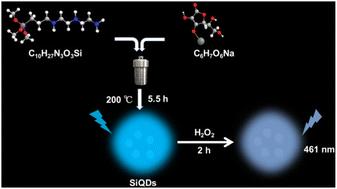
A sensor for non-enzymatic hydrogen peroxide (H2O2) detection was developed based on silicon quantum dots (SiQDs). The fluorescent SiQDs were synthesized using a one-pot hydrothermal method. The SiQDs were made water-soluble and pH-stable by covering their surfaces with amino and hydroxyl groups. Additionally, the prepared SiQDs had a large Stokes shift (131 nm), excellent photostability (442 min), and hypotoxicity (e.g., 99% cell viability was retained after a 24 h-treatment at 8.0 mg mL−1 of SiQDs). The dynamic quenching effect induced by H2O2 effectively suppresses the blue fluorescence of SiQDs. Under the optimum conditions, the SiQD-based H2O2 sensor exhibited a wide linear range (10–1000 μM), high sensitivity and selectivity, and good anti-interference ability. The detection limit and relative standard deviation were 1.7 μM and 4.5% (c = 20 μM, n = 7), respectively. Accordingly, a simple, enzyme-free, and highly efficient method was established for detecting H2O2 in aqueous solutions. Moreover, this eco-friendly fluorescent sensor successfully determined the H2O2 concentration in human serum samples with 92.0–102.4% recoveries.



 京公网安备 11010802042870号
京ICP备2023020795号-1
京公网安备 11010802042870号
京ICP备2023020795号-1

 分享
分享
 求助内容:
求助内容: 应助结果提醒方式:
 扫码关注我们
