{"title":"Acid responsive molybdenum (Mo)-based nanoparticles inhibit the cGAS-STING signaling pathway for sepsis therapy†","authors":"Xinyu Wang, Qingbin He, Lining Wang, Chengzhilin Li, Wenyu Zhang, Zhonghou Rong, Qingqing Yin and Yingchun Zhao","doi":"10.1039/D5BM00007F","DOIUrl":null,"url":null,"abstract":"<p >Sepsis, an inflammatory disease caused by bacterial infection, has become a global public health crisis. Excessive reactive oxygen species (ROS) in sepsis patients act as the primary trigger for activating intracellular immune pathways, ultimately leading to multiple organ dysfunction syndrome. The overexpression of acidic metabolites and ROS, characteristic of the infected microenvironment, significantly impedes sepsis treatment. Cyclic GMP-AMP synthase (cGAS), a cytosolic DNA sensor, plays a key role in inflammatory diseases. The detrimental effects of STING in sepsis have been well documented. Here, we developed a pH-responsive nanotherapy platform (DMSNM@C-178/PAA) that combines ROS scavenging with cGAS-STING pathway inhibition for anti-inflammatory therapy. This nanoparticle is selectively released in the infected microenvironment, where reduced molybdenum-based polyoxometalates (Mo-POM) efficiently neutralize toxic ROS <em>in vivo</em>, while C-178 selectively inhibits the cGAS-STING pathway, thereby attenuating the inflammatory response and preventing organ deterioration. <em>In vitro</em> and <em>in vivo</em> studies demonstrate that DMSNM@C-178/PAA treats sepsis by eliminating excess ROS and modulating autoimmune dysfunction <em>via</em> the cGAS-STING pathway, providing a novel therapeutic strategy for sepsis management.</p>","PeriodicalId":65,"journal":{"name":"Biomaterials Science","volume":" 9","pages":" 2410-2421"},"PeriodicalIF":5.7000,"publicationDate":"2025-03-25","publicationTypes":"Journal Article","fieldsOfStudy":null,"isOpenAccess":false,"openAccessPdf":"","citationCount":"0","resultStr":null,"platform":"Semanticscholar","paperid":null,"PeriodicalName":"Biomaterials Science","FirstCategoryId":"5","ListUrlMain":"https://pubs.rsc.org/en/content/articlelanding/2025/bm/d5bm00007f","RegionNum":3,"RegionCategory":"医学","ArticlePicture":[],"TitleCN":null,"AbstractTextCN":null,"PMCID":null,"EPubDate":"","PubModel":"","JCR":"Q1","JCRName":"MATERIALS SCIENCE, BIOMATERIALS","Score":null,"Total":0}
引用次数: 0
Abstract
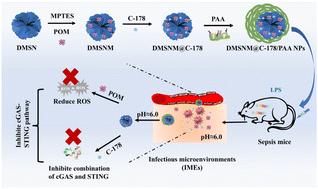
Sepsis, an inflammatory disease caused by bacterial infection, has become a global public health crisis. Excessive reactive oxygen species (ROS) in sepsis patients act as the primary trigger for activating intracellular immune pathways, ultimately leading to multiple organ dysfunction syndrome. The overexpression of acidic metabolites and ROS, characteristic of the infected microenvironment, significantly impedes sepsis treatment. Cyclic GMP-AMP synthase (cGAS), a cytosolic DNA sensor, plays a key role in inflammatory diseases. The detrimental effects of STING in sepsis have been well documented. Here, we developed a pH-responsive nanotherapy platform (DMSNM@C-178/PAA) that combines ROS scavenging with cGAS-STING pathway inhibition for anti-inflammatory therapy. This nanoparticle is selectively released in the infected microenvironment, where reduced molybdenum-based polyoxometalates (Mo-POM) efficiently neutralize toxic ROS in vivo, while C-178 selectively inhibits the cGAS-STING pathway, thereby attenuating the inflammatory response and preventing organ deterioration. In vitro and in vivo studies demonstrate that DMSNM@C-178/PAA treats sepsis by eliminating excess ROS and modulating autoimmune dysfunction via the cGAS-STING pathway, providing a novel therapeutic strategy for sepsis management.
期刊介绍:
Biomaterials Science is an international high impact journal exploring the science of biomaterials and their translation towards clinical use. Its scope encompasses new concepts in biomaterials design, studies into the interaction of biomaterials with the body, and the use of materials to answer fundamental biological questions.



 京公网安备 11010802042870号
京ICP备2023020795号-1
京公网安备 11010802042870号
京ICP备2023020795号-1

 分享
分享
 求助内容:
求助内容: 应助结果提醒方式:
 扫码关注我们
