Jaeguk Choi, Kyunghee Yu, Seung-Tae Lee, Saeam Shin, Jong Rak Choi
{"title":"Factors Influencing Fluorescence-activated Cell Sorting for Multiple Myeloma Fluorescence <i>in situ</i> Hybridization: Real-world Experience.","authors":"Jaeguk Choi, Kyunghee Yu, Seung-Tae Lee, Saeam Shin, Jong Rak Choi","doi":"10.3343/alm.2024.0582","DOIUrl":null,"url":null,"abstract":"<p><strong>Background: </strong>FISH is the standard method for detecting cytogenetic abnormalities (CAs) in patients with multiple myeloma, and pre-enrichment of plasma cells is recommended to increase detection rates. However, optimal strategies to ensure sufficient plasma cell retrieval when standard enrichment techniques fail remain underexplored. We investigated factors influencing the success of fluorescence-activated cell sorting (FACS) and assessed the use of direct FISH in cases in which FACS failed.</p><p><strong>Methods: </strong>A retrospective analysis was conducted on 457 bone marrow samples submitted for FISH between November 2016 and May 2022. FACS was considered successful when plasma cells (CD38+ and CD138+ cells) constituted >1% of the total number of cells. Direct FISH was performed for samples with FACS failure.</p><p><strong>Results: </strong>FACS was successful in 70.9% of cases and had a high positivity rate (94.8%). Shorter sample transfer times significantly improved FACS success, with a 77.1% success rate for transfer times <2 hrs, compared with 67.8% for longer times (<i>P</i> =0.0388). Plasma cell percentage was a strong determinant of FACS success, with a median of 31.2% in successful cases versus 8.5% in failures (<i>P</i> <0.0001). Even when FACS failed, direct FISH detected CAs in 43.6% of cases.</p><p><strong>Conclusions: </strong>Plasma cell percentage and sample transfer time are critical factors influencing FACS success. While FACS-FISH demonstrates superior sensitivity in detecting CAs, direct FISH serves as a valuable alternative when FACS fails. These findings highlight the importance of optimizing sample handling and FISH protocols for accurate cytogenetic analysis of multiple myeloma.</p>","PeriodicalId":8421,"journal":{"name":"Annals of Laboratory Medicine","volume":" ","pages":"322-328"},"PeriodicalIF":3.9000,"publicationDate":"2025-05-01","publicationTypes":"Journal Article","fieldsOfStudy":null,"isOpenAccess":false,"openAccessPdf":"https://www.ncbi.nlm.nih.gov/pmc/articles/PMC11996684/pdf/","citationCount":"0","resultStr":null,"platform":"Semanticscholar","paperid":null,"PeriodicalName":"Annals of Laboratory Medicine","FirstCategoryId":"3","ListUrlMain":"https://doi.org/10.3343/alm.2024.0582","RegionNum":2,"RegionCategory":"医学","ArticlePicture":[],"TitleCN":null,"AbstractTextCN":null,"PMCID":null,"EPubDate":"2025/3/25 0:00:00","PubModel":"Epub","JCR":"Q1","JCRName":"MEDICAL LABORATORY TECHNOLOGY","Score":null,"Total":0}
引用次数: 0
Abstract
Background: FISH is the standard method for detecting cytogenetic abnormalities (CAs) in patients with multiple myeloma, and pre-enrichment of plasma cells is recommended to increase detection rates. However, optimal strategies to ensure sufficient plasma cell retrieval when standard enrichment techniques fail remain underexplored. We investigated factors influencing the success of fluorescence-activated cell sorting (FACS) and assessed the use of direct FISH in cases in which FACS failed.
Methods: A retrospective analysis was conducted on 457 bone marrow samples submitted for FISH between November 2016 and May 2022. FACS was considered successful when plasma cells (CD38+ and CD138+ cells) constituted >1% of the total number of cells. Direct FISH was performed for samples with FACS failure.
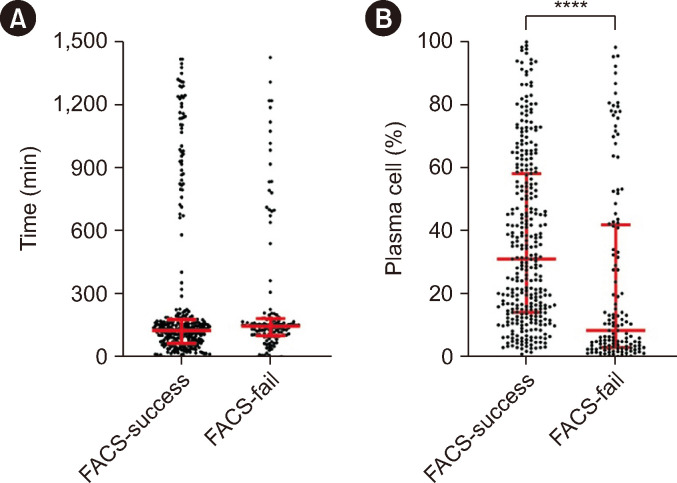
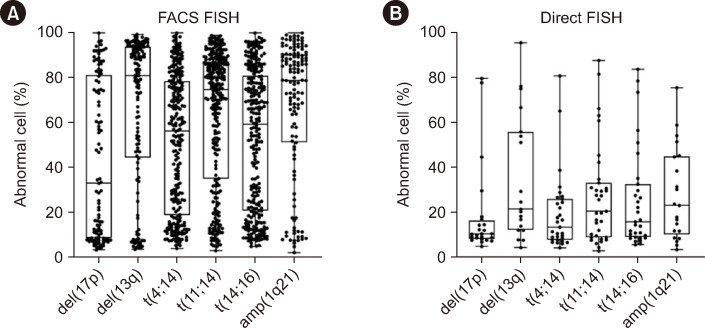
Results: FACS was successful in 70.9% of cases and had a high positivity rate (94.8%). Shorter sample transfer times significantly improved FACS success, with a 77.1% success rate for transfer times <2 hrs, compared with 67.8% for longer times (P =0.0388). Plasma cell percentage was a strong determinant of FACS success, with a median of 31.2% in successful cases versus 8.5% in failures (P <0.0001). Even when FACS failed, direct FISH detected CAs in 43.6% of cases.
Conclusions: Plasma cell percentage and sample transfer time are critical factors influencing FACS success. While FACS-FISH demonstrates superior sensitivity in detecting CAs, direct FISH serves as a valuable alternative when FACS fails. These findings highlight the importance of optimizing sample handling and FISH protocols for accurate cytogenetic analysis of multiple myeloma.
期刊介绍:
Annals of Laboratory Medicine is the official journal of Korean Society for Laboratory Medicine. The journal title has been recently changed from the Korean Journal of Laboratory Medicine (ISSN, 1598-6535) from the January issue of 2012. The JCR 2017 Impact factor of Ann Lab Med was 1.916.



 京公网安备 11010802042870号
京ICP备2023020795号-1
京公网安备 11010802042870号
京ICP备2023020795号-1

 分享
分享
 求助内容:
求助内容: 应助结果提醒方式:
 扫码关注我们
