Xinlan Xie, Jiaqun Que, Linsu Sun, Tao Sun, Feng Yang
{"title":"Association between urbanization levels and frailty among middle-aged and older adults in China: evidence from the CHARLS.","authors":"Xinlan Xie, Jiaqun Que, Linsu Sun, Tao Sun, Feng Yang","doi":"10.1186/s12916-025-03961-y","DOIUrl":null,"url":null,"abstract":"<p><strong>Background: </strong>Rapid urbanization is underway in China. However, the impact of urbanization on frailty remains unclear. This study aims to investigate the relationship between urbanization and frailty among middle-aged and older adults.</p><p><strong>Methods: </strong>We analyzed nationally representative data from the China Health and Retirement Longitudinal Study (CHARLS) spanning 2011 to 2018. After applying inclusion and exclusion criteria, 10,758 non-frail individuals at baseline were analyzed. The exposure of interest was the comprehensive urbanization level. Urbanization level (0.072-0.689) was assessed using the entropy method. Frailty was assessed using the frailty index (FI), which ranges from 0 to 100. Frailty was defined as FI ≥ 25, and the urbanization-frailty association was assessed using - the restricted cubic spline (RCS) expressions and Cox proportional hazards models. Least absolute shrinkage and selection operator (LASSO) regression were employed to evaluate major factors associated with frailty.</p><p><strong>Results: </strong>The results revealed a U-shaped nonlinear association between urbanization level and frailty incidence, with a turning point at 0.3 (P<sub>nonlinear</sub> < 0.001). In the Cox model, for urbanization scores below 0.3, each ten-percentile increase was associated with an HR of 0.871 (95% CI 0.843-0.900, P < 0.05). Conversely, scores at or above 0.3 had an HR of 1.178 (95% CI 1.053-1.319, P < 0.05) per ten-percentile increase. In the subgroup analysis of participants with urbanization scores below 0.3, there was a significant interaction between current work status and subgroups with dyslipidemia. LASSO regression showed that, for urbanization scores < 0.3, total retail sales (coefficient = - 0.129) and per capita income (coefficient = - 0.071) were most protective against frailty. For scores ≥ 0.3, key urbanization factors associated with increased frailty risk included the number of college students per 10,000 people (coefficient = 0.080) and the proportion of built-up land in the urban area (coefficient = 0.060).</p><p><strong>Conclusions: </strong>Urbanization level had U-shaped association with frailty incidence. Factors such as total retail sales of consumer goods per capita, per capita disposable income of urban residents, and the number of college students per 10,000 people may be key in formulating a strategy for frailty prevention.</p>","PeriodicalId":9188,"journal":{"name":"BMC Medicine","volume":"23 1","pages":"171"},"PeriodicalIF":8.3000,"publicationDate":"2025-03-24","publicationTypes":"Journal Article","fieldsOfStudy":null,"isOpenAccess":false,"openAccessPdf":"https://www.ncbi.nlm.nih.gov/pmc/articles/PMC11934686/pdf/","citationCount":"0","resultStr":null,"platform":"Semanticscholar","paperid":null,"PeriodicalName":"BMC Medicine","FirstCategoryId":"3","ListUrlMain":"https://doi.org/10.1186/s12916-025-03961-y","RegionNum":1,"RegionCategory":"医学","ArticlePicture":[],"TitleCN":null,"AbstractTextCN":null,"PMCID":null,"EPubDate":"","PubModel":"","JCR":"Q1","JCRName":"MEDICINE, GENERAL & INTERNAL","Score":null,"Total":0}
引用次数: 0
Abstract
Background: Rapid urbanization is underway in China. However, the impact of urbanization on frailty remains unclear. This study aims to investigate the relationship between urbanization and frailty among middle-aged and older adults.
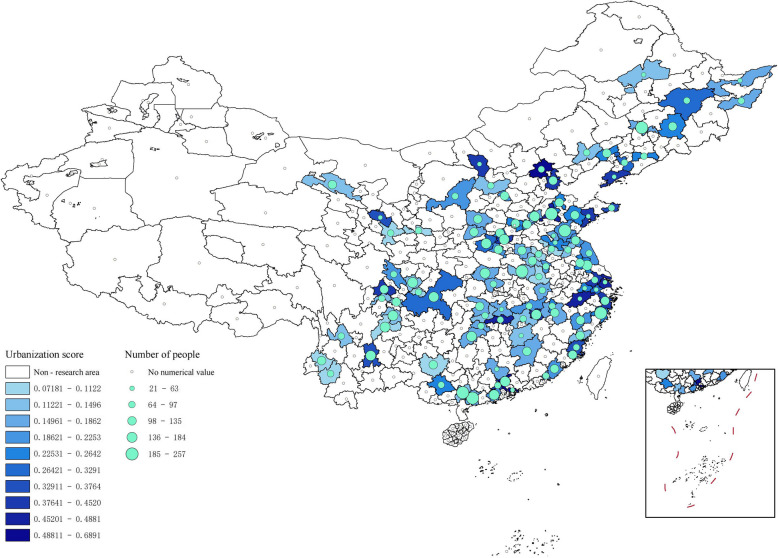
Methods: We analyzed nationally representative data from the China Health and Retirement Longitudinal Study (CHARLS) spanning 2011 to 2018. After applying inclusion and exclusion criteria, 10,758 non-frail individuals at baseline were analyzed. The exposure of interest was the comprehensive urbanization level. Urbanization level (0.072-0.689) was assessed using the entropy method. Frailty was assessed using the frailty index (FI), which ranges from 0 to 100. Frailty was defined as FI ≥ 25, and the urbanization-frailty association was assessed using - the restricted cubic spline (RCS) expressions and Cox proportional hazards models. Least absolute shrinkage and selection operator (LASSO) regression were employed to evaluate major factors associated with frailty.
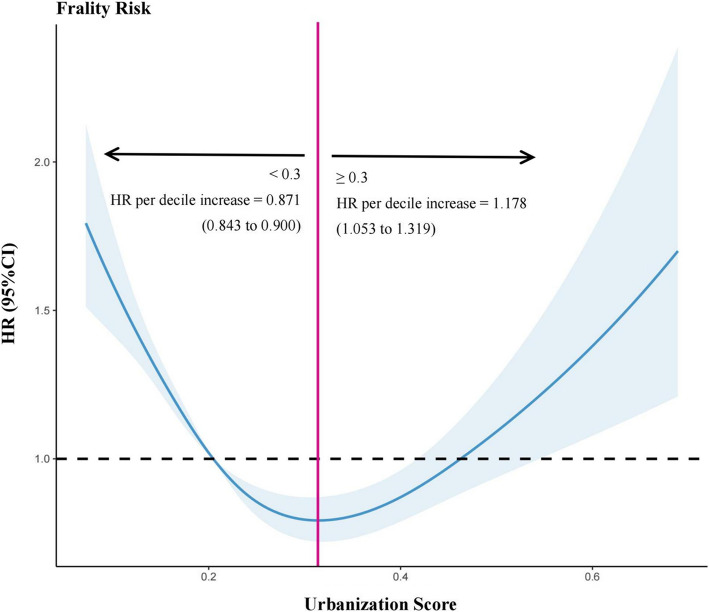
Results: The results revealed a U-shaped nonlinear association between urbanization level and frailty incidence, with a turning point at 0.3 (Pnonlinear < 0.001). In the Cox model, for urbanization scores below 0.3, each ten-percentile increase was associated with an HR of 0.871 (95% CI 0.843-0.900, P < 0.05). Conversely, scores at or above 0.3 had an HR of 1.178 (95% CI 1.053-1.319, P < 0.05) per ten-percentile increase. In the subgroup analysis of participants with urbanization scores below 0.3, there was a significant interaction between current work status and subgroups with dyslipidemia. LASSO regression showed that, for urbanization scores < 0.3, total retail sales (coefficient = - 0.129) and per capita income (coefficient = - 0.071) were most protective against frailty. For scores ≥ 0.3, key urbanization factors associated with increased frailty risk included the number of college students per 10,000 people (coefficient = 0.080) and the proportion of built-up land in the urban area (coefficient = 0.060).
Conclusions: Urbanization level had U-shaped association with frailty incidence. Factors such as total retail sales of consumer goods per capita, per capita disposable income of urban residents, and the number of college students per 10,000 people may be key in formulating a strategy for frailty prevention.
期刊介绍:
BMC Medicine is an open access, transparent peer-reviewed general medical journal. It is the flagship journal of the BMC series and publishes outstanding and influential research in various areas including clinical practice, translational medicine, medical and health advances, public health, global health, policy, and general topics of interest to the biomedical and sociomedical professional communities. In addition to research articles, the journal also publishes stimulating debates, reviews, unique forum articles, and concise tutorials. All articles published in BMC Medicine are included in various databases such as Biological Abstracts, BIOSIS, CAS, Citebase, Current contents, DOAJ, Embase, MEDLINE, PubMed, Science Citation Index Expanded, OAIster, SCImago, Scopus, SOCOLAR, and Zetoc.




 京公网安备 11010802042870号
京ICP备2023020795号-1
京公网安备 11010802042870号
京ICP备2023020795号-1

 分享
分享
 求助内容:
求助内容: 应助结果提醒方式:
 扫码关注我们
