{"title":"Assessing the impact of different types of masks on COPD patients: a randomised controlled trial.","authors":"Jingchun Fan, Tiantian Feng, Xiaomei Jiang, Caihong Wei, Xuhui Zhang, Caiyun Li, Feiyan Yue, Hong Yang, Shisan Bao, Xuwen Chen","doi":"10.1183/23120541.00806-2024","DOIUrl":null,"url":null,"abstract":"<p><strong>Background: </strong>Wearing masks imposes an additional respiratory burden on COPD patients. This study aimed to investigate the impact of various mask types on physiological parameters and subjective feelings in COPD patients.</p><p><strong>Methods: </strong>This randomised, open-label, parallel-controlled trial randomly assigned 129 COPD patients from two Chinese hospitals to the N95 mask group, the surgical mask group and the no mask group, who were required to complete a 6-min rest (6MR) and a 6-min walking test (6MWT) while wearing their designated masks, and were assessed for blood pressure, oxygen saturation, pulse rate, Borg score, rating of perceived exertion (RPE) score, 6-min walk distance (6MWD) and subjective feeling score. Data were analysed using intention-to-treat analysis and per-protocol analysis.</p><p><strong>Results: </strong>No significant differences were observed in blood pressure, oxygen saturation, pulse rate or the 6MWD among the three groups following a 6MR or 6MWT. Wearing N95 masks and surgical masks during the 6MWT significantly elevated perceived dyspnoea (p<0.001) and exertion scores (p<0.001) in COPD patients. The differences in the two scores between the highest and lowest groups were 2 and 4 points, respectively.</p><p><strong>Conclusion: </strong>Wearing surgical masks or N95 masks for 6MR or 6MWT did not adversely affect physiological parameters in COPD patients. However, it significantly increased perceived dyspnoea and exertion.</p>","PeriodicalId":11739,"journal":{"name":"ERJ Open Research","volume":"11 2","pages":""},"PeriodicalIF":4.0000,"publicationDate":"2025-03-24","publicationTypes":"Journal Article","fieldsOfStudy":null,"isOpenAccess":false,"openAccessPdf":"https://www.ncbi.nlm.nih.gov/pmc/articles/PMC11931569/pdf/","citationCount":"0","resultStr":null,"platform":"Semanticscholar","paperid":null,"PeriodicalName":"ERJ Open Research","FirstCategoryId":"3","ListUrlMain":"https://doi.org/10.1183/23120541.00806-2024","RegionNum":3,"RegionCategory":"医学","ArticlePicture":[],"TitleCN":null,"AbstractTextCN":null,"PMCID":null,"EPubDate":"2025/3/1 0:00:00","PubModel":"eCollection","JCR":"Q1","JCRName":"RESPIRATORY SYSTEM","Score":null,"Total":0}
引用次数: 0
Abstract
Background: Wearing masks imposes an additional respiratory burden on COPD patients. This study aimed to investigate the impact of various mask types on physiological parameters and subjective feelings in COPD patients.
Methods: This randomised, open-label, parallel-controlled trial randomly assigned 129 COPD patients from two Chinese hospitals to the N95 mask group, the surgical mask group and the no mask group, who were required to complete a 6-min rest (6MR) and a 6-min walking test (6MWT) while wearing their designated masks, and were assessed for blood pressure, oxygen saturation, pulse rate, Borg score, rating of perceived exertion (RPE) score, 6-min walk distance (6MWD) and subjective feeling score. Data were analysed using intention-to-treat analysis and per-protocol analysis.
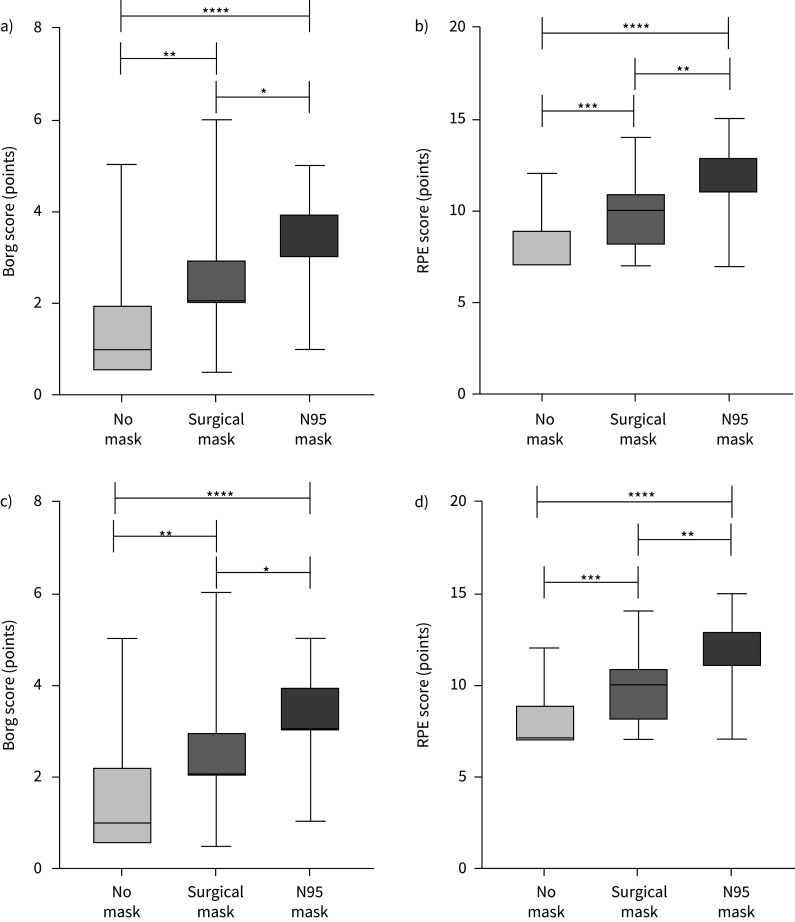
Results: No significant differences were observed in blood pressure, oxygen saturation, pulse rate or the 6MWD among the three groups following a 6MR or 6MWT. Wearing N95 masks and surgical masks during the 6MWT significantly elevated perceived dyspnoea (p<0.001) and exertion scores (p<0.001) in COPD patients. The differences in the two scores between the highest and lowest groups were 2 and 4 points, respectively.
Conclusion: Wearing surgical masks or N95 masks for 6MR or 6MWT did not adversely affect physiological parameters in COPD patients. However, it significantly increased perceived dyspnoea and exertion.
期刊介绍:
ERJ Open Research is a fully open access original research journal, published online by the European Respiratory Society. The journal aims to publish high-quality work in all fields of respiratory science and medicine, covering basic science, clinical translational science and clinical medicine. The journal was created to help fulfil the ERS objective to disseminate scientific and educational material to its members and to the medical community, but also to provide researchers with an affordable open access specialty journal in which to publish their work.






 京公网安备 11010802042870号
京ICP备2023020795号-1
京公网安备 11010802042870号
京ICP备2023020795号-1

 分享
分享
 求助内容:
求助内容: 应助结果提醒方式:
 扫码关注我们
